Topical authority is the idea that a website earns more trust and better rankings for a subject when it covers that subject thoroughly, accurately and consistently, rather than publishing scattered pages on many unrelated topics. Google has not published a single “topical authority score”, but its guidance on helpful content and expertise, its documented “topic authority” system for news, and years of SEO results all point the same way: depth, structure and real expertise on a topic help a site rank across that topic.
Key Takeaways
- Topical authority comes from covering a subject in depth, with pages that connect logically.
- Google rewards expertise and helpfulness; topical depth is one of the clearest ways to show both.
- Internal links and consistent coverage help search engines understand what your site is about.
- Backlinks and mentions from relevant sources strengthen topical signals.
- AI assistants also favour sources that cover a subject thoroughly and consistently.
What Google Has Actually Said
It helps to separate what Google has documented from what SEOs infer.
- Helpful content guidance: Google asks whether content demonstrates first-hand expertise and depth of knowledge, and whether a site has a primary purpose or focus.
- Topic authority for news: Google has described a “topic authority” system that helps identify which news publications have expertise on specific topics, such as local or specialised news, using signals like how notable a source is for a topic and its history of original reporting.
- E-E-A-T: Google’s quality rater guidelines describe Experience, Expertise, Authoritativeness and Trust as concepts raters use to assess content quality.
None of these is a single score you can measure. But together they show that Google cares about whether a source is a genuine, focused expert on the topic it covers.
How Topical Authority Shows Up in Practice
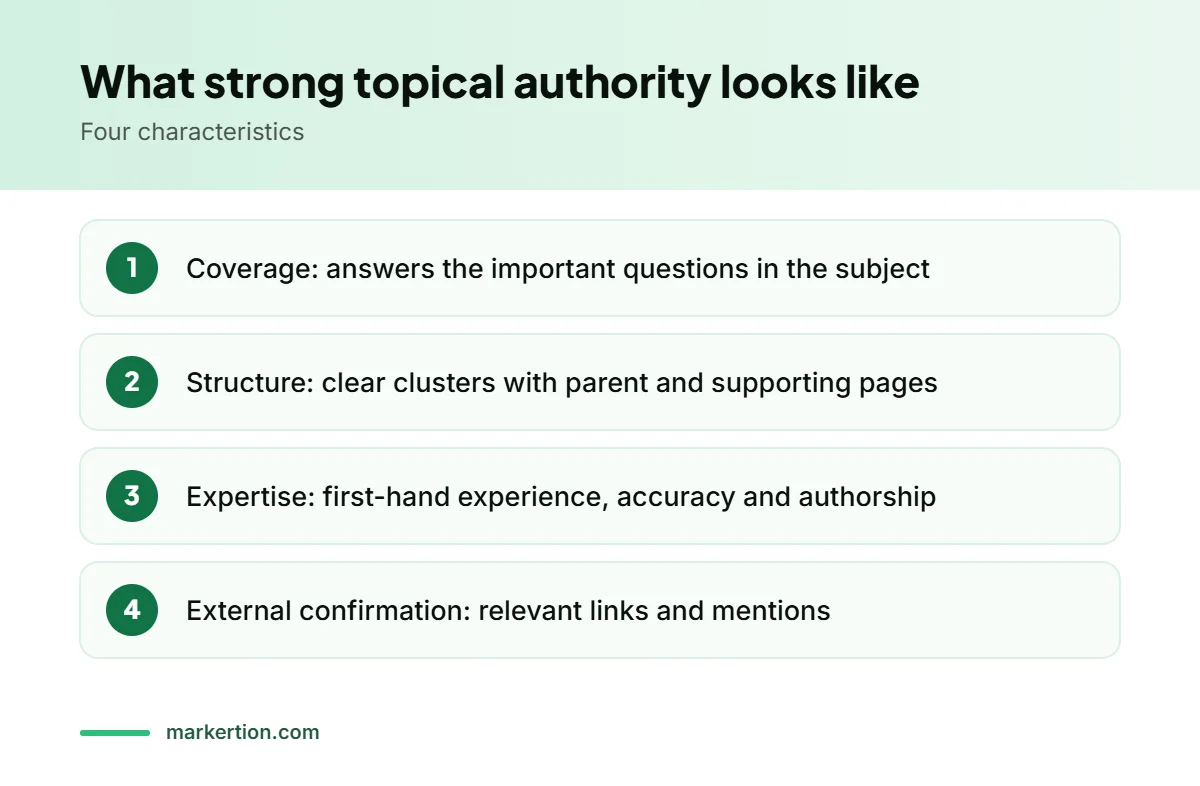
Sites with strong topical authority tend to share four characteristics:
- Coverage. They answer most of the important questions in their subject, from basics to advanced detail.
- Structure. Their pages are organised into clear clusters, with parent pages and supporting articles linked together.
- Expertise. Content includes first-hand experience, accurate detail and clear authorship.
- External confirmation. Relevant sites link to and mention them as a source on the topic.
When these are in place, new pages on the same subject often rank faster and higher, because the site has already shown it knows the area.
Topical Authority vs Domain Authority
| Topical authority | Domain authority metrics | |
|---|---|---|
| What it describes | How strongly a site is associated with a subject | Overall strength of a site’s backlink profile |
| Who defines it | Concept based on Google’s guidance and SEO results | Third-party tools such as Ahrefs (DR) or Moz (DA) |
| How you build it | Depth, structure, expertise and relevant links | Links from many strong domains |
| Example | A focused link building blog ranking for link building terms | A general news site with high DR |
A smaller site with strong topical authority can outrank a much larger site on its subject, because relevance and depth beat raw size for many queries.
How to Build Topical Authority
1. Map the topic
List the subtopics, questions and attributes people search for in your subject, then plan a page for each distinct intent. Our step-by-step guide on how to build a topical map covers this in detail.
2. Cover the core first
Publish the pages closest to your business and buying intent first, then expand into wider supporting topics. This builds a solid centre the rest of the site connects to.
3. Link pages into clusters
Every supporting article should link to its parent page, and siblings should link to each other where helpful. See our internal linking strategy for the method.
4. Show real expertise
Write from experience. Include real examples, results and opinions, add clear author bios, and keep facts accurate and up to date. Our guide on writing helpful content explains what this looks like on the page.
5. Stay focused
Publishing on unrelated subjects dilutes the signals that tell search engines what you are about. If you need to cover a new area, build it as a separate, planned cluster.
6. Earn relevant links and mentions
Links and brand mentions from sites in your subject area confirm that others see you as a source. Focus on relevance rather than raw domain metrics. Our link building strategy framework explains how to tie links to topics.
7. Keep content fresh
Update key pages when facts change, merge overlapping articles and improve pages that underperform. Authority fades when content goes stale.
Signs You Are Building Topical Authority
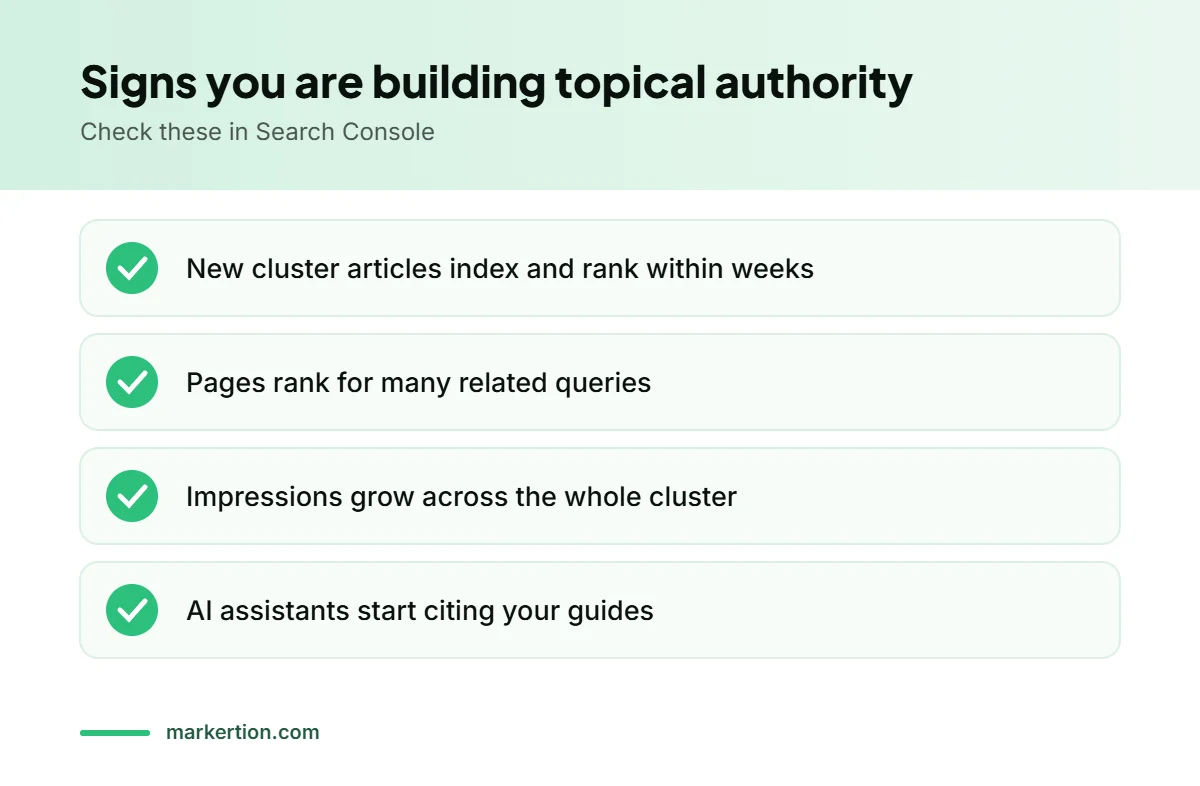
- New articles in a cluster index quickly and start ranking within weeks.
- Pages rank for many related queries, not just their main keyword.
- Impressions grow across the whole cluster, not only on pages with backlinks.
- Service or parent pages climb as supporting articles are added.
- AI assistants start citing your guides when asked questions in your subject.
Topical Authority and AI Search
AI assistants that retrieve sources tend to favour sites that answer a subject clearly and consistently across many pages. A site with deep coverage gives them more relevant passages to quote and a clearer sense of who the expert is. That makes topical authority one of the strongest long-term foundations for AI search visibility.
Common Misconceptions
- “More content always means more authority.” Thin or overlapping pages can weaken a cluster. Quality and structure matter.
- “Topical authority replaces backlinks.” It changes how much each link is worth, but competitive topics still need relevant links.
- “It is a score in a tool.” Some tools estimate topical coverage, but Google does not publish a topical authority score.
- “You can build it in a week.” It builds over months of consistent, focused publishing.
Example: Two Sites, One Topic
Imagine two websites competing for searches about guest posting.
Site A is a large general marketing blog. It has one guest posting article from three years ago, plus hundreds of posts on social media, email, design and advertising. It has a high domain rating.
Site B is a smaller agency site. It has a guest posting service page plus a cluster of supporting guides: pricing, how to find sites, a quality checklist for spotting link farms, outreach templates, follow-up timing and the difference between sponsored and dofollow posts. Every guide links to the service page and to its siblings, and the content includes real examples from campaigns.
For a detailed question such as “how to check if a guest post site is a link farm”, Site B often has the better answer, a clear structure around it, and supporting pages that show depth. That is topical authority at work: Site B is not bigger, but it is clearly the more focused expert on the subject. Over time, its new guest posting articles also tend to rank faster, because the cluster they join is already trusted.
Frequently Asked Questions
What is topical authority in SEO?
Topical authority is the trust a site earns on a subject by covering it in depth, with well-structured, accurate, expert content and relevant links and mentions from other sites.
Is topical authority a Google ranking factor?
Google does not publish a single topical authority score, but its guidance on expertise and helpful content, and its documented topic authority system for news, support the idea that depth and focus on a subject help rankings.
How long does it take to build topical authority?
Most sites see clusters gain traction within a few months of consistent publishing, with stronger results as coverage deepens and relevant links are earned.
Can a small site beat a big site with topical authority?
Often, yes, for queries in its subject. A focused site with deep, expert coverage can outrank a larger general site that covers the topic only lightly.
Can Markertion help build topical authority?
Yes. We plan topical maps, produce expert content and earn relevant links through our SEO service and content writing service.
Final Thoughts
Topical authority is not a trick or a single metric. It is the result of covering a subject properly: mapping the topic, building the core first, linking pages into clear clusters, writing from real expertise and earning recognition from relevant sites. Keep that up consistently and both search engines and AI assistants will increasingly treat your site as the place to go for your subject.
About the author: Shahidul Afridi is the founder of Markertion, a digital PR and link building agency that has built 6,000+ links for 260+ client partners since 2021. He writes from hands-on campaign work, not theory.

Digital PR & Link Building Expert