Helpful content is content written first for people, based on real knowledge or experience, that fully answers what the reader came to find and leaves them satisfied. Google’s guidance asks creators to focus on people-first content, show expertise and trust, and avoid pages made mainly to attract search traffic. In practice that means answering the real question early, adding first-hand insight, being accurate and transparent, and cutting anything that exists only for search engines.
Key Takeaways
- Write for a specific reader with a specific question, then answer it early.
- First-hand experience is the strongest way to stand out from generic content.
- Accuracy, clear sourcing and visible authorship build trust.
- Length is not a goal. Completeness for the reader’s need is.
- Review older content regularly and improve or remove pages that no longer help anyone.
What Google Means by Helpful Content
Google’s public documentation on creating helpful, reliable, people-first content asks a set of self-assessment questions. They boil down to a few themes:
- Does the content provide original information, research or analysis?
- Does it offer a substantial, complete description of the topic?
- Does it show first-hand expertise and a depth of knowledge?
- Would a reader leave feeling they learned enough to achieve their goal?
- Is it clear who wrote it and why it can be trusted?
Google also describes “search engine-first” warning signs: content made mainly to rank, summaries of other pages with nothing added, chasing trends outside your expertise, and writing to a word count. If a page fits those patterns, it is unlikely to perform well for long.
The Five Pillars of Helpful Content
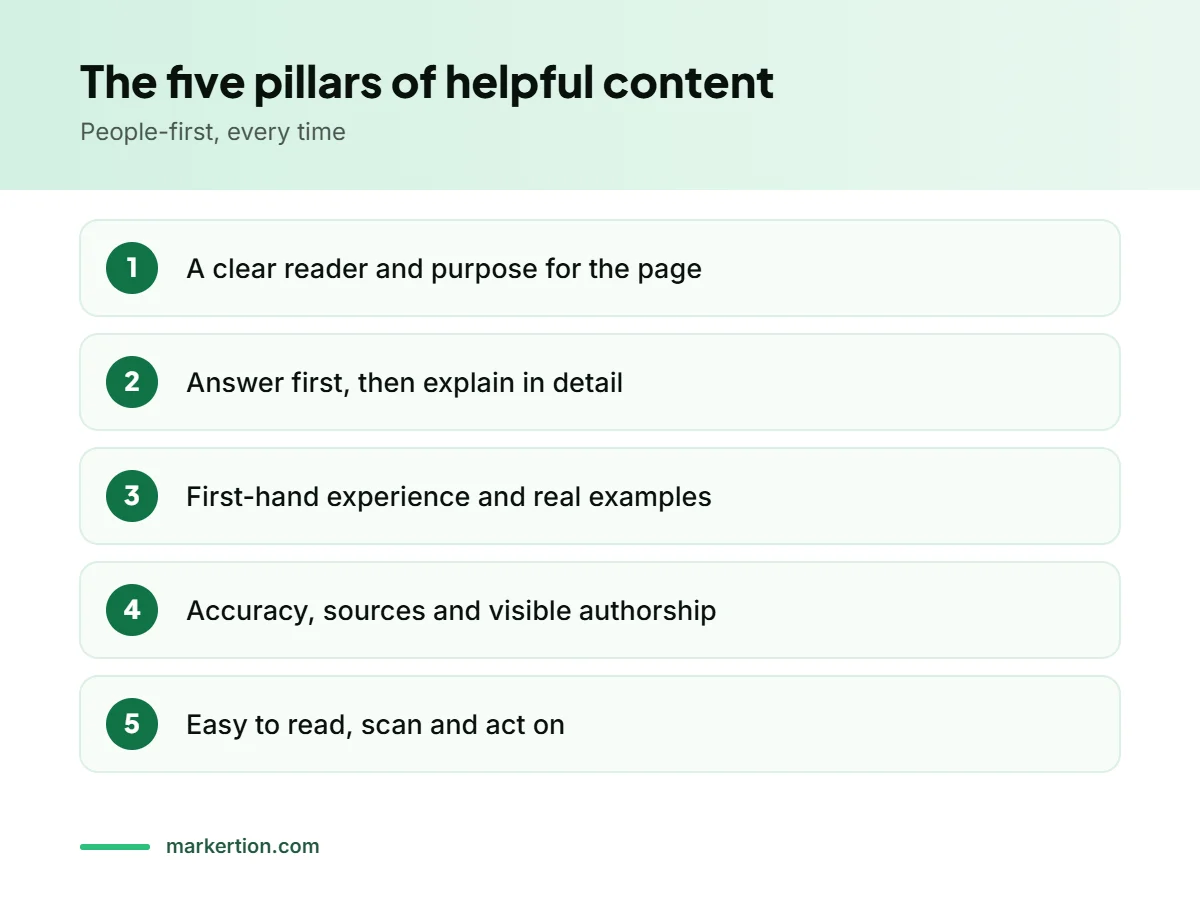
1. A clear reader and purpose
Before writing, finish this sentence: “This page helps [reader] to [goal].” If you cannot, the page probably does not need to exist. Clear purpose also tells you what to leave out.
2. Answer first, then explain
Put the direct answer in the first one or two sentences, then expand with detail, steps, examples and edge cases. This respects the reader’s time and is exactly the format that featured snippets and AI assistants like to quote. Our answer engine optimization checklist shows how to structure these openings.
3. First-hand experience
This is where most content fails. Add what only you can add:
- Results from your own projects or clients.
- Screenshots, photos or examples from real work.
- Mistakes you made and what you learned.
- Opinions based on experience, clearly framed as opinions.
A guide to link building written by a team that has built thousands of links reads very differently from one written from search results alone.
4. Accuracy and transparency
Check every fact. Link to primary sources for statistics. Date your content and update it when facts change. Show who wrote the page with a short author bio, and explain how you tested or reviewed things when that matters. Our guide on E-E-A-T for SEO agencies explains how these trust signals work.
5. Easy to read and use
Use descriptive headings, short paragraphs, lists for steps, tables for comparisons and images that explain rather than decorate. A helpful page is easy to scan and easy to act on.
A Helpful Content Writing Process
- Research the question, including the reasons people ask it and what they do next.
- Read the current top results and note what they miss or get wrong.
- Collect your own experience, data or examples before you start writing.
- Outline with question-based headings that follow the reader’s journey.
- Write the answer-first opening, then each section.
- Edit hard: cut filler, repeated points and vague claims.
- Add trust signals: author, sources, dates and examples.
- Check the page against Google’s self-assessment questions before publishing.
Helpful vs Search-First Content
| Helpful content | Search-first content |
|---|---|
| Answers the question in the opening | Long introductions before the answer |
| Adds original experience or data | Repeats what other pages say |
| Clear author and sources | Anonymous, unsourced claims |
| Length matches the reader’s need | Padded to hit a word count |
| Stays within the site’s expertise | Chases any trending topic |
| Updated when facts change | Left to go stale |
The Pre-Publish Helpfulness Check
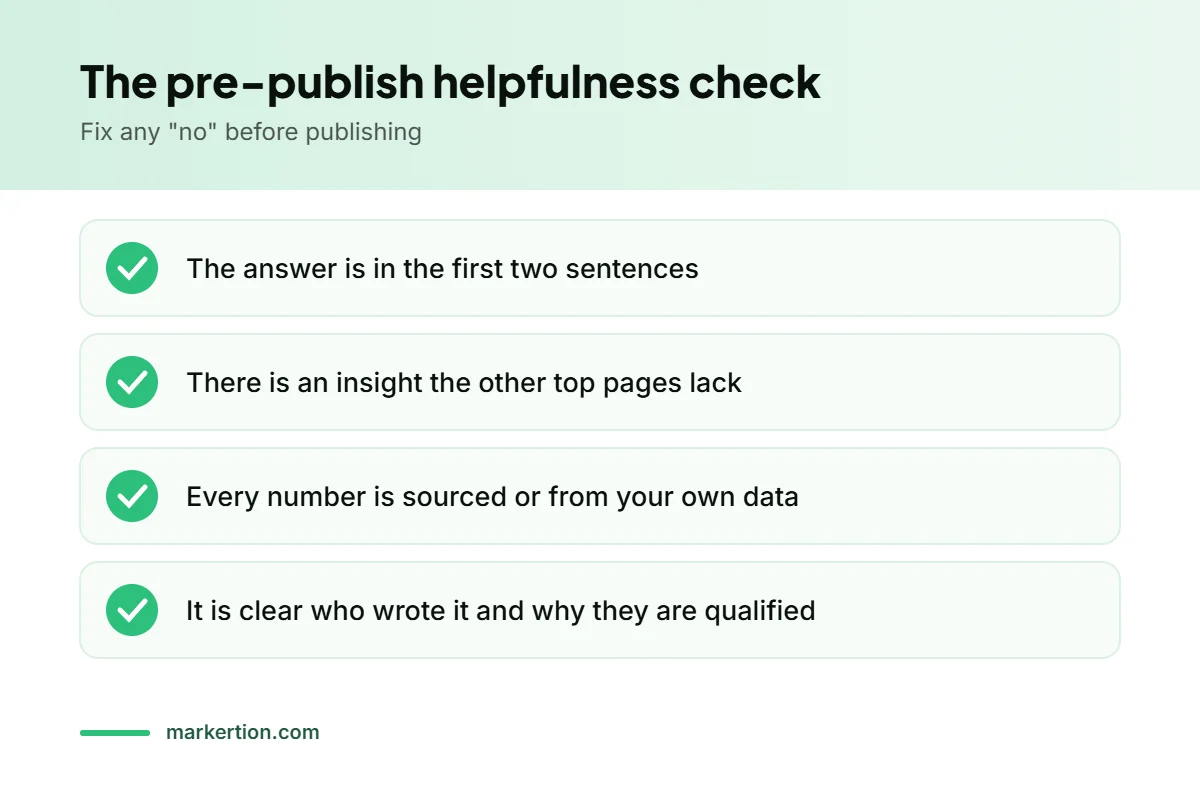
- Can a reader find the answer in the first two sentences?
- Is there at least one insight they would not find on the other top pages?
- Is every number sourced or from your own data?
- Is it clear who wrote it and why they are qualified?
- Would you be happy to send this page to a client or a friend who asked the question?
If any answer is no, fix it before publishing.
Using AI Without Losing Helpfulness
AI tools can speed up research and drafting, but they cannot add your experience. Use them for outlines and first drafts, then edit heavily, add real examples and check facts. Our AI SEO workflow for agencies lays out where people must stay in control.
How to Audit Existing Content for Helpfulness
Helpfulness is not only for new posts. Older pages that no longer help readers can hold back how a whole site is seen. Run a simple audit once or twice a year:
- Export your pages with clicks, impressions and average position from Search Console for the last 12 months.
- Mark pages with no clicks and very few impressions. These are candidates to improve, merge or remove.
- Read a sample of each group and ask the self-assessment questions above.
- Improve pages with potential: add first-hand insight, update facts, sharpen the opening and fix the structure.
- Merge overlapping pages that answer the same question, and redirect the weaker one.
- Remove or noindex pages with no purpose, such as outdated announcements or thin tag archives.
If you want a team to run this audit, our SEO service includes a full content review. Most sites find that improving a smaller number of strong pages does more than publishing many new weak ones.
Common Mistakes
- Writing for keywords instead of readers.
- Long, generic introductions that delay the answer.
- Adding words to reach a target length.
- Publishing outside your expertise just because a topic is popular.
- Never updating old posts, which slowly turn unhelpful as facts change.
Example: Turning a Generic Section Into a Helpful One
Here is the difference in practice. A generic section on “how to choose a guest post site” might say: “Look for sites with high authority and good content that are relevant to your niche.” It is not wrong, but it gives the reader nothing to act on.
A helpful version says: “Open the site’s last five posts. If most of them link out to casinos, loans or unrelated products, skip it. Then check its organic traffic trend for the past 12 months; a sharp drop after a core update usually means Google has lost trust in it.” That version names a specific action, explains why it matters and reflects real experience of vetting sites.
When you edit, look for sentences that could appear on any website and rewrite them with a concrete step, a real example or a clear reason. That single habit lifts the helpfulness of almost any article.
Frequently Asked Questions
What is helpful content according to Google?
Helpful content is people-first content that provides original, accurate and complete information from real expertise or experience, and leaves the reader satisfied that they found what they needed.
Does word count matter for helpful content?
Not directly. Content should be as long as it needs to be to fully answer the question. Padding a page to reach a word count is one of the signs Google describes as search engine-first.
How do I show experience in my content?
Include your own results, examples, screenshots, client lessons and clearly framed opinions, and show who wrote the page with a short author bio.
Can AI-written content be helpful?
Yes, if people edit it, check the facts and add real expertise and experience. Unedited AI content that adds nothing new rarely meets Google’s guidance.
Can Markertion write helpful content for my site?
Yes. Our content writing service pairs subject research with first-hand insight, careful editing and on-page optimisation.
Final Thoughts
Helpful content is not a trick or a format. It is the habit of writing for a real reader, answering their question early, adding what only you know, and being accurate and open about who you are. Build that habit into every brief and edit, and your content will serve readers, search engines and AI assistants at the same time.
About the author: Shahidul Afridi is the founder of Markertion, a digital PR and link building agency that has built 6,000+ links for 260+ client partners since 2021. He writes from hands-on campaign work, not theory.

Digital PR & Link Building Expert