
AI search visibility is how often, and how accurately, AI assistants such as ChatGPT, Gemini, Perplexity, Copilot and Google’s AI Overviews mention your brand when people ask about your category. You improve it by earning consistent mentions on the sources those assistants already trust, publishing clear answer-first content on your own site, and keeping facts about your brand identical everywhere they appear.
Key Takeaways
- AI assistants do not rank ten blue links. They pick a handful of sources, merge them, and name the brands those sources agree on.
- The brands that get cited are the ones that appear consistently across trusted third-party pages: reviews, “best of” lists, news, forums and industry blogs.
- Your own site still matters. Clear definitions, comparison tables, FAQs and schema make your pages easy to quote.
- You cannot buy a citation directly. You earn it by strengthening the signals that the assistants rely on, which is mostly digital PR, brand mentions and content.
- Track it like rankings: a fixed list of prompts, checked on each assistant every month.
What AI Search Visibility Actually Means
Traditional SEO asks one question: where does my page rank for a keyword? AI search visibility asks a different one: when someone asks an AI assistant for a recommendation in my category, does it name my brand, and does it describe us correctly?
That second question matters more every month. Buyers now ask assistants things like “best link building agency for SaaS” or “which project management tool is good for small teams” and act on the short list they get back. If your brand is missing from that list, you are invisible to that buyer, even if you rank on page one of Google.
AI search visibility has three parts:
- Mention rate: the share of relevant prompts where your brand is named at all.
- Position and framing: whether you are named first, in passing, or as a weaker alternative.
- Accuracy: whether the assistant gets your services, pricing model, audience and strengths right.
How AI Assistants Decide Which Brands to Cite
Most assistants follow the same broad pattern when they answer a recommendation question. Understanding it tells you exactly where to put effort.
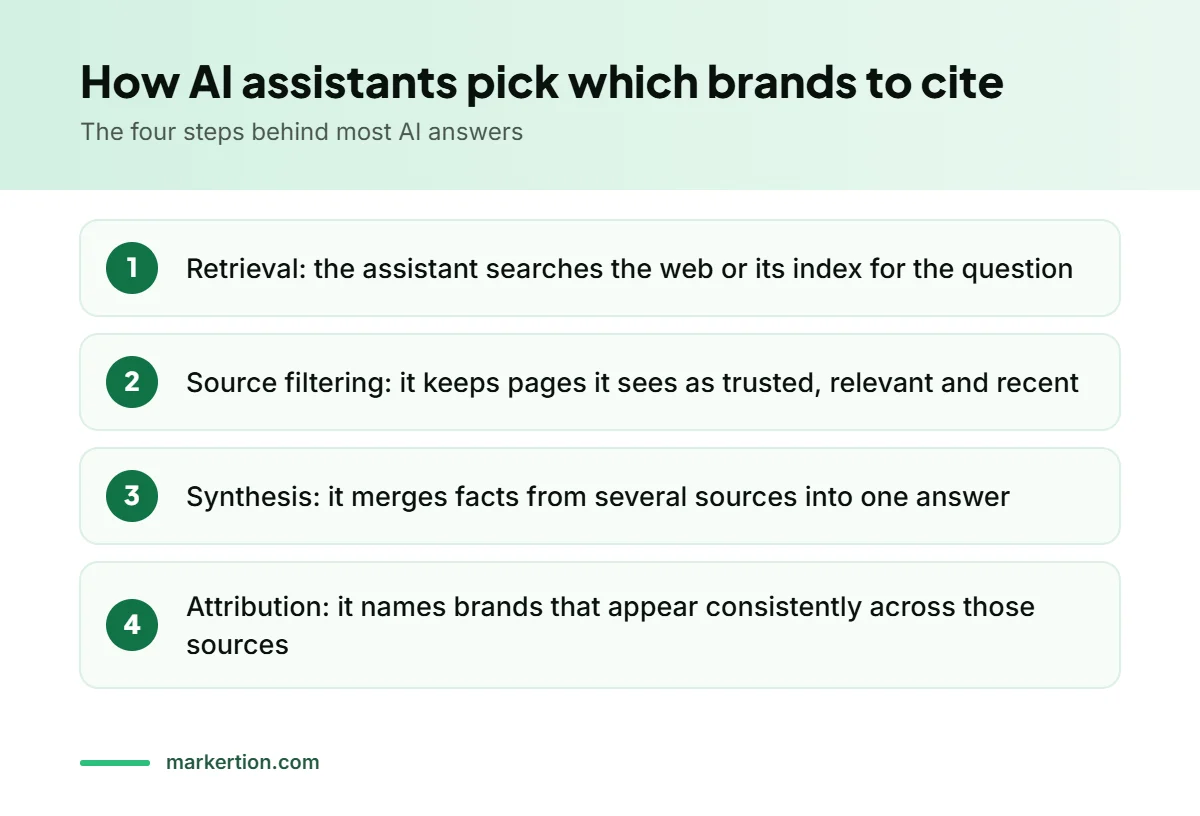
- Retrieval. The assistant searches the live web or its own index for pages that match the question. Perplexity, Copilot, Gemini and ChatGPT search all do this visibly; Google’s AI Overviews draw on Google’s own index.
- Source filtering. It keeps the pages it sees as trustworthy, relevant and recent. In practice that means established publications, review platforms, well-linked industry blogs and active community threads.
- Synthesis. It merges facts from several of those sources into one answer, which is why a single mention rarely moves anything.
- Attribution. It names the brands that come up repeatedly across the sources it kept, and often links to the pages it used.
The lesson is simple: assistants repeat what the trusted web already agrees on. Your job is to make sure the trusted web says clear, consistent things about you.
The Signals That Get a Brand Cited
1. Mentions on sources assistants already trust
This is the biggest lever. Check which pages the assistants cite when they answer questions in your category, then work to appear on those exact pages or pages like them. Typical winners are “best X for Y” roundups, comparison articles, industry news and review platforms. Our brand mentions service and media placement work exist for this reason.
2. Consistent brand facts
If one directory says you were founded in 2019 and another says 2021, assistants hedge or skip you. Keep your name, description, services, founding year and key numbers identical on your site, social profiles, directories and press coverage.
3. Answer-first content on your own site
Assistants quote passages that answer a question cleanly. Start key pages with a one or two sentence definition, use question-style headings, add comparison tables and finish with an FAQ. Our guide on answer engine optimization covers the format in detail.
4. Structured data
Organization, Article, FAQ and Product or Service schema do not guarantee a citation, but they remove ambiguity about who you are and what a page covers. See our schema markup guide for AI Overviews.
5. Authority through links and PR
Pages with strong backlink profiles get retrieved and trusted more often. Digital PR earns both at once: a news feature is a citation-ready source and a high-authority link. That is why we pair AI visibility work with digital PR campaigns.
6. Freshness
Many assistants prefer recent sources for anything that changes, such as tools, prices and “best of” lists. Update your key pages on a schedule and show the updated date.
A 30-Day Plan to Improve AI Search Visibility
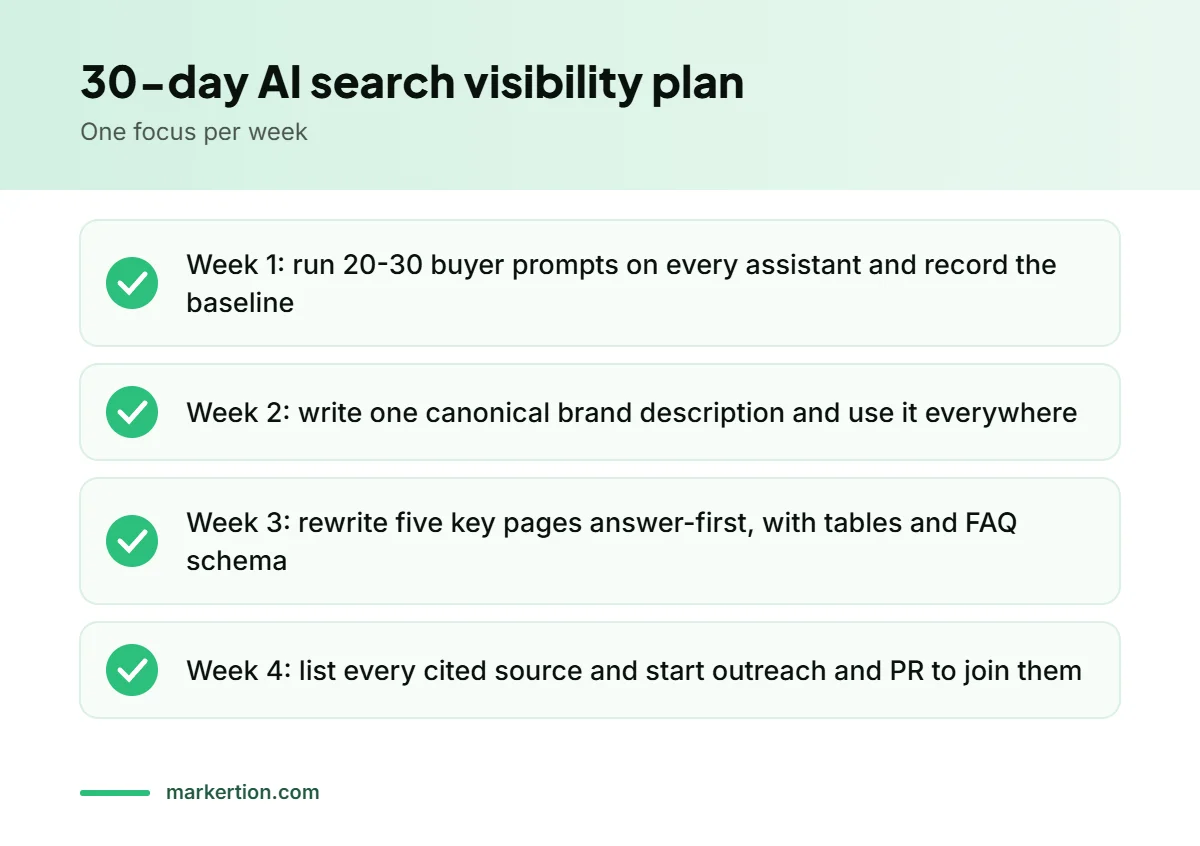
Week 1: Measure the baseline
Write 20 to 30 prompts a real buyer would ask, such as “best [category] for [audience]”, “[your brand] vs [competitor]” and “is [your brand] good for [use case]”. Run each prompt on ChatGPT, Gemini, Perplexity and Copilot, and check Google’s AI Overviews for the same queries. Record whether you are mentioned, where, how you are described, and which sources were cited.
Week 2: Fix your own facts
Write one canonical brand description of about 50 words and use it everywhere. Update your About page, your Organization schema, your social bios and your main directory listings so the facts match exactly.
Week 3: Rewrite your key pages answer-first
Pick the five pages that should be cited most, usually the homepage, your main service pages and one strong guide. Add a direct definition at the top, a comparison table, clear headings phrased as questions and an FAQ with schema.
Week 4: Go after the cited sources
From your Week 1 notes, list every third-party page the assistants cited. Sort them into pages you can realistically join (roundups that accept submissions, review sites, community threads) and publications you need PR to reach. Start outreach on the first group and plan a PR angle for the second.
How to Measure Progress
| Metric | How to check it | Good sign |
|---|---|---|
| Mention rate | Share of your prompt list where the brand is named | Rising month over month |
| Position | First, middle or last in the assistant’s list | Moving toward first |
| Accuracy | Description matches your canonical facts | No wrong services or old details |
| Cited sources | Which URLs the assistant links to | More pages that mention you |
| Referral traffic | Visits from chatgpt.com, perplexity.ai and similar in analytics | Steady growth |
Run the same prompt list on the same day each month. AI answers vary between sessions, so look at the trend across many prompts rather than any single answer.
Common Mistakes
- Chasing one assistant. Each one retrieves differently. Strong, consistent third-party coverage helps all of them at once.
- Publishing thin “AI SEO” pages. Assistants quote substance. A page that only repeats keywords gives them nothing to cite.
- Ignoring brand facts. Conflicting details across the web are one of the fastest ways to be left out.
- Treating it as separate from SEO. Retrieval still depends on authority, relevance and crawlable pages. Read GEO vs SEO for how the two fit together.
Frequently Asked Questions
What is AI search visibility?
AI search visibility is how often and how accurately AI assistants like ChatGPT, Gemini, Perplexity, Copilot and Google AI Overviews mention your brand when users ask questions about your category.
Can I pay to be cited by ChatGPT or Gemini?
No. There is no paid placement inside organic AI answers. You earn citations by appearing on the trusted sources the assistants retrieve and by publishing clear, quotable content.
How long does it take to improve AI visibility?
Fixing brand facts and page structure can show up within weeks for assistants that search the live web. Earning new third-party mentions usually takes two to four months to show a clear trend.
Is AI search visibility different from SEO?
It builds on SEO but measures something different. SEO tracks rankings and clicks; AI visibility tracks whether assistants name and describe your brand. Authority, links and good content help both.
How does Markertion help with AI search visibility?
We audit how assistants describe your brand today, find the sources they cite, then strengthen those signals with brand mentions, digital PR and answer-first content. See our AI search visibility service or book a call.
Final Thoughts
AI assistants reward brands that the trusted web already describes clearly and consistently. Measure where you stand with a fixed prompt list, fix your own facts, make your key pages easy to quote, and then earn mentions on the sources the assistants rely on. If you want a team to run that process with you, start with an AI visibility audit.
About the author: Shahidul Afridi is the founder of Markertion, a digital PR and link building agency that has built 6,000+ links for 120+ client partners since 2021. He writes from hands-on campaign work, not theory.

Digital PR & Link Building Expert