A topical map is a structured plan of every topic, subtopic and question your website needs to cover to be seen as an authority on a subject, and how those pages link together. You build one by defining your central entity and business goal, listing the attributes and questions around it, grouping them into core and supporting sections, and then planning internal links so every page supports the pages that make money.
Key Takeaways
- A topical map turns “what should we write next?” into a clear, ordered plan.
- Start from your central entity and the business goal, not from a keyword list.
- Split the map into a core section (closest to revenue) and an outer section (wider context and questions).
- Plan internal links as part of the map, not after publishing.
- Publish in a steady rhythm and keep updating the map as you learn.
Why Topical Maps Matter
Search engines try to understand which sites know a subject deeply. A site that covers one topic thoroughly, with clear connections between pages, sends stronger signals than a site with scattered posts on unrelated subjects. The semantic SEO approach popularised by Koray Tuğberk GÜBÜR, built around topical maps, entities and contextual coverage, has helped many sites rank competitive topics with fewer backlinks than expected, because the content itself shows depth.
Topical maps also help with AI search. Assistants that retrieve pages to answer questions favour sources that cover a topic clearly and consistently. A well-mapped site has an answer page for almost every question in its niche, which gives assistants more reasons to quote it. Our guide on AI search visibility explains how that connects to citations.
The Core Ideas Behind a Topical Map
- Central entity: the main thing your site is about, for example “link building” for an agency or “project management software” for a SaaS company.
- Source context: who you are and why you cover the topic. A link building agency covers link building from the angle of a service provider, which shapes which subtopics matter most.
- Attributes: the properties of the entity people search about, such as types, costs, tools, risks, processes and comparisons.
- Core section: pages closest to your service or product and buying intent.
- Outer section: broader pages that answer related questions, build context and attract links.
How to Build a Topical Map Step by Step
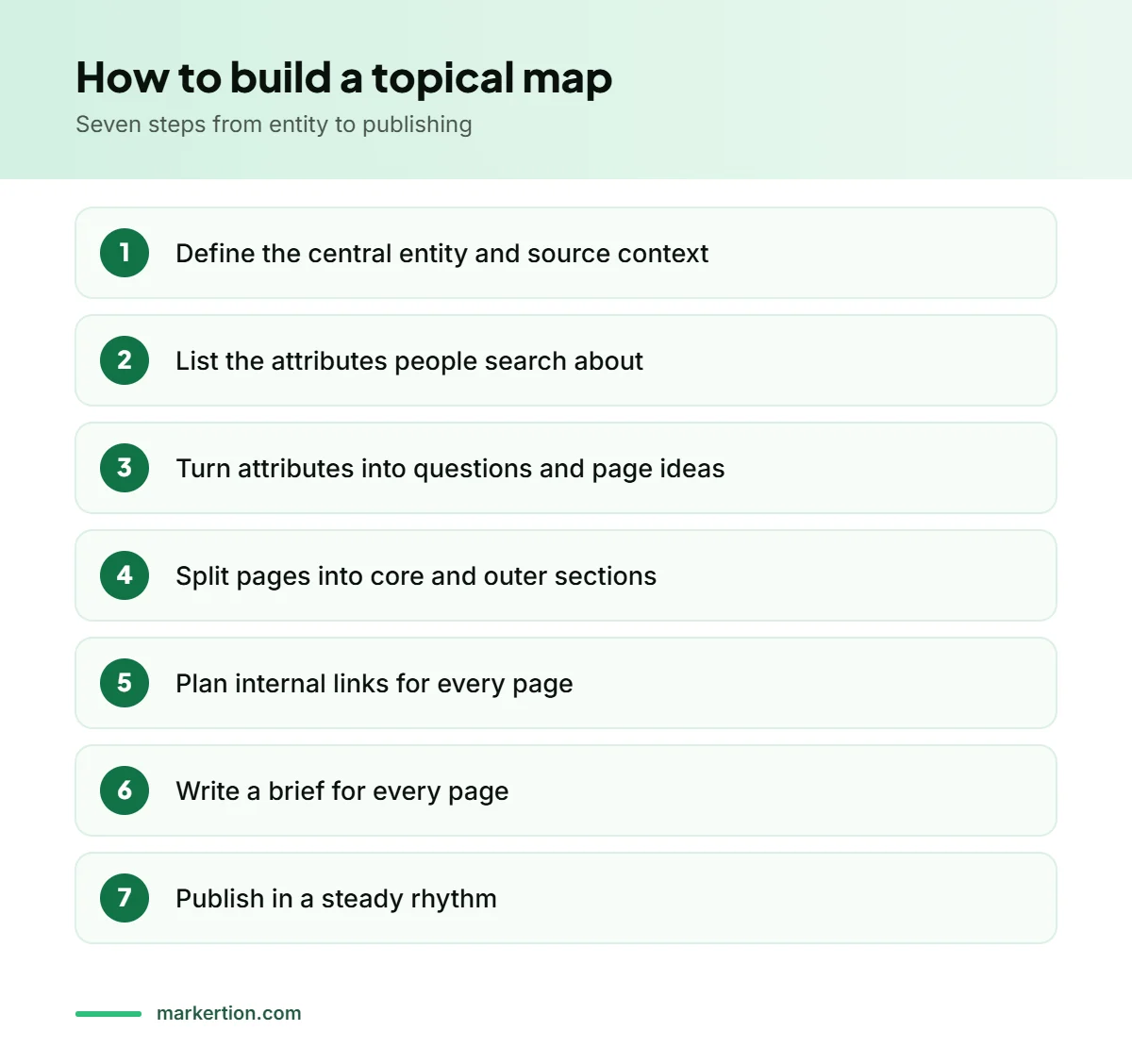
Step 1: Define the central entity and source context
Write one sentence: “We are [who] and we help [audience] with [entity] by [how].” For example: “Markertion is a digital PR and link building agency that helps SaaS companies and agencies earn authority through guest posts, niche edits and digital PR.” Every topic in the map should make sense from that sentence.
Step 2: List the attributes
Brainstorm everything people want to know about the entity. For link building that includes types (guest posts, niche edits, digital PR), cost, quality signals, risks, tools, processes, measurement, industries and comparisons. Use search suggestions, “People also ask”, competitor sitemaps, forums and AI assistants to expand the list.
Step 3: Turn attributes into questions and page ideas
Each attribute becomes a group of questions. “Cost” becomes “how much do guest posts cost”, “link building pricing models”, “niche edit pricing” and so on. Each distinct intent becomes a page. Merge questions with the same intent into one page to avoid cannibalisation.
Step 4: Split into core and outer sections
| Section | What goes here | Example for a link building agency |
|---|---|---|
| Core | Service pages and buying-intent guides | Guest posting services, link building pricing, niche edit services |
| Core support | Deep guides that feed the service pages | Guest post quality checklist, how to choose niche edit pages |
| Outer | Wider context and top-of-funnel questions | Topical authority explained, internal linking strategy, AI search visibility |
The core section should be finished first, because it is closest to revenue and gives the outer pages something to link to.
Step 5: Plan the internal links
For each page, list:
- The parent page it supports (often a service page or pillar).
- Two or three sibling pages in the same cluster.
- One or two pages from a neighbouring cluster where the topics connect naturally.
Use descriptive anchors that match the target page’s topic. Internal links are how authority and context flow through the map. Our link building strategy framework shows how external links should follow the same structure.
Step 6: Write a brief for every page
Each brief should include the main question, the intent, the headings, the entities and terms to cover, the internal links and the format. A good brief template keeps every writer consistent. See our content brief template.
Step 7: Publish in a steady rhythm
Publishing a cluster together or on a regular schedule helps search engines discover and connect the pages. Many semantic SEO practitioners prefer a consistent publishing frequency over large irregular bursts.
A Simple Topical Map Template
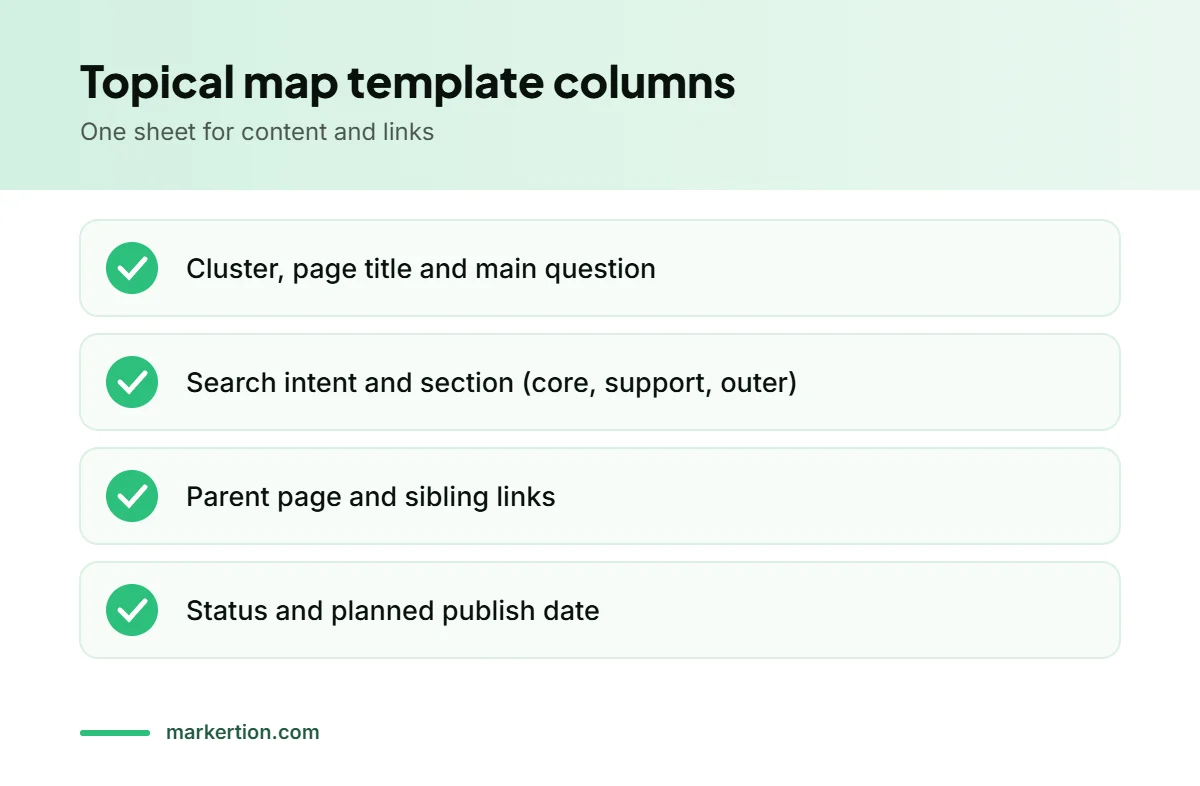
Use a spreadsheet with these columns:
- Cluster (for example “Guest Posting”)
- Page title
- Main question or keyword
- Search intent (informational, commercial, transactional)
- Section (core, core support, outer)
- Parent page
- Sibling links
- Status and publish date
This becomes both your content plan and your internal linking plan.
How Topical Maps and Backlinks Work Together
A topical map does not replace links, but it changes how much each link is worth. When a page sits inside a well-covered cluster, a single strong backlink lifts the whole cluster through internal links. When a page stands alone, the same link helps only that page. That is why we always map topics before planning link campaigns for clients.
Common Mistakes
- Starting with keywords instead of the entity, which leads to scattered content.
- Writing several pages for the same intent, causing them to compete.
- Ignoring internal links until after publishing.
- Skipping the core section and writing only top-of-funnel posts that never connect to revenue.
- Treating the map as finished. Review it every quarter with Search Console data.
How to Know Your Topical Map Is Working
Give a new cluster a few months, then check Search Console for these signs:
- More queries per page. Pages in a strong cluster start ranking for many related questions, not just their main keyword.
- Impressions growing across the whole cluster, not only on the pages with backlinks.
- New pages indexing and ranking faster than older standalone posts did.
- Service pages climbing as supporting articles link to them.
- AI answers citing your guides when you test questions from the map on ChatGPT, Gemini and Perplexity.
If a cluster stays flat, check whether pages target overlapping intents, whether internal links actually point to the parent page, and whether the content answers questions more completely than the current top results.
Frequently Asked Questions
What is a topical map in SEO?
A topical map is a plan of all the topics, subtopics and questions a site needs to cover to show authority on a subject, along with how those pages connect through internal links.
How many articles does a topical map need?
It depends on the subject. A narrow niche may need a few dozen pages; a broad one may need hundreds. Build the core section first, then expand the outer section over time.
Who created the topical map approach?
Topical maps are part of semantic SEO. Koray Tuğberk GÜBÜR is widely known for popularising topical authority and topical map frameworks through his case studies and training.
How long does topical authority take to build?
Most sites see clusters start to gain impressions within a few months of publishing consistently, with stronger results as the map fills in and earns links.
Can Markertion build a topical map for my site?
Yes. We map topics, write briefs and plan internal and external links as part of our SEO service and content writing service.
Final Thoughts
A topical map gives your content a purpose and an order. Define your entity and source context, list the attributes and questions around it, split them into core and outer sections, plan the internal links, and publish steadily. Each page then strengthens the others, and the whole site becomes the obvious answer for its subject, for Google and for AI assistants alike.
About the author: Shahidul Afridi is the founder of Markertion, a digital PR and link building agency that has built 6,000+ links for 260+ client partners since 2021. He writes from hands-on campaign work, not theory.

Digital PR & Link Building Expert