
A link building strategy is a plan for earning backlinks that supports the pages and topics you want to rank for, instead of collecting links at random. In 2026 the strongest strategies start with a topical map, point links at the pages that prove expertise on each topic, and mix guest posts, niche edits (link insertion), digital PR and brand mentions so the profile looks natural to Google and to AI assistants.
Key Takeaways
- Links work best when they reinforce topics you already cover in depth. Random links to random pages waste budget.
- Build your topical map first, then decide which pages each topic’s links should support.
- Use a mix of link types. Each one does a different job.
- Relevance and real traffic on the linking page matter more than a domain metric on its own.
- Measure by rankings and traffic on the target pages, not by link count.
Why Most Link Building Plans Fail
Most failed campaigns share the same pattern. Someone buys a batch of links, points them at the homepage with exact-match anchors, and waits. Rankings move a little, then stall. The problem is not the links themselves. It is that the links do not connect to a clear topical structure on the site, so Google has no strong reason to treat the site as the best answer for a group of related searches.
After building more than 6,000 links for over 120 client partners since 2021, the pattern we see most often is simple: sites with a clear topic structure get far more out of each link than sites with scattered content.
The Framework: Five Layers
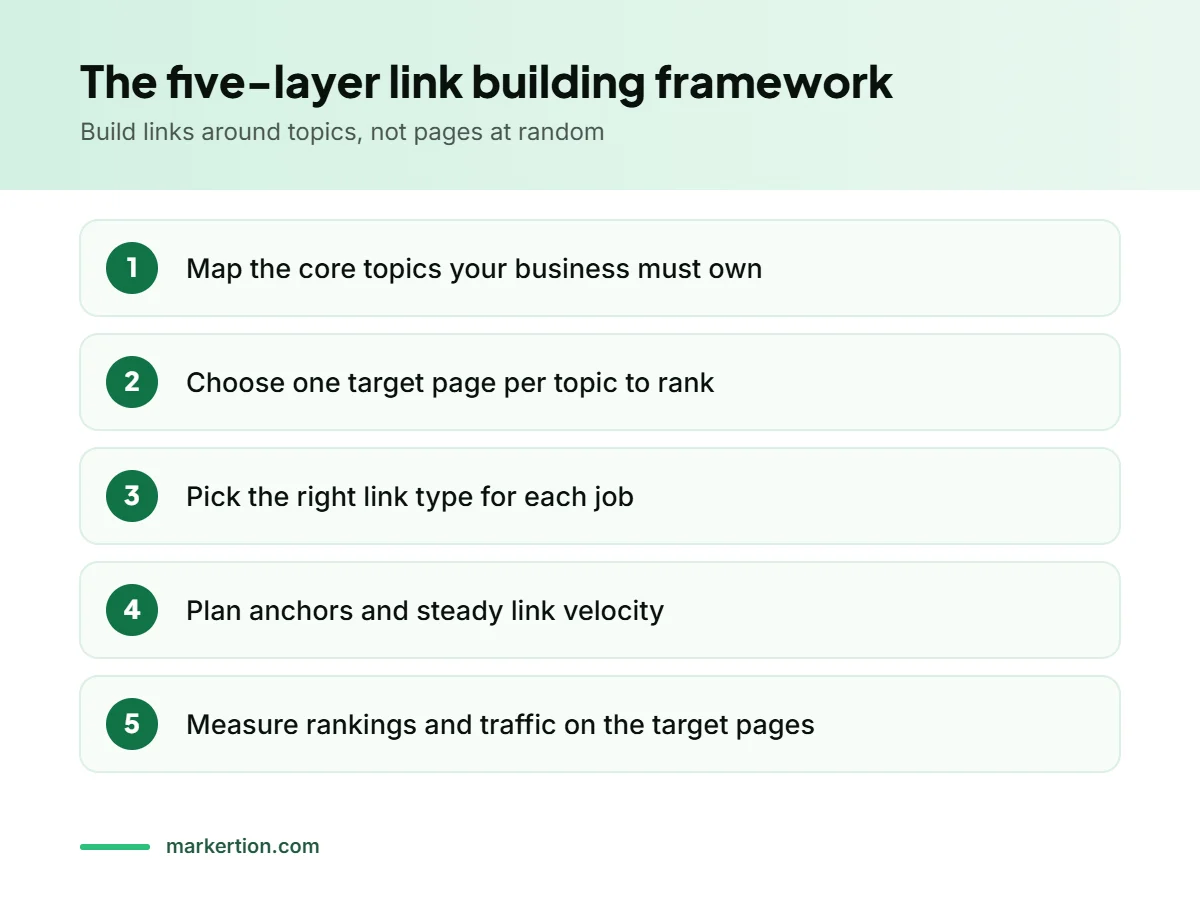
Layer 1: Map your topics
List the core topics your business must own. For a link building agency that might be guest posting, niche edits, SaaS link building, digital PR and local SEO. Under each topic, list the subtopics and questions buyers search for. This becomes your topical map. If you have never built one, start with our guide on content brief templates and expand from there.
Layer 2: Choose a target page per topic
Each topic needs one main page that should rank: usually a service page or a pillar guide. Supporting articles link to it internally, and most external links for that topic should point either to it or to the supporting articles that feed it.
Layer 3: Pick the right link type for the job
| Link type | Best for | Speed | Notes |
|---|---|---|---|
| Guest posts | Topical relevance, controlled anchors | Medium | Choose sites with real traffic in your niche |
| Niche edits (link insertion) | Links on pages that already rank and have age | Fast | Page-level traffic matters most |
| Digital PR | High-authority news links and brand mentions | Slower | Also builds AI search visibility |
| Brand mentions in listicles | Being named in “best X” articles | Medium | Strong for AI assistants and buyers |
| Resource and broken link building | Links to useful guides | Slow | Works well for strong content |
You can read more about each in our guides on guest posting and niche edits.
Layer 4: Plan anchors and velocity
Spread anchors across branded, naked URL, topic and partial-match phrases. Keep exact-match anchors rare and reserve them for the most relevant placements. Grow link volume steadily rather than in sudden spikes, especially on newer domains.
Layer 5: Measure against the target pages
Track rankings, impressions and organic traffic for the pages each topic’s links support. If a page is not moving after a reasonable time, check whether the issue is on-page (thin content, wrong intent) before adding more links.
How to Judge a Link Before You Build It
A strong link usually meets most of these tests:
- Relevance: the linking site and the specific page talk about your topic.
- Real traffic: the page or site gets organic visitors, not just a high metric.
- Editorial context: the link sits inside the body of useful content, not in a footer or author bio.
- Clean outbound profile: the site does not link out to casinos, pills and loans on every page.
- Indexation: the page is in Google’s index and has been crawled recently.
We cover these checks in depth in a later guide on evaluating backlinks.
Building a 90-Day Link Plan
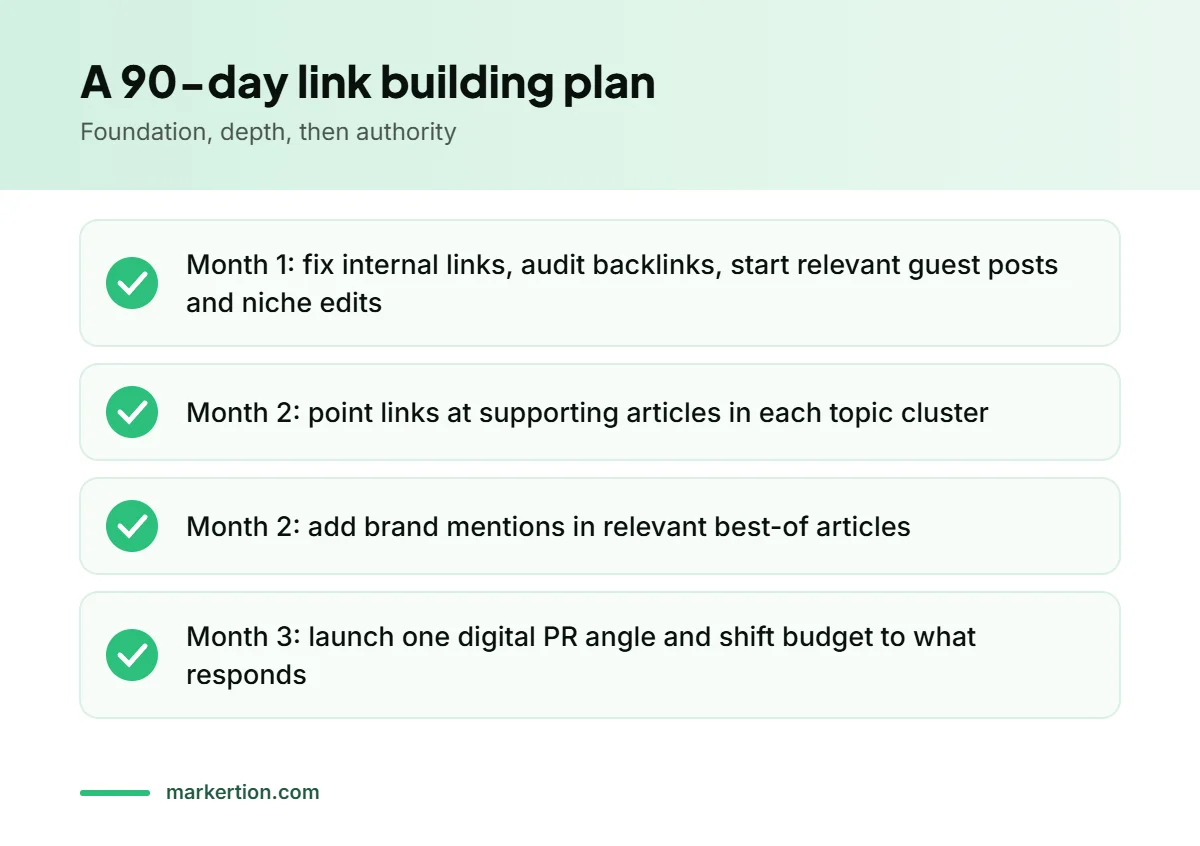
Month 1: Foundation
Fix internal linking first so authority flows to your target pages. Audit existing backlinks for problems using a process like our SaaS backlink audit. Then start with a small number of highly relevant guest posts and niche edits pointed at your main service pages.
Month 2: Topic depth
Point links at supporting articles in each cluster, not only the main page. This tells Google that your whole topic area is trusted. Add brand mentions in relevant “best of” articles.
Month 3: Authority and reach
Launch one digital PR angle, such as a data story or expert commentary, to earn news coverage. Review the target pages’ rankings and shift budget toward the topics that respond best.
Link Building and AI Search
Links still drive Google rankings, but they now do a second job. AI assistants such as ChatGPT, Gemini and Perplexity retrieve and trust pages with strong authority and then cite the brands those pages mention. That means a mention on a well-linked industry article helps twice: it passes authority to your site and puts your brand into the sources assistants quote. Our guide on getting cited by AI assistants explains the second effect in detail.
Common Mistakes to Avoid
- Pointing every link at the homepage.
- Buying links on sites with high metrics but no real traffic.
- Using the same exact-match anchor again and again.
- Building links to thin pages that do not deserve to rank.
- Stopping after one month. Link building compounds over time.
- Relying on private blog networks, which carry real risk. See how to get high-authority backlinks without PBNs.
Example: Mapping Links to One Topic
Here is how the framework looks for a single topic. Say an agency wants to rank for guest posting services. The target page is the guest posting service page. Supporting articles in the cluster cover guest post pricing, how to find guest post sites, outreach templates and a quality checklist for spotting link farms.
The link plan for that topic then looks like this: a few highly relevant guest posts and niche edits point to the service page with branded and partial-match anchors; more links point to the supporting articles using topic anchors; and every supporting article links internally to the service page and to its siblings. Over a few months the whole cluster rises together, because Google sees depth on the topic and authority flowing through it, not a single page with links and nothing behind it.
Frequently Asked Questions
What is the best link building strategy in 2026?
The best strategy ties links to a topical map: build one strong page per topic, support it with related articles, and earn a mix of guest posts, niche edits, digital PR and brand mentions pointed at those pages.
How many backlinks do I need per month?
It depends on your competitors and your domain age. Look at the referring domains of the pages ranking for your target topics and plan steady growth toward that level rather than a fixed monthly number.
Are guest posts or niche edits better?
Both have a place. Guest posts give you more control over context and anchors; niche edits (link insertion) place your link on pages that already have age and traffic. Most strong profiles use both.
Does link building still matter with AI search?
Yes. Authority still decides which pages get retrieved and trusted, and AI assistants often cite brands that appear on well-linked sources. Links and mentions now support both rankings and AI visibility.
Can Markertion build a link strategy for my site?
Yes. We map your topics, choose target pages and run guest posting, niche edits and digital PR together. Start with our SaaS link building service or book a strategy call.
Final Thoughts
Link building works when it serves a clear structure. Map your topics, choose the page each topic should rank with, use the right link type for each job, and judge results by the pages you set out to grow. Do that consistently and every new link adds to a stronger whole instead of sitting on its own.
About the author: Shahidul Afridi is the founder of Markertion, a digital PR and link building agency that has built 6,000+ links for 120+ client partners since 2021. He writes from hands-on campaign work, not theory.

Digital PR & Link Building Expert