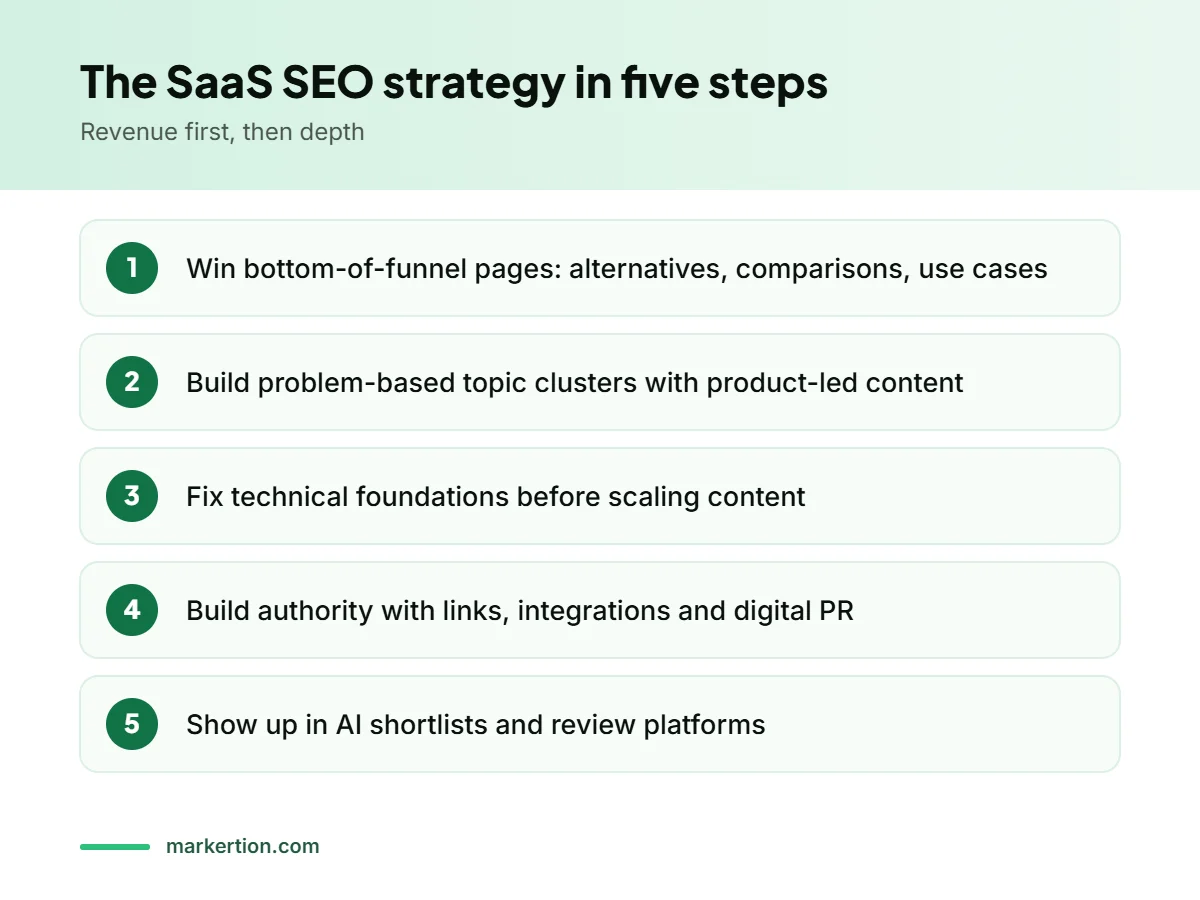
A SaaS SEO strategy turns organic search into sign-ups, demos and pipeline by targeting the searches buyers make at every stage, from problem awareness to product comparison. The most effective plans in 2026 start with bottom-of-funnel pages such as alternatives, comparisons, integrations and use cases, then build topical depth with guides, and support both with technical health, links and digital PR.
Key Takeaways
- Start where buyers are closest to buying: comparison, alternative, integration and use-case pages.
- Build topic clusters around the problems your product solves, not just your product name.
- Product-led content, which shows the product solving the problem, converts better than generic advice.
- Links and brand mentions decide how far good content can climb in competitive SaaS niches.
- Measure pipeline and sign-ups from organic, not just traffic.
Why SaaS SEO Is Different
SaaS buyers research heavily before they talk to sales. They compare tools, read reviews, look for integrations and ask AI assistants for shortlists. That creates a long, search-heavy journey, which is good news for SEO, but it also means competitors with bigger budgets chase the same keywords. A SaaS SEO strategy has to be selective: win the searches that lead to revenue first, then expand.
SaaS also has a natural advantage: the product itself. Screenshots, workflows, templates and free tools are content assets that generic publishers cannot match.
The SaaS SEO Funnel
| Stage | What buyers search | Page types |
|---|---|---|
| Bottom of funnel (BOFU) | “[competitor] alternatives”, “[tool A] vs [tool B]”, “[category] software for [audience]” | Alternatives, comparisons, use-case and industry pages |
| Middle of funnel (MOFU) | “how to [solve problem]”, “[process] template”, “best way to [task]” | Product-led guides, templates, workflows |
| Top of funnel (TOFU) | “what is [concept]”, “[topic] statistics”, “[problem] causes” | Explainers, research, glossary |
| Retention | “how to [feature]”, “[tool] integration with [tool]” | Help docs, integration pages |
Step 1: Win the Bottom of the Funnel First
BOFU pages often have lower search volume but much higher conversion rates. Build these first:
- Alternatives pages: “[Competitor] alternatives” pages capture people ready to switch.
- Comparison pages: “[Your tool] vs [competitor]” pages with honest, specific differences.
- Use-case pages: “[Category] software for [industry or role]”.
- Integration pages: one page per important integration. Our guide on integration and partner page backlinks shows how these also earn links.
Keep them honest. Buyers can tell when a comparison page is pure spin, and AI assistants are less likely to quote biased pages.
Step 2: Build Problem-Based Topic Clusters
List the problems your product solves. Each problem becomes a cluster with a pillar guide and supporting articles. Write product-led content: explain the problem, show the manual way, then show how your product makes it easier with real screenshots. Plan each cluster with a topical map so pages link together and avoid overlap.
Step 3: Fix the Technical Foundations
SaaS sites often have specific technical issues:
- Marketing site and app on different subdomains with mixed signals.
- JavaScript-heavy pages that do not render content for crawlers.
- Thousands of thin, auto-generated pages from templates or help centres.
- Staging or app pages accidentally indexed.
Run a full audit using our technical SEO audit checklist and fix indexing blockers before scaling content.
Step 4: Build Authority With Links and PR
In most SaaS categories, content alone is not enough to beat established competitors. You need referring domains pointing at your pages. The strongest SaaS link sources are integration partners, guest posts on relevant industry blogs, inclusion in “best tools” lists, data-driven digital PR and founder commentary. Our SaaS link building service is built around this mix.
Step 5: Show Up in AI Answers
Buyers increasingly ask ChatGPT, Gemini and Perplexity for software shortlists. Those assistants lean on review sites, comparison articles and “best X” lists. Make sure your product is listed on major review platforms, included in relevant roundups and described consistently everywhere. Our guide on AI search visibility covers the full process.
A 6-Month SaaS SEO Roadmap
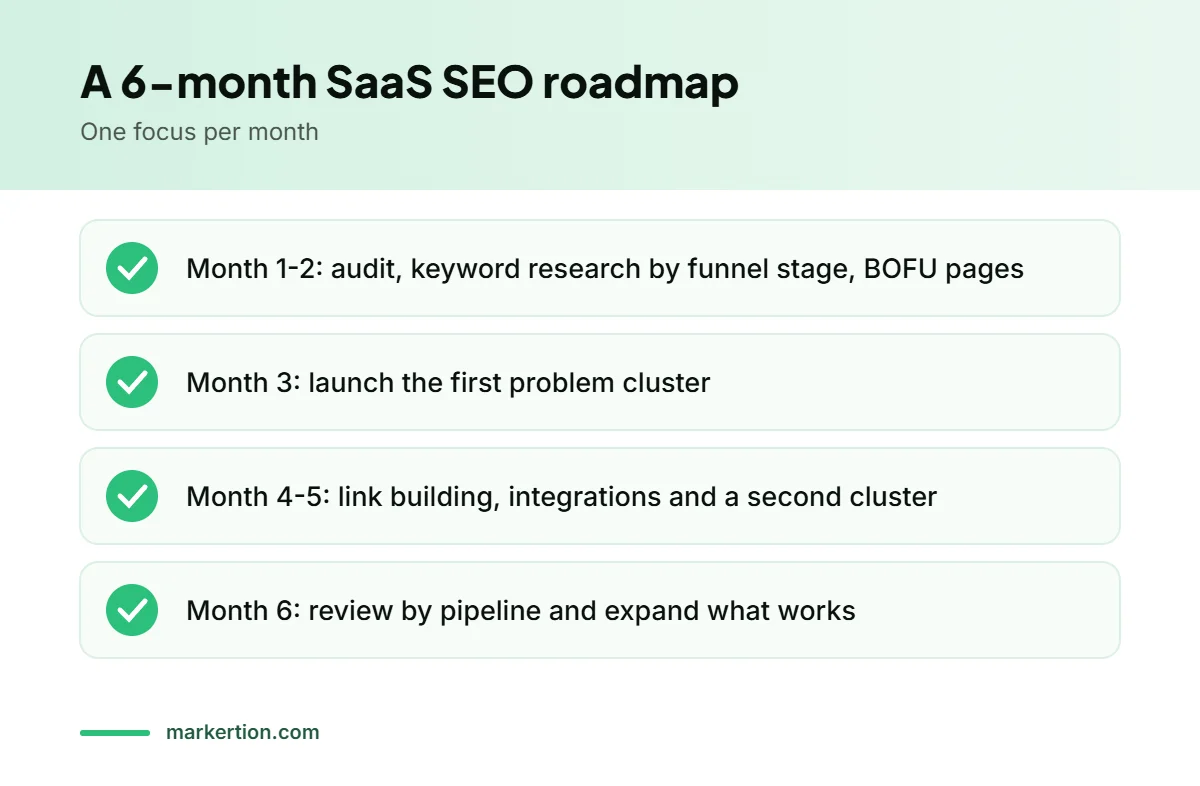
- Month 1: technical audit and fixes; keyword research by funnel stage; topical map.
- Month 2: publish alternatives, comparison and top use-case pages.
- Month 3: launch the first problem cluster with a pillar and supporting guides.
- Month 4: link building to BOFU pages and the first pillar; integration listings.
- Month 5: second cluster; first digital PR or data campaign.
- Month 6: review results by pipeline, update winners, expand what works.
Measuring SaaS SEO
| Metric | Why it matters |
|---|---|
| Organic sign-ups and demo requests | The real goal of SaaS SEO |
| Pipeline and revenue from organic | Shows business impact |
| BOFU page rankings | Leading indicator for conversions |
| Non-branded organic traffic | Growth beyond people who already know you |
| Referring domains to key pages | Authority behind rankings |
| AI mentions in shortlist prompts | Visibility in AI-assisted buying |
For a real example of these steps in action, see our SaaS SEO case study.
Common SaaS SEO Mistakes
- Starting with top-of-funnel content that brings traffic but no buyers.
- Thin comparison pages that only list features.
- Ignoring the product in content, missing the best way to differentiate.
- No link building in competitive categories.
- Measuring traffic only instead of sign-ups and pipeline.
Choosing Keywords When You Have Little Authority
New SaaS sites cannot win every keyword at once. When your domain is still young, filter your keyword list with three questions:
- Is the intent close to buying? Comparison, alternative, integration and “software for [role]” searches convert even at low volume.
- Are the current top results beatable? If page one is full of forum threads, thin listicles or outdated posts, a strong page can break in.
- Can the product prove the point? Keywords where screenshots, templates or a free tool can show the answer give you an edge generic publishers lack.
Keywords that pass all three are your first targets. As authority grows through content depth and links, move up to broader, more competitive terms. Our list of SaaS SEO tools for startups covers affordable tools for this research.
What a Strong SaaS Comparison Page Includes
Comparison and alternatives pages are where many SaaS sites win or lose buyers, so it is worth getting the structure right:
- A short, honest summary at the top that says who each tool is best for. Buyers and AI assistants both quote this part.
- A feature table covering the features buyers actually compare, with clear yes, no or partial answers.
- Pricing model notes, such as per seat, usage-based or flat, without guessing at competitors’ exact prices if you cannot verify them.
- Real screenshots of the same task done in each tool.
- Migration help: how to move data from the competitor, how long it takes and what support you offer.
- Customer proof: a quote or short story from someone who switched.
- An FAQ with the objections your sales team hears most often.
Update these pages whenever you or the competitor ships major changes. An outdated comparison costs trust quickly, and fresh, accurate pages are more likely to be retrieved when buyers ask AI assistants to compare tools.
Frequently Asked Questions
What is SaaS SEO?
SaaS SEO is the process of growing sign-ups, demos and revenue for software companies through organic search, by targeting the searches buyers make from problem awareness to product comparison.
Which SaaS pages should I create first?
Start with bottom-of-funnel pages: competitor alternatives, comparisons, use-case or industry pages and key integration pages. They convert best and often face less competition than broad keywords.
How long does SaaS SEO take to work?
BOFU pages can start converting within a few months, while broader topic clusters and authority usually take six to twelve months to show strong growth.
Do SaaS companies need link building?
In most competitive categories, yes. Links from relevant sources help strong content outrank established competitors and support visibility in AI shortlists.
Can Markertion help with SaaS SEO?
Yes. We combine technical audits, topical maps, product-led content and SaaS link building to grow organic pipeline.
Final Thoughts
A strong SaaS SEO strategy goes after revenue first. Build honest bottom-of-funnel pages, then problem-based clusters that show your product at work, keep the technical base clean, and earn the links and mentions that competitive categories demand. Measure what matters, sign-ups and pipeline, and keep putting effort where it pays off.
About the author: Shahidul Afridi is the founder of Markertion, a digital PR and link building agency that has built 6,000+ links for 260+ client partners since 2021. He writes from hands-on campaign work, not theory.

Digital PR & Link Building Expert