Integration and partner pages are pages on other SaaS companies’ websites that list the tools they connect with or work alongside. They are one of the most underused backlink sources for SaaS because the links are highly relevant, sit on strong domains, send buyers who already use a related product, and are usually earned through a partnership conversation rather than paid outreach.
Key Takeaways
- Integration directories, app marketplaces, partner listings and “works with” pages all count.
- These links are relevant by nature: the linking company serves the same buyers you do.
- Most are earned by building or documenting a real integration, then asking to be listed.
- They also feed AI assistants, which often read integration directories to answer “what works with X” questions.
- Treat them as a repeatable programme, not a one-off task.
Why Integration Links Work So Well for SaaS
Most SaaS link building focuses on guest posts and listicles. Those work, but they compete with every other SaaS brand chasing the same blogs. Integration and partner pages are different for three reasons.
Relevance is built in. A CRM that lists your email tool as an integration is telling Google that the two products belong to the same topic and audience.
The domains are strong. Established SaaS companies tend to have powerful backlink profiles, and their integration directories are often among their most linked pages.
The traffic converts. Visitors on an integration page are actively looking for tools that connect to software they already pay for. That is about as close to purchase intent as referral traffic gets.
There is also an AI angle. When someone asks ChatGPT or Perplexity “what tools integrate with HubSpot”, the assistant often retrieves the official integration directory. Being listed there helps you appear in those answers, which is a core part of AI search visibility.
Types of Integration and Partner Pages
| Page type | Example | How you get listed |
|---|---|---|
| App marketplace | A platform’s public app store | Build an app and submit it for review |
| Integrations directory | “Integrations” page on a SaaS site | Build a native or API integration and ask |
| Zapier/Make-style connectors | Automation platform app pages | Publish a connector and documentation |
| Technology partner page | “Our partners” listings | Formal or informal partnership |
| “Works with” or compatibility page | Hardware or platform compatibility lists | Prove compatibility and request inclusion |
| Agency or reseller partner directory | Partner finder pages | Join the partner programme |
How to Find Integration Link Opportunities
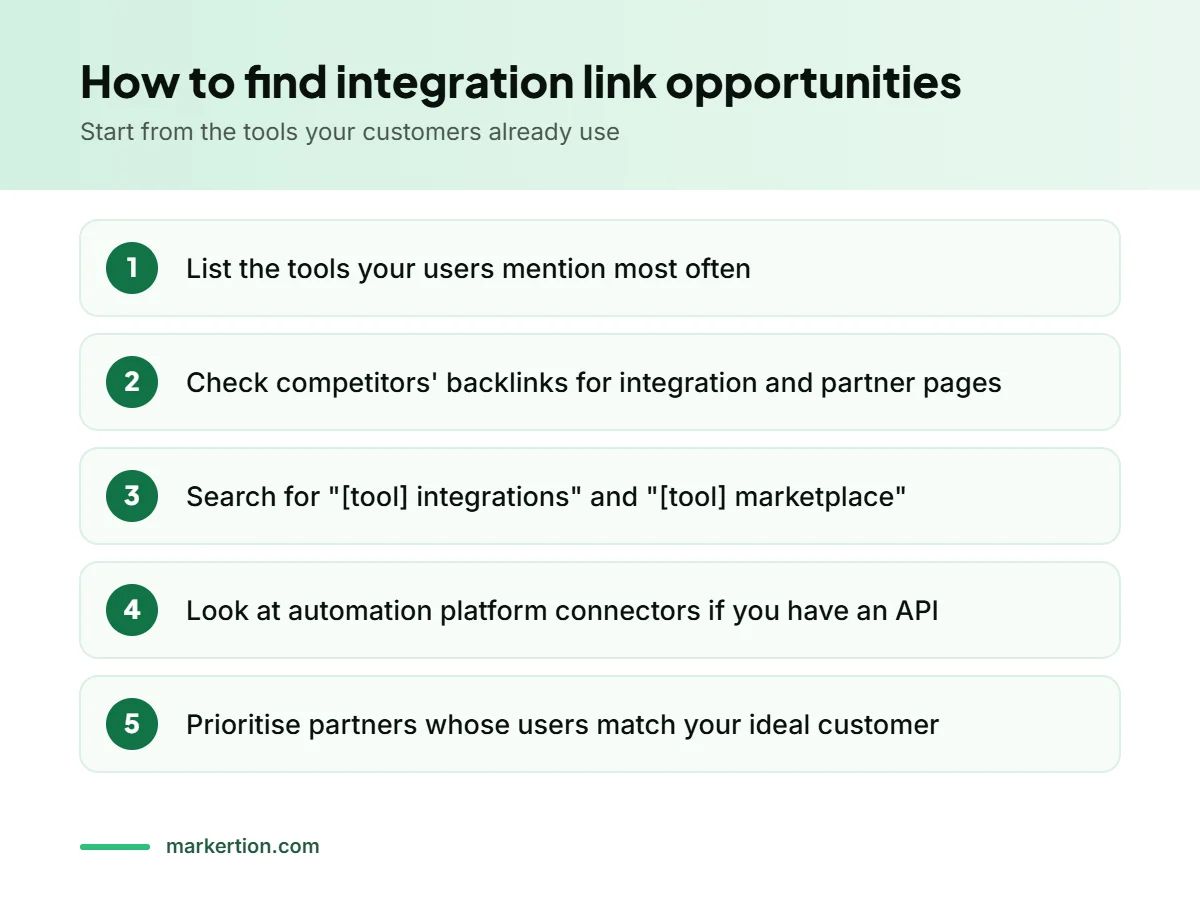
- List the tools your users already use. Check onboarding surveys, support tickets and sales calls. The tools mentioned most often are your best targets.
- Check competitors’ integration links. Put a competitor into a backlink tool and filter referring pages for words like integrations, apps, marketplace and partners. Every result is a page that already lists a product like yours.
- Search directly. Use searches such as “[tool name] integrations”, “[tool name] app marketplace” and “[tool name] partners”.
- Check automation platforms. If you have an API, a connector on automation platforms can create dozens of app pages that each link back.
- Sort by fit. Prioritise tools whose users match your ideal customer, not just those with the biggest domain.
How to Earn the Listing
Step 1: Make the integration real
You need something genuine to list: a native integration, a documented API connection, or a tested workflow using an automation platform. Fake or half-built integrations get rejected and damage the relationship.
Step 2: Document it publicly
Create a dedicated page on your own site for each integration. Explain what the integration does, who it is for, how to set it up and what problems it solves. This page becomes the link target and is also a strong page for long-tail searches like “[your tool] + [partner tool]”.
Step 3: Follow the partner’s process
Most marketplaces have a submission form, review guidelines and listing requirements such as logos, screenshots and support contacts. Follow them exactly. Missing assets are the most common reason listings stall.
Step 4: Ask for more than a listing
Once approved, ask about co-marketing: a joint blog post, a case study, a webinar or inclusion in the partner’s newsletter. Each one can create additional links and brand mentions on a highly relevant domain.
Making It a Repeatable Programme
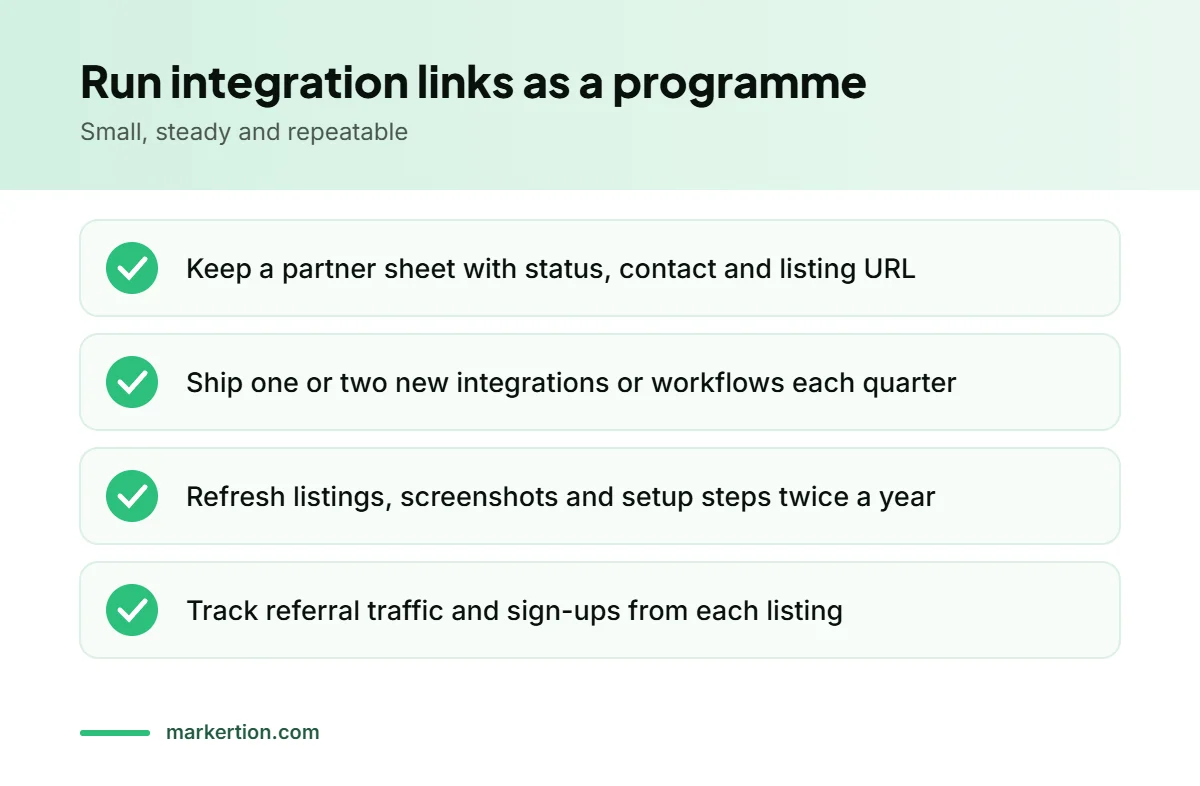
The SaaS companies that get the most from integration links treat it as an ongoing process:
- Keep a sheet of target partners with status, contact and listing URL.
- Ship one or two new integrations or documented workflows each quarter.
- Review existing listings twice a year to keep descriptions, screenshots and links current.
- Track referral traffic and sign-ups from each listing in your analytics.
- Link your integration pages internally from your product, pricing and feature pages.
How This Fits With Other SaaS Link Building
Integration links are a foundation, not a full strategy. They give you relevant, trusted links that competitors cannot easily copy, but you still need content-led links to your guides and feature pages. Combine them with the tactics in our guide to link building for SaaS and the sources listed in best backlink sources for B2B SaaS. For the overall structure, see our link building strategy framework.
Common Mistakes
- Listing without a landing page. If the partner links to your homepage, you lose the chance to rank for integration searches.
- Chasing big names only. Smaller tools with a close audience match often approve faster and send better users.
- Letting listings go stale. Old screenshots and broken setup steps reduce clicks and can get listings removed.
- Ignoring nofollow. Some marketplaces use nofollow links. They are still worth having for referral traffic, brand mentions and AI visibility, but plan your expectations.
What a Strong Integration Landing Page Includes
Your own integration page is what the partner links to, so it needs to earn that link and convert the visitors it sends. The best ones we have built for SaaS clients share the same parts:
- A clear headline that names both products, such as “Connect [Your Tool] with [Partner Tool]”.
- A one-paragraph summary of what the integration does and who it helps, written so it can be quoted on its own.
- Use cases: three to five short examples of workflows the integration makes possible.
- Setup steps with screenshots, so a new user can connect the tools in a few minutes.
- Pricing and plan notes: which of your plans include the integration.
- An FAQ covering sync frequency, data fields and common errors.
- Calls to action to start a trial or book a demo.
Pages built this way often rank for “[your tool] [partner tool] integration” searches by themselves, which means the listing brings you visitors from the partner’s directory and from Google at the same time.
Frequently Asked Questions
What are integration backlinks?
Integration backlinks are links from other software companies’ integration directories, app marketplaces or partner pages that list your product as a compatible tool.
Are integration page links dofollow?
Some are and some are not. It varies by company. Even nofollow listings are valuable for referral traffic, brand mentions and appearing in AI answers about compatible tools.
Do I need a native integration to get listed?
Not always. Some directories accept documented API connections or automation platform connectors. A real, working connection is required in almost every case.
How many integration links should a SaaS company aim for?
There is no fixed number. Start with the ten tools your customers use most and expand from there. Quality of fit matters far more than volume.
Can Markertion help with SaaS partner and integration links?
Yes. We find partner opportunities, prepare integration landing pages and outreach, and combine them with content-led links through our SaaS link building service.
Final Thoughts
Integration and partner pages give SaaS companies links that are relevant, durable and hard for competitors to copy. Start from the tools your customers already use, make the integration real, document it well and follow each partner’s process. Then keep the programme running, because every new integration is both a product feature and a new source of authority.
About the author: Shahidul Afridi is the founder of Markertion, a digital PR and link building agency that has built 6,000+ links for 260+ client partners since 2021. He writes from hands-on campaign work, not theory.

Digital PR & Link Building Expert