A bad niche edits (link insertion) vendor usually shows the same warning signs: prices that look too cheap, lists sorted only by DR, no page-level traffic data, refusal to show live examples, “niche edits” on brand-new pages, crowded outbound links, no replacement policy and vague answers about how links are placed. Spotting these red flags before you pay protects your budget and your link profile.
Key Takeaways
- Judge vendors by the pages they place links on, not by the domain metrics they advertise.
- Real niche edits go into existing, indexed articles with traffic. New posts are guest posts.
- Transparency is the clearest quality signal: examples, data and clear policies.
- Extremely low prices usually mean low-value or risky inventory.
- Start with a small test order and check every link yourself.
Why Vendor Choice Matters So Much
Niche edits (link insertion) can be one of the most efficient link types, because your link goes into a page that already has age, authority and traffic. But the same model makes the market attractive to low-quality sellers. A vendor can sell placements on dead pages, link-selling sites or pages packed with other paid links, and the buyer may not notice until rankings fail to move. Our guide on how to choose pages for niche edits explains what a good host page looks like; this guide covers the vendor side.
The 10 Red Flags
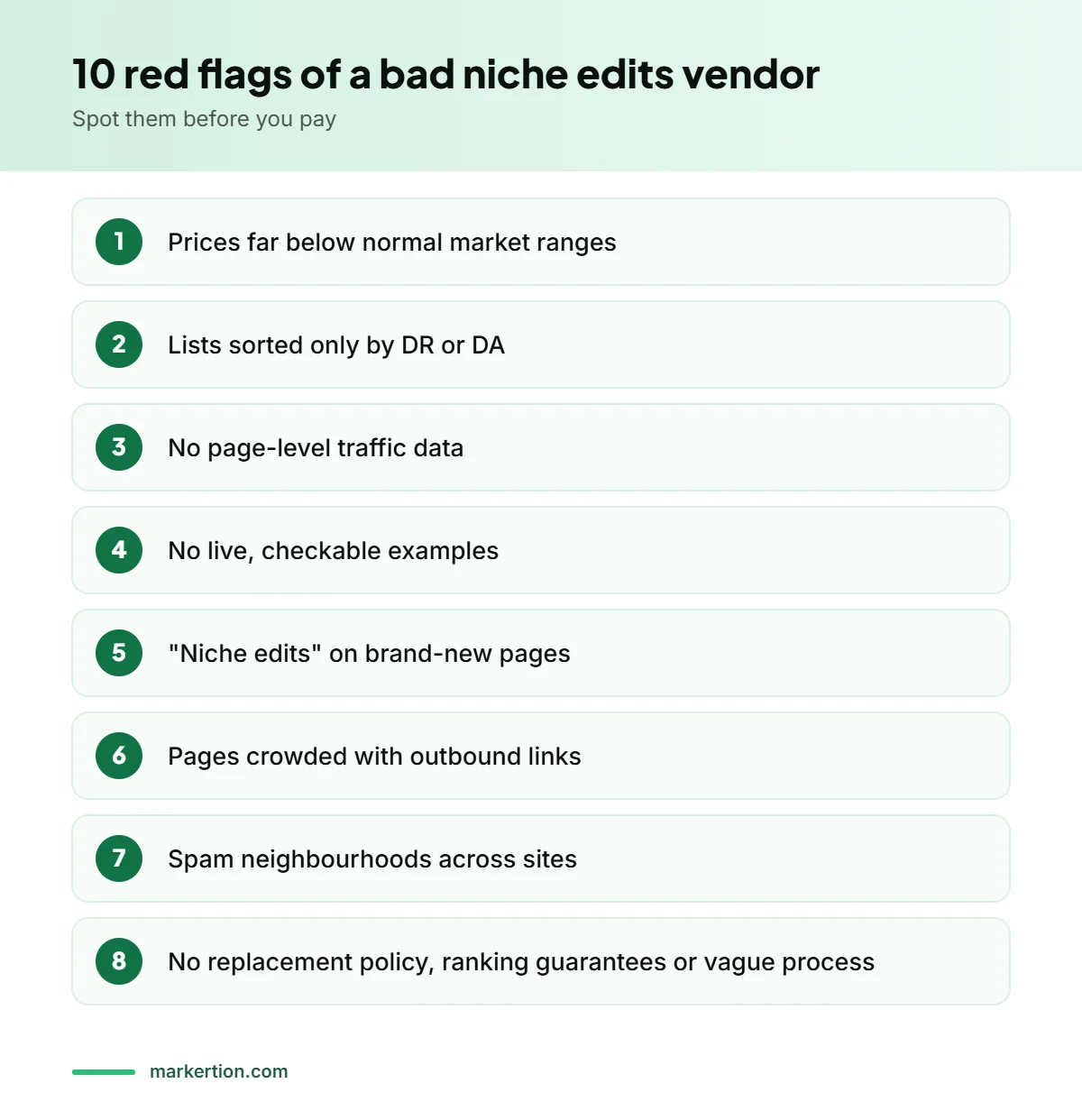
1. Prices that seem too good to be true
Real placements on relevant pages with traffic cost money, because the site owner, the outreach and the vetting all take time. When prices are far below normal market ranges, the inventory is usually weak, the links are nofollow, or the sites are link farms. Our niche edit pricing guide shows typical ranges.
2. Lists sorted only by DR or DA
If a vendor’s whole offer is a spreadsheet of domains sorted by DR, with no traffic or relevance data, they are selling a metric, not a placement. DR can be inflated and says nothing about the page your link will sit on.
3. No page-level traffic data
Ask for the organic traffic of the specific page, not the domain. A vendor who cannot or will not provide it has either not checked or does not want you to see the answer.
4. No live examples
A trustworthy vendor can share recent placements in niches like yours. Refusing to share examples, or sharing only screenshots that cannot be checked, is a serious warning sign.
5. “Niche edits” on new pages
A link insertion should go into an existing, indexed article. If the “niche edit” appears on a page published the same week, it is a new post sold under the wrong label, often at a higher price.
6. Crowded outbound links
Open some example pages and count the external links. If articles are packed with links to unrelated businesses, the site is selling links heavily, and each link passes less value.
7. Spam neighbourhoods
Search the vendor’s example sites for casino, payday loans, pills and adult anchors. If they appear across many pages, avoid the network.
8. No replacement or removal policy
Links on other people’s sites can disappear. Good vendors state clearly what happens if a link is removed within an agreed period. Markertion, for example, replaces a niche edit removed within six months. No policy usually means no accountability.
9. Guarantees about rankings
No honest vendor can guarantee a specific ranking from a set number of links, because rankings depend on many factors. Ranking guarantees usually signal aggressive tactics or empty promises.
10. Vague answers about the process
Ask how they find pages, how they contact site owners, how they check quality and how they report. Clear, specific answers suggest a real process. Vague answers suggest a reseller with no control over quality.
Questions to Ask Before You Buy
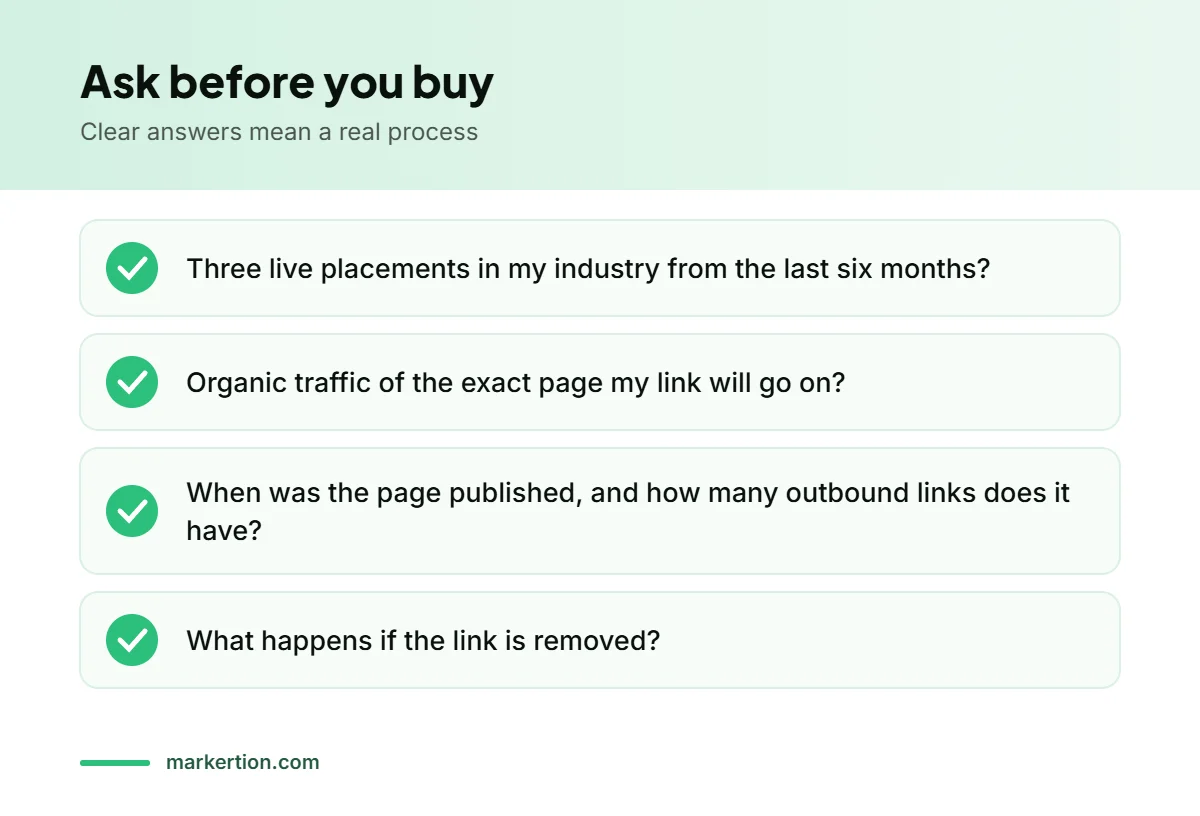
- Can you share three live niche edits in my industry from the last six months?
- What is the organic traffic of the exact page where my link will go?
- When was that page first published and indexed?
- How many outbound links does the page carry?
- What anchor text do you recommend, and why?
- What happens if the link is removed?
- How do you report placements?
Good Vendor vs Bad Vendor
| Area | Good vendor | Bad vendor |
|---|---|---|
| Inventory | Existing, indexed pages with traffic | Domains sorted by DR only |
| Data | Page traffic, keywords and outbound links | Domain metrics only |
| Examples | Live, checkable placements | None or screenshots only |
| Policy | Clear replacement terms | No policy |
| Promises | Realistic expectations | Ranking guarantees |
| Process | Specific and transparent | Vague or secret |
How to Run a Safe Test Order
- Order a small number of placements, two to five, from the vendor.
- Check every page against the signals in our backlink evaluation guide: traffic, relevance, indexation, placement, outbound links.
- Confirm the pages were existing articles, not new posts.
- Wait a few weeks and check that links are still live and indexed.
- Only scale up if every placement passes.
What to Do if You Already Bought Bad Links
If you discover that a past vendor placed links on spammy sites, do not panic. Google says it ignores most low-quality links automatically. Audit your backlinks, note the worst placements, and stop working with the vendor. A disavow file is only worth considering if there is a large, clear pattern of manipulative links or you have received a manual action. Our backlink audit guide explains the process.
How Good Vendors Report Their Work
Reporting is another quick way to tell vendors apart. A good monthly report for niche edits includes, for every placement:
- The live URL of the host page and the date the link was added.
- The anchor text and the target page on your site.
- The host page’s organic traffic and main ranking keywords at the time of placement.
- The link attribute (dofollow, nofollow or sponsored).
- Indexation status, checked after placement.
Over time, good vendors also share how the target pages are moving in rankings and traffic. If a vendor only sends a bare list of URLs with domain metrics, ask for more. If they cannot provide it, that tells you how much checking happened before the link was placed.
Frequently Asked Questions
How can I tell if a niche edit vendor is legitimate?
A legitimate vendor shares live examples, gives page-level traffic data, places links in existing indexed articles, has a clear replacement policy and explains its process in detail.
Why are some niche edits so cheap?
Very cheap niche edits usually come from low-traffic pages, link-selling sites or networks, or are nofollow links. Real placements on relevant pages with traffic cost more.
What is the difference between a niche edit and a guest post?
A niche edit adds your link to an existing article, while a guest post is a new article written for the site. Vendors who sell new posts as niche edits are mislabelling their product.
Should I ask for page traffic or domain traffic?
Ask for both, but page-level traffic matters more because it shows whether the specific article your link is in gets visitors and rankings.
How does Markertion handle niche edits?
Our niche edits (link insertion) service places links only in existing, indexed articles with real traffic and relevance, shares full placement details and replaces any link removed within six months.
Final Thoughts
Most niche edit problems can be avoided before you pay. Watch for prices that are too low, metric-only lists, missing page data, no examples, new pages sold as edits, crowded outbound links and vague answers. Ask direct questions, run a small test order, check every placement yourself, and only scale with vendors who pass. Your budget and your link profile will both be better for it.
About the author: Shahidul Afridi is the founder of Markertion, a digital PR and link building agency that has built 6,000+ links for 260+ client partners since 2021. He writes from hands-on campaign work, not theory.

Digital PR & Link Building Expert