Yes, press releases still matter in 2027, but not for the reason many people buy them. A press release will not rank your website on its own, and the links inside it should not pass ranking credit. What it can do is put an accurate, official version of your news on trusted news and finance sites, give journalists something to work from, add verified facts about your brand to the open web, and feed the sources that search engines and AI assistants use to answer questions about you.
This guide explains how press release distribution works today, what it does and does not do for SEO, how it fits alongside Digital PR, what is known (and unknown) about press releases in AI search, and how to plan for 2027. It draws on Google’s own documentation, recent industry research and what we see running press release and media placement campaigns at Markertion.
By Shahidul Afridi, Digital PR & Link Building, Markertion · Last updated: November 2026
Key Takeaways
- Press releases are an official record and a distribution tool. Their main value is visibility, credibility and brand mentions, not direct ranking power.
- Google’s spam policies list “links with optimized anchor text in articles, guest posts, or press releases distributed on other sites” as link spam. Paid or widely distributed release links should be qualified with
rel="sponsored"orrel="nofollow". - Earned coverage carries more weight than paid distribution, both in search and in AI answers. Muck Rack’s May 2026 analysis attributes 84% of AI citations to earned sources and 0.3% to paid and advertorial content.
- Brand mentions matter more than ever. In Ahrefs’ study of 75,000 brands, branded web mentions had the strongest correlation (0.664) with visibility in Google AI Overviews of the factors tested.
- There is no special markup or trick for AI search. Google says pages need to be indexed and eligible for a snippet, and there are no additional requirements.
- The best 2027 strategy combines distribution (for reach and record) with Digital PR outreach (for earned stories), consistent brand facts and honest measurement.
Will Press Releases Still Matter in 2027?
Every few years someone declares the press release dead. Newsrooms are smaller, journalists receive more pitches than they can read, and Google stopped rewarding links in syndicated releases more than a decade ago. Then AI assistants arrived and changed how people find information about companies.
Yet companies keep sending releases, and the people who send them expect to send more. PR Newswire’s 2026 State of the Press Release Report, based on 1,016 communications and marketing professionals in more than 30 countries, found that fewer than 10% of respondents in North America, EMEIA and Central/South America plan to send fewer releases next year, and 49% of APAC respondents expect to increase volume. Respondents said releases raised brand or product visibility (60%), reinforced industry authority (45%) and supported SEO, AEO and GEO efforts (39%). (PR Newswire sells distribution, so read these figures as self-reported practitioner views, not independent proof of results.)
The format has survived because its job has changed rather than disappeared. In 2027 a press release does three things well:
- It creates an official, dated record of your news that journalists, investors, partners and AI systems can reference.
- It distributes that record to news sites, finance portals, news apps and media databases in hours, not weeks.
- It gives Digital PR something to build on. A release with real news, data and a quotable spokesperson is easier to pitch and easier to cover.
What it no longer does is act as a shortcut to rankings. The rest of this guide explains the difference.
What Is a Press Release?
A press release is a short, factual, official announcement written by an organization and published or sent to the media so that others can report on it. It is written in a news style: a headline, a dateline, an opening paragraph that answers who, what, when, where and why, supporting detail, a quote from a spokesperson, a standard company description (the boilerplate) and media contact details.
The format goes back more than a century. It is widely credited to publicist Ivy Lee, who issued a statement directly to reporters after a 1906 rail accident instead of waiting for them to piece the story together. The principle is unchanged: the organization publishes its own account of the facts, first.
How businesses use press releases
- Product and feature launches, such as a SaaS company releasing an AI feature or a new pricing tier.
- Funding, acquisitions and partnerships, where a clear, consistent public record matters to investors and customers.
- Financial and regulatory disclosures. Listed companies have long used newswires to make information public broadly and at the same time.
- Research and data releases, such as an annual industry survey.
- Awards, executive hires, expansions and events.
- Crisis and corrective statements, where speed and an authoritative source matter most.
Why companies publish them
The reasons are practical: control of the message, speed, a permanent public record, visibility on recognized media and finance sites, and a link-worthy page on your own site that journalists and partners can cite. PR Newswire’s 2026 survey found that 76% of communicators still judge success by media pickup, and 82% repurpose release content into blogs, emails and social posts, which shows how the release has become a hub rather than a single broadcast.
How Press Release Distribution Works
Press release distribution is the process of publishing one announcement across a network of newswires, news sites, finance portals, news apps and media databases at the same time. Most campaigns move through six stages.
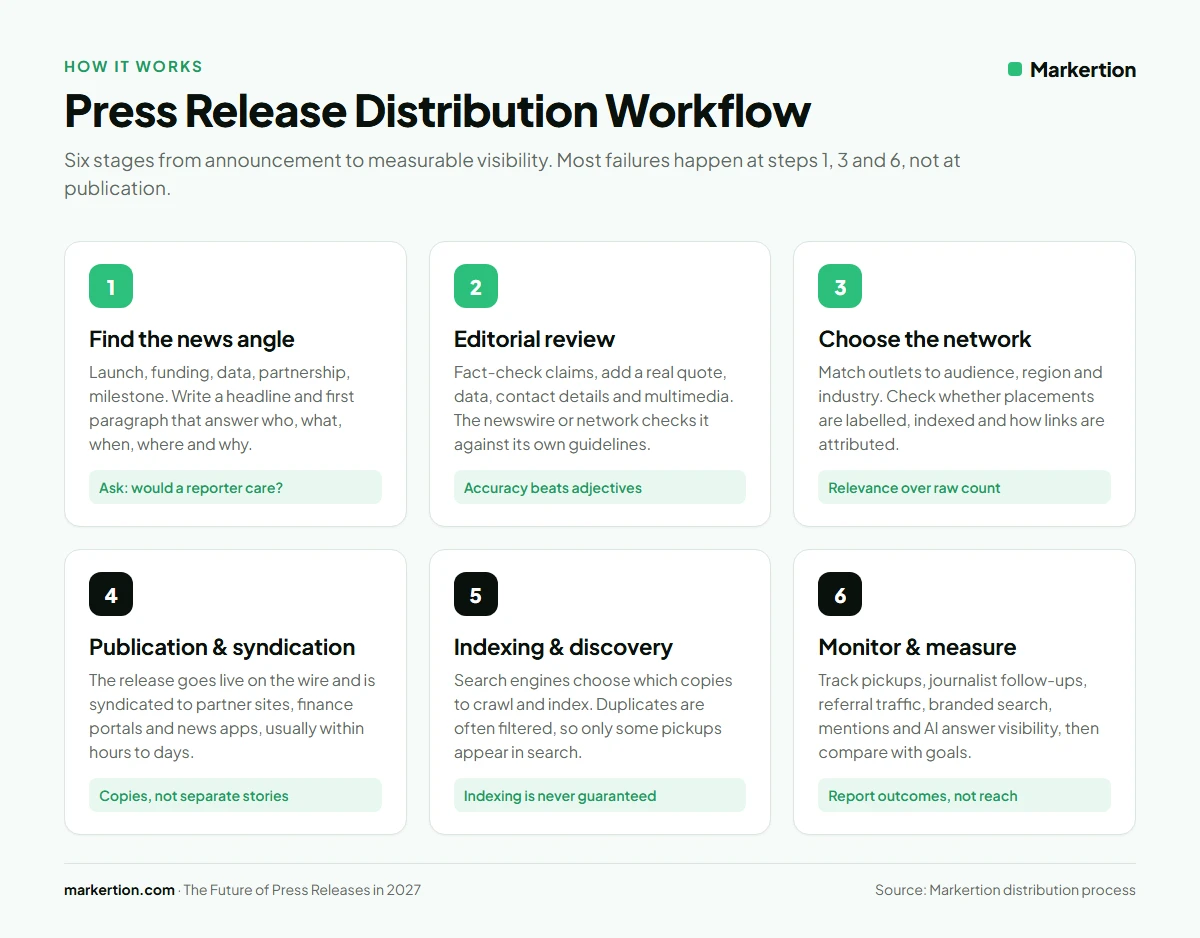
- Writing. Decide the single news angle, then write a specific headline and an opening paragraph that a busy editor could publish as-is.
- Editorial review. Check every claim, number and name. Reputable newswires also review releases against their own guidelines and may reject promotional or unverifiable content.
- Network and publisher selection. Choose distribution by audience, geography and industry: national or regional news, finance portals, trade publications, local TV news sites, journalist databases and terminals.
- Publication and syndication. The release goes live on the wire and is syndicated to partner sites, usually in a “press release” or partner section, often within hours.
- Indexing and discovery. Search engines decide which copies to crawl and index. Because syndicated copies are near-duplicates, many are filtered from results.
- Monitoring and reporting. A good report lists every live URL, the outlet and its audience, plus anything that happened next: journalist follow-ups, earned stories, traffic and leads.
The report below is a real distribution report from a Markertion client campaign (client name hidden). It is a useful example of what a release can and cannot tell you.
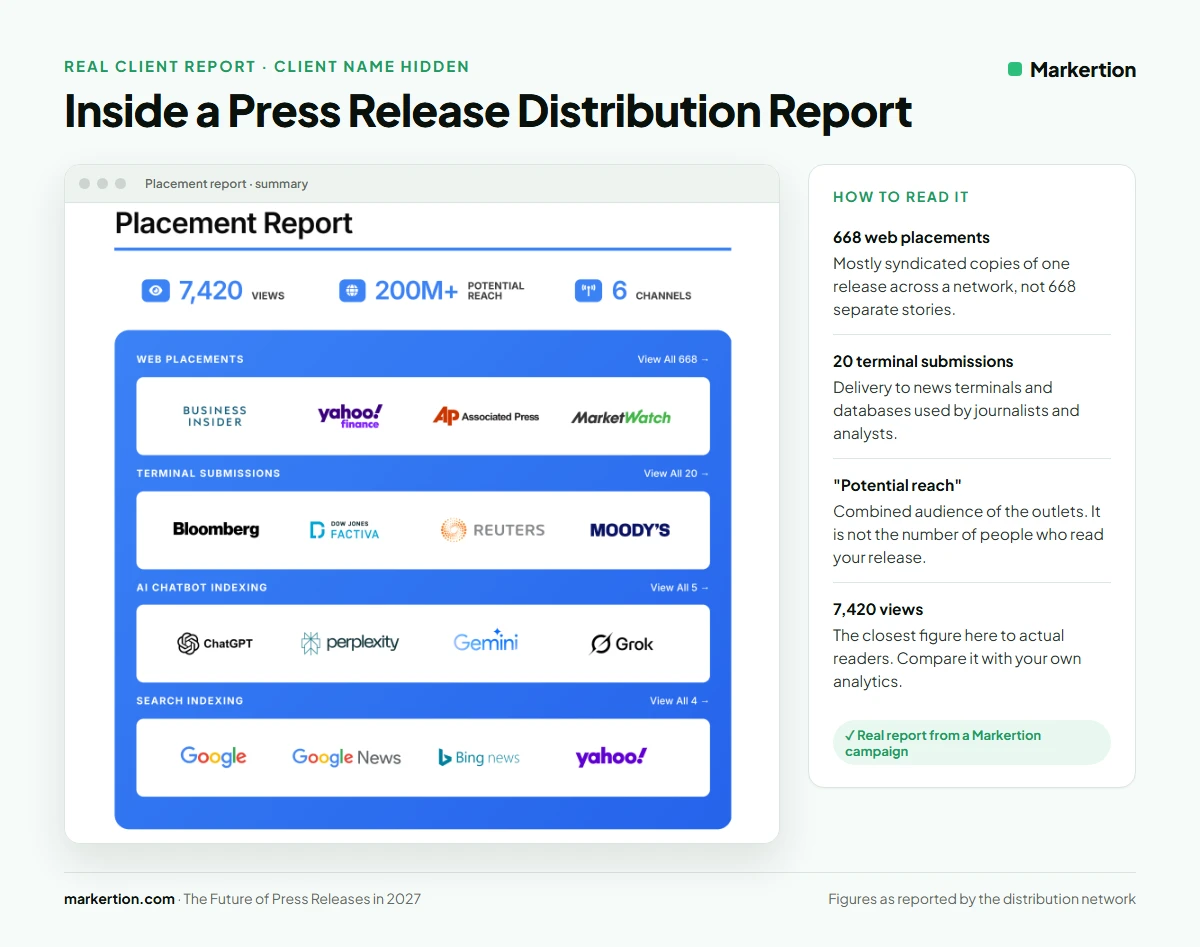
Notice the gap between “200M+ potential reach” and 7,420 views. That gap is normal. Potential reach adds up the audiences of every outlet that carries the release. Views are the closest thing to actual readers. Honest providers report both, and you should judge a campaign by the second number and by what happens next.
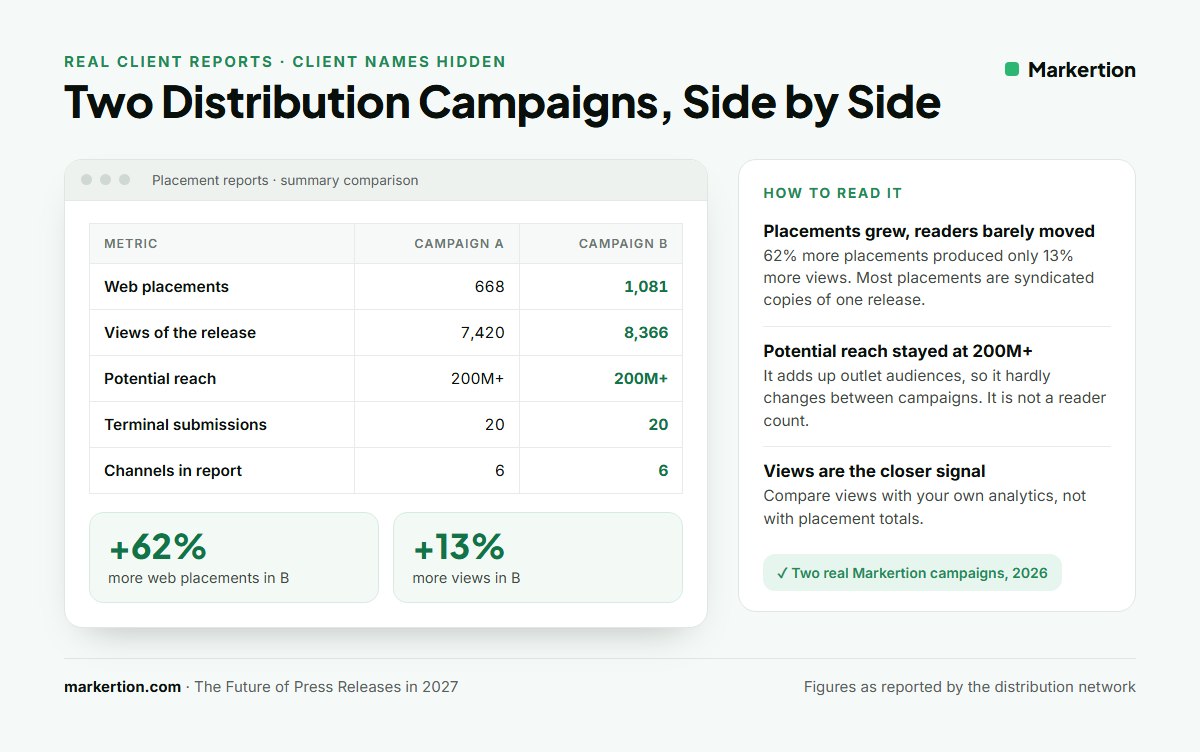
A second campaign gives a useful comparison. Campaign B, for a B2B cold calling company in November 2026, reached 1,081 web placements against Campaign A’s 668, about 62% more. Views rose only 13%, from 7,420 to 8,366. More placements mostly means more syndicated copies of the same release, not proportionally more readers.
Why Press Releases Still Matter in 2027
Brand awareness and media exposure
A distributed release appears on sites people already trust, such as finance portals and local news sites. For a startup or a company entering a new market, that is often the first time its name appears next to recognized publishers.
Credibility
Prospects, investors and journalists search for a company before they engage with it. Finding a clear, dated announcement on recognized sites, matched by the same facts on your own website, builds confidence. Google’s guidance on helpful, reliable, people-first content notes that of the E-E-A-T aspects, “trust is most important”. Consistent, verifiable facts across the web are one of the clearest trust signals you can control.
Search visibility
Releases can rank for branded and news queries (your company name plus “funding”, “launch” or “partnership”) and appear in news surfaces. They rarely rank for competitive non-branded terms, and they should not be bought for that purpose.
A structured record for business announcements
When something material happens, the release becomes the source everyone else quotes. That matters more as AI tools summarize your company: an accurate primary source reduces the chance that an assistant repeats outdated or wrong information.
Digital footprint
Every release adds dated, factual mentions of your brand, people and products across the web. Over time, that footprint helps search engines and AI systems connect your brand to the topics you work in.
Press Release Distribution vs Digital PR: What Is the Difference?
Press release distribution publishes your announcement, in your words, across a network. Digital PR earns independent coverage by persuading journalists and editors that your story, data or expertise is worth writing about. One is fast and controlled. The other is slower, less predictable and usually more valuable.
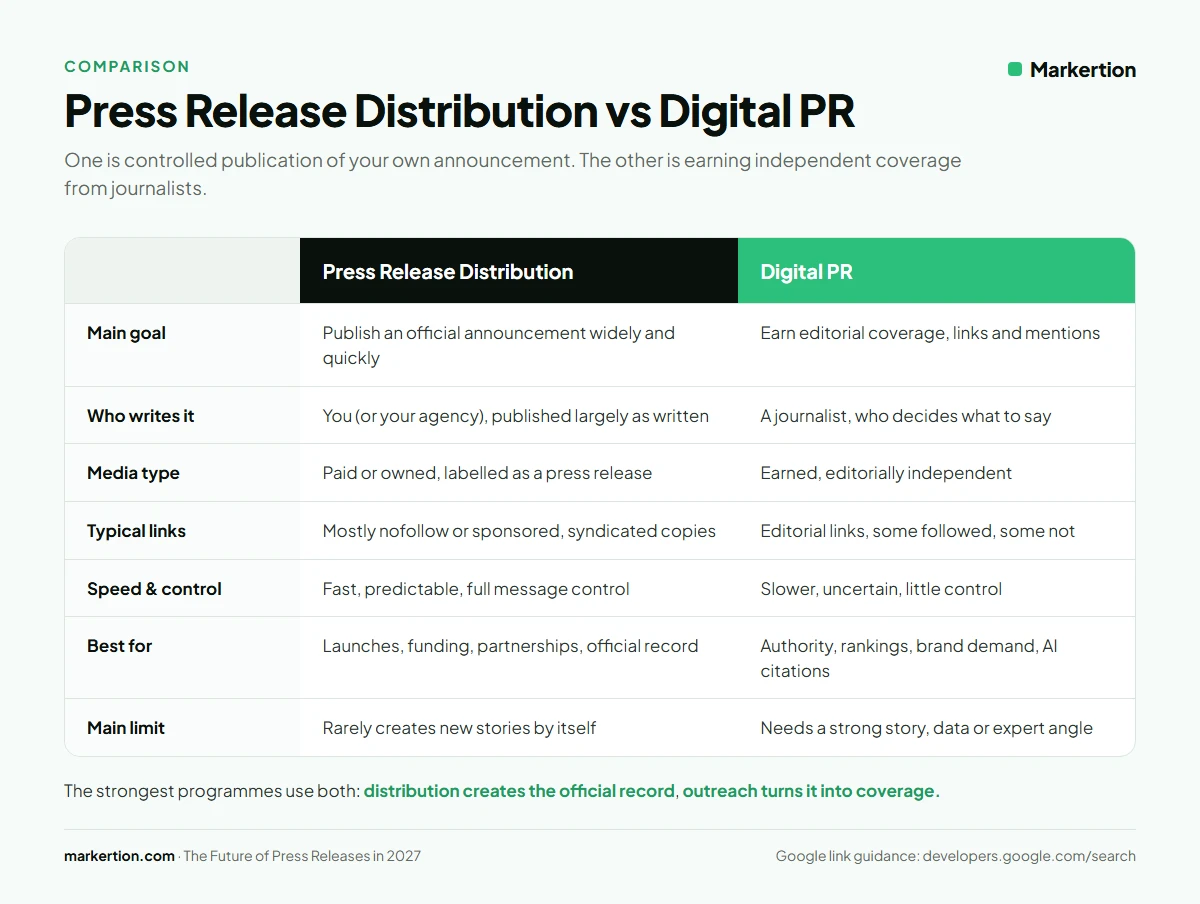
| Factor | Press release distribution | Digital PR |
|---|---|---|
| Objective | Publish an official announcement widely and quickly | Earn editorial coverage, links, mentions and authority |
| Distribution method | Newswire and syndication network | Targeted pitching to journalists, reactive PR, data stories |
| Media relationships | Not required | Central: research, relevance and trust with reporters |
| Editorial outreach | Optional follow-up | The core activity |
| Typical results | Hundreds of labelled pickups, mostly nofollow or sponsored links, brand mentions | Fewer pieces, but original articles with editorial links and quotes |
| Benefits | Speed, certainty, message control, official record | Authority, rankings support, brand demand, AI citations |
| Limitations | Little direct SEO value; reach is often overstated | Needs a strong story; outcomes cannot be guaranteed |
| Use it when | You have real news that must be on the record now | You want to be cited and trusted in your industry |
In practice they work best together. The release establishes the facts; outreach gives reporters a reason to cover them. If you are planning outreach, our guide to earning links from news sites with Digital PR covers the pitching side in detail, and these data-driven PR campaign ideas show the kinds of stories journalists pick up.
Press Releases and SEO: What Actually Works?
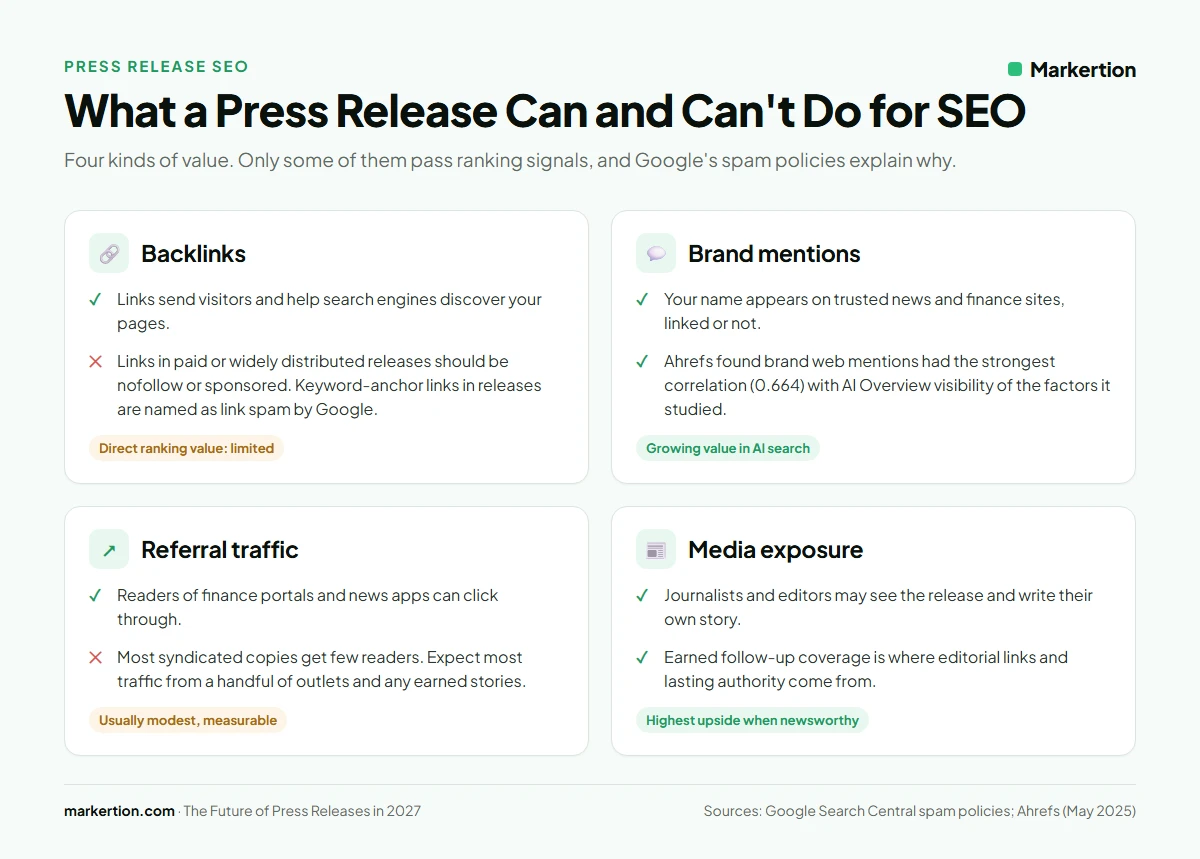
Press releases help SEO indirectly, through brand mentions, discovery, referral traffic and the earned coverage they can trigger. They do not reliably help through the links inside the release, and trying to use them that way breaks Google’s rules.
Backlinks and what Google says
Google’s spam policies define link spam to include “buying or selling links for ranking purposes”, advertorials where payment is received for articles with links that pass ranking credit, and “links with optimized anchor text in articles, guest posts, or press releases distributed on other sites.” The same page says it is not a violation to have such links “as long as they are qualified” with rel="nofollow" or rel="sponsored".
So a press release link is not harmful in itself. A keyword-stuffed anchor in a release syndicated to hundreds of sites, presented as a ranking tactic, is exactly what the policy describes.
Dofollow, nofollow, sponsored and UGC links
Google’s guide to qualifying outbound links defines the attributes:
| Attribute | Meaning | Typical press release use |
|---|---|---|
| No attribute (“dofollow”) | A normal editorial link that can pass ranking signals | Earned articles written independently by journalists |
rel="sponsored" | Advertisements or paid placements. Google says sponsored is preferred for paid links | Paid distribution and paid placements |
rel="nofollow" | Use when other values don’t apply; still acceptable for paid links | Common on newswire and syndicated copies |
rel="ugc" | User-generated content such as comments and forum posts | Rarely relevant |
Practical rule: in a distributed release, use your brand name or the plain URL as anchor text, link to the most useful page (often the announcement on your own site), and expect the link to be qualified.
Referral traffic
Releases can send visitors, especially from finance portals, news apps and the handful of outlets your audience actually reads. Most syndicated copies receive very few readers. Add UTM parameters to your links so you can see which outlets drive visits, and compare the numbers with the reach figures in your report.
Brand mentions, linked and unlinked
A brand mention is any reference to your company online, with or without a link. Semrush’s guide to brand mentions separates linked mentions, which can drive referral traffic and support SEO through backlinks, from unlinked mentions, which build awareness, credibility and entity signals. An unlinked mention in a respected publication is still valuable, and you can sometimes ask the editor to add a link. Our guide to unlinked brand mentions explains how to find and use them.
Realistic SEO expectations
- Expect: faster discovery of new pages, branded search visibility, mentions on trusted sites, some referral traffic, and occasionally journalist follow-up stories.
- Do not expect: rankings for competitive keywords from distribution alone, a jump in Domain Rating from syndicated nofollow links, or guaranteed indexing of every pickup.
Paid Media vs Earned Media
Paid media is coverage you pay to publish. Earned media is coverage a journalist or creator chooses to publish because they find it worth sharing. Owned media (your website, newsroom and newsletter) and shared media (social platforms) complete the picture.
| Paid media | Earned media | |
|---|---|---|
| Examples | Newswire distribution, sponsored articles, paid placements, advertorials | A reporter’s article quoting your CEO, an independent review, inclusion in an editor’s roundup |
| Editorial independence | None or limited; you control the message | Full; the publisher decides |
| Transparency | Should be labelled (press release, sponsored, partner content) | Presented as editorial content |
| Link treatment | Should be qualified as sponsored or nofollow | Editorial links can pass ranking signals |
| Strengths | Certainty, speed, scale | Credibility, authority, influence on AI answers |
| Weaknesses | Lower trust, little ranking value | Unpredictable, slower, needs a real story |
Transparency matters. Most press release pickups and paid placements are labelled, and that is a good thing: readers, search engines and AI systems can tell what kind of content they are looking at. At Markertion, paid media placements are described as paid editorial placements, and we explain Google’s link policies to clients before work begins.
The difference also shows up in AI answers. Muck Rack’s May 2026 “What Is AI Reading?” analysis of more than 25 million links cited by ChatGPT, Claude and Gemini attributes 84% of citations to earned media and 0.3% to paid and advertorial content, with journalism alone accounting for 27%. Note that Muck Rack’s “earned” category is broad: it includes journalism, academic research, government sources, encyclopedic sites and third-party corporate content.
Press Releases and AI Search Visibility
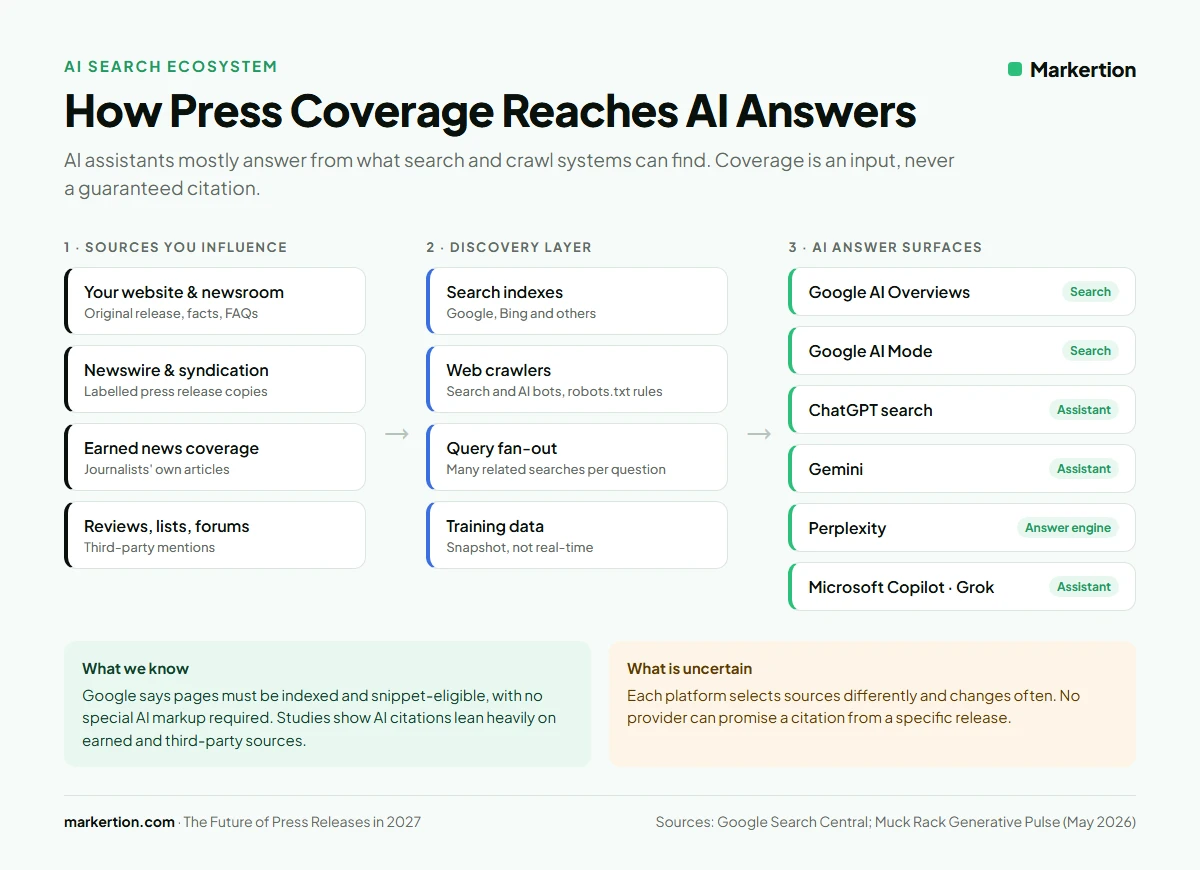
AI search tools answer questions using content they can retrieve from search indexes and the web, plus what their models learned in training. A press release can contribute to that pool of information, but no one can guarantee that a particular release will be cited.
Google AI Overviews and AI Mode
Google’s page on AI features and your website is direct: “There are no additional requirements to appear in AI Overviews or AI Mode, nor other special optimizations necessary.” A page must be indexed and eligible to be shown in Search with a snippet. Google also explains that both features may use a “query fan-out” technique, running several related searches across subtopics to build an answer, and that traffic from these features is included in Search Console’s Performance report under the “Web” search type.
Google’s guide to optimizing for generative AI features adds that “the best practices for SEO continue to be relevant” and that you don’t need new machine-readable files, AI text files or special markup. In other words, a press release earns AI visibility the same way any page does: by being indexable, useful, and supported by trustworthy sources.
ChatGPT, Gemini, Perplexity, Microsoft Copilot and Grok
Assistants that search the web retrieve pages through search indexes and their own crawlers, then summarize and cite them. Each platform chooses sources differently and changes often. Two things are reasonably well supported by research:
- Earned and third-party sources dominate citations. See the Muck Rack data above.
- Brand mentions correlate with AI visibility. In Ahrefs’ analysis of 75,000 brands (May 2025), branded web mentions showed the strongest correlation with AI Overview visibility (0.664), ahead of branded anchors (0.527) and branded search volume (0.392), while backlinks showed a much weaker correlation (0.218). Ahrefs is clear these are correlations, not proof of cause.
For a deeper look at how assistants pick sources, read what sources LLMs trust.
What the distribution reports say, and what they mean
Many distribution reports now include an “AI chatbot indexing” section. Here is one from the same real client campaign shown earlier.
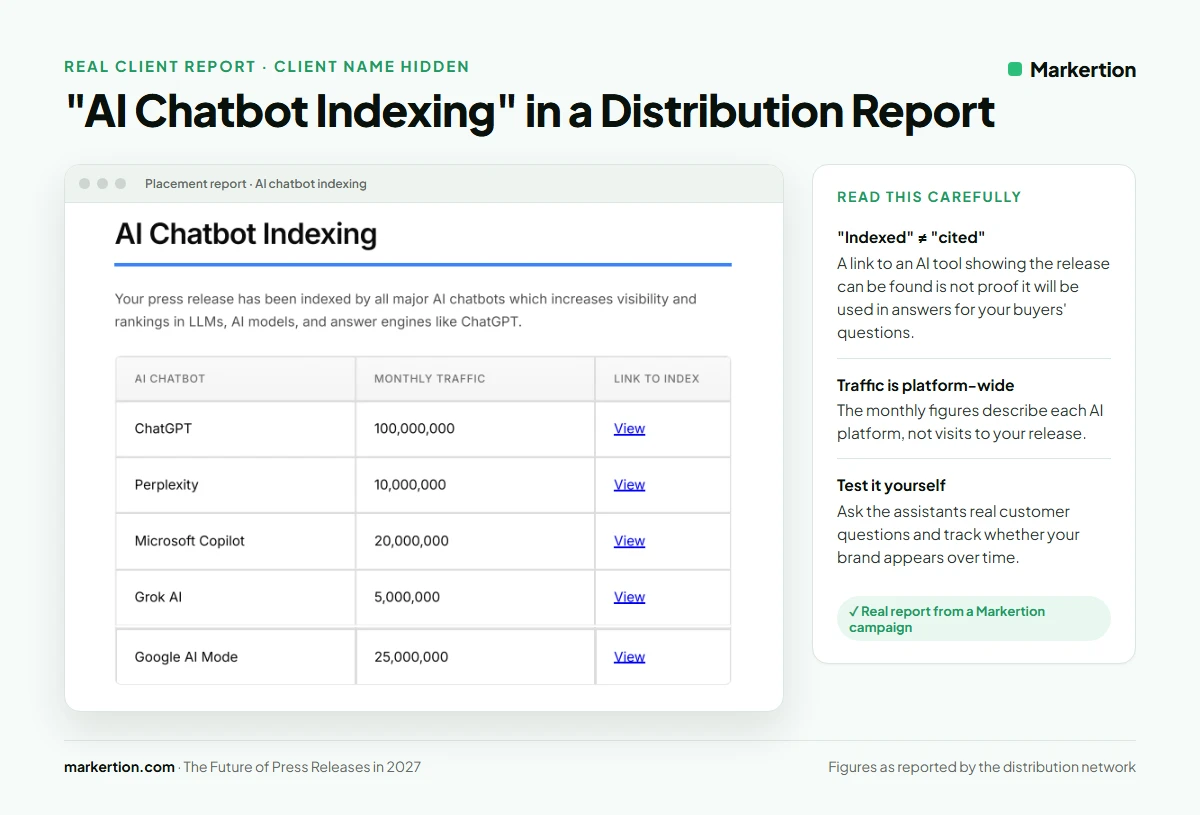
Read these sections carefully. Showing that an AI tool can find a release when asked about it is not the same as being cited when a customer asks a real buying question. The traffic numbers belong to each platform as a whole. The useful test is to ask the assistants the questions your buyers ask, before and after a campaign, and track whether your brand appears.
A second example: tracking real questions, 24 hours after release
In November 2026 we distributed a release for a B2B cold calling company announcing its expansion across the US and Canada. The 24-hour report tracked 16 questions across ChatGPT, Gemini, Perplexity, Microsoft Copilot and Google’s AI features, and captured a screenshot each time the release surfaced in an answer. It logged 56 such answers.
Splitting those answers by question type shows why the test above matters:
| Question type | Example question | AI answers |
|---|---|---|
| General buyer questions that did not name the brand | “What are the top cold calling services for B2B companies in the US and Canada?” | 11 |
| Questions about facts in the release | “Which company added 50+ sales representatives for outbound prospecting?” | 21 |
| Questions that named the brand | “What is [brand]’s approach to managing outbound campaigns?” | 24 |
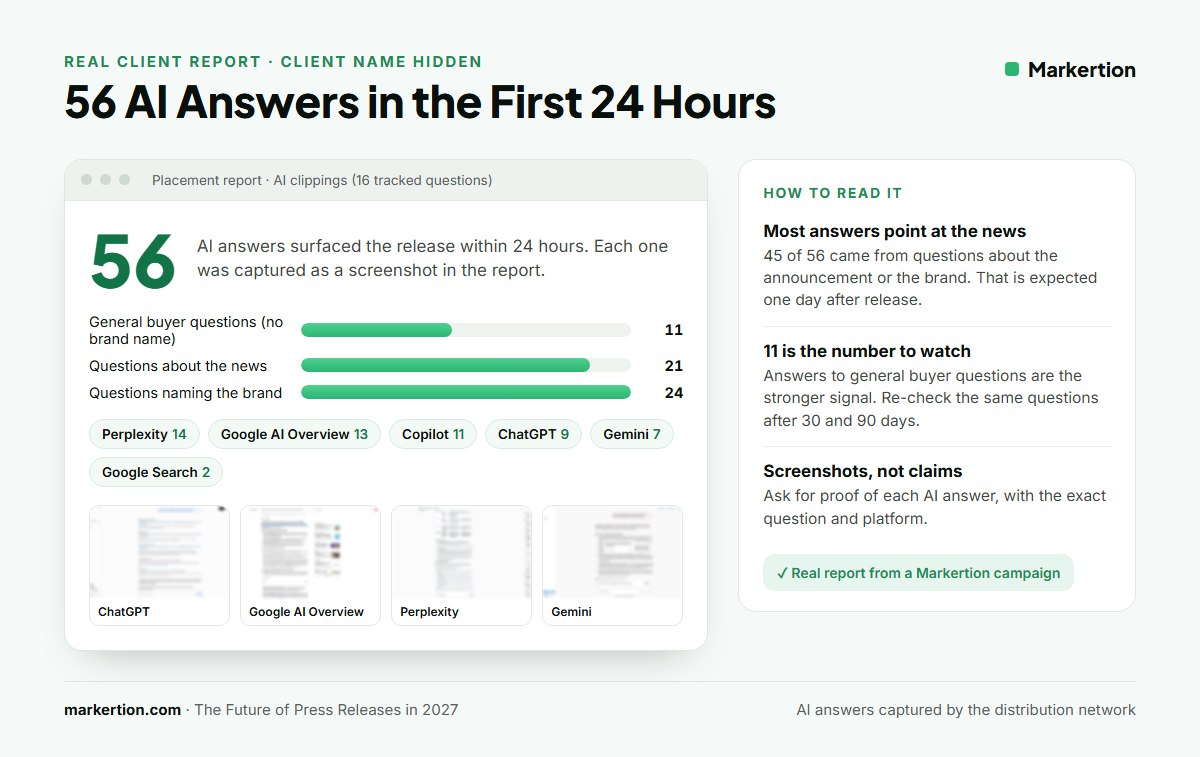
Most answers came from questions that pointed at the announcement itself, which is expected for a release that is one day old. The 11 answers to general buyer questions are the more meaningful signal, and the number worth re-checking after 30 and 90 days. The same report listed 6+ AI citations, 110+ AI index hits and 50+ AI training hits. Those figures come from the distribution partner, and we cannot verify them independently.
What is known and what remains uncertain
| Known | Uncertain |
|---|---|
| Google’s AI features rely on its core Search systems and indexed pages | How each assistant weights press releases vs news articles |
| No special markup or llms.txt file is needed for Google Search | How long a release influences answers after publication |
| Earned and third-party sources make up most AI citations in published studies | Whether syndicated copies add value beyond the first few trusted outlets |
| Brand mentions correlate with AI Overview visibility | Whether mentions cause visibility, or both reflect brand strength |
GEO, AEO and LLM Optimization Explained
What is GEO (Generative Engine Optimization)?
GEO is the practice of making your brand and content more likely to be accurately represented and cited in AI-generated answers, such as Google AI Overviews, ChatGPT and Perplexity. It focuses on being a credible, clearly stated source that AI systems can find and trust.
What is AEO (Answer Engine Optimization)?
AEO is the practice of structuring content so it directly answers specific questions, for featured snippets, voice assistants and AI answers. It favors question-led headings, short direct answers, definitions, lists and tables. Our AEO checklist covers the details.
What is LLM optimization?
LLM optimization (sometimes called LLM SEO) is a broader label for improving how large language models describe your brand, whether through live retrieval or training data. In practice it overlaps almost entirely with GEO.
How they relate to traditional SEO
They are extensions of SEO, not replacements. Google says SEO best practices remain relevant for its AI features. The differences are in emphasis: GEO puts more weight on off-site reputation (mentions, reviews, coverage) and on entity consistency; AEO puts more weight on answer formatting. See GEO vs SEO for a side-by-side comparison.
What businesses can realistically do
- Publish the original, detailed version of every announcement on your own site, with clear headings and a short summary.
- Keep company facts (name, description, founders, locations, products, numbers) consistent everywhere.
- Earn coverage and mentions on publications your industry trusts, not just syndicated copies.
- Use clear, descriptive headlines and answer the obvious questions in the release itself. PR Newswire’s 2026 survey found 57% of communicators now write clearer, more descriptive headlines and roughly 40% answer key questions directly in the release.
- Track AI answers for a fixed set of prompts over time. Our list of AI visibility tracking tools can help.
Why there are no guaranteed AI citations
AI answers are generated per query, vary by user and location, and change as models and indexes update. Even the communicators in PR Newswire’s survey are unsure: only 13% felt very confident their releases are being seen or cited by AI search tools, and 11% don’t measure it at all. Anyone promising specific AI citations from a press release is promising something they do not control.
What Makes a High-Quality Press Release?
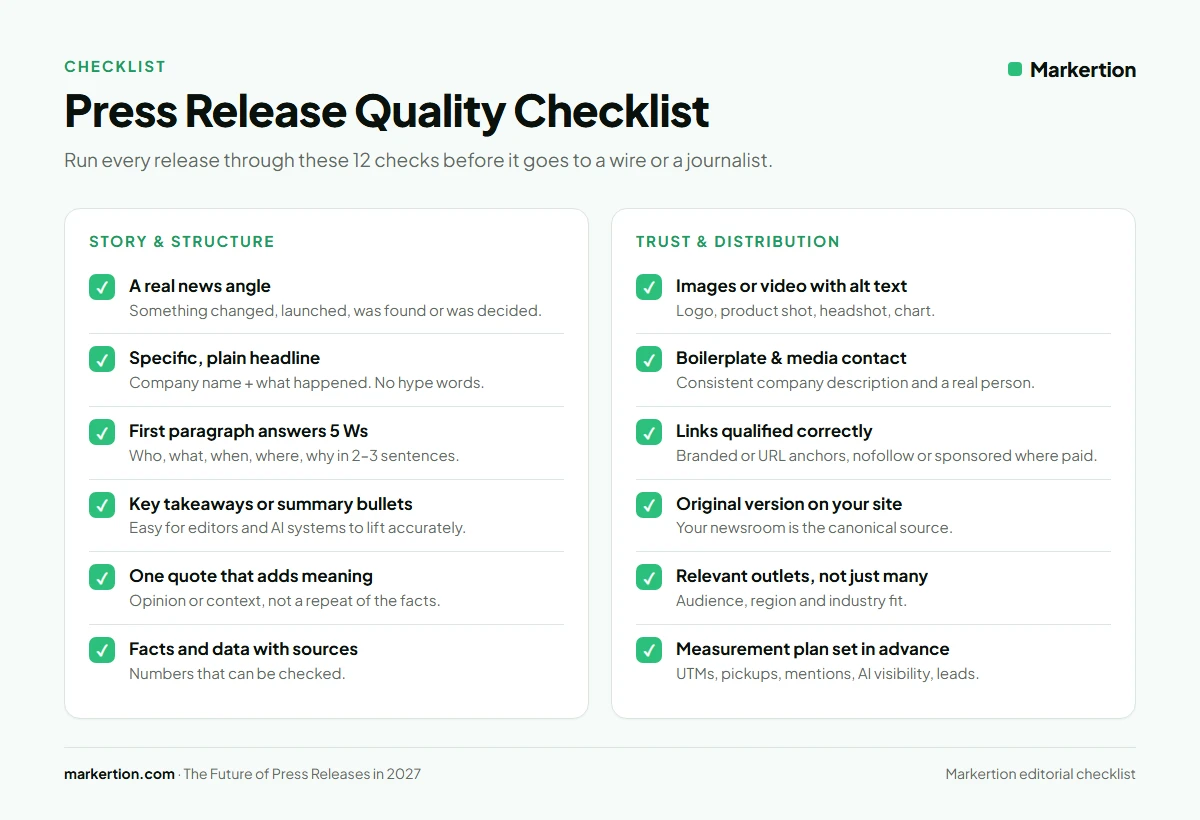
A high-quality press release contains genuine news, states it plainly in the first two sentences, backs it with checkable facts, and is easy for a journalist, a reader or an AI system to quote accurately.
Newsworthiness
Ask what changed. Something launched, was discovered, was decided, was funded or was measured. Timeliness, impact on a defined audience, novelty, local relevance and notable people all make news. “We updated our website” usually does not.
Headline
Name the company and the news in plain words: “Acme Raises $12M Series A to Expand Payroll Software to Canada” works; “Acme Revolutionizes the Future of Work” does not. PR Newswire’s respondents ranked the headline as the most important element of a release.
Opening paragraph
Answer who, what, when, where and why in two or three sentences. Many outlets and AI summaries rely heavily on this paragraph.
Supporting information
Add context: why it matters, who it is for, availability, pricing, and a short “key takeaways” list if the news is complex.
Quotes
A good quote adds opinion, meaning or vision, not a restatement of the facts. Attribute it to a real, named person with a clear role.
Facts and statistics
Every number needs a source and a date. If you publish original data, explain the method and sample size, because journalists will ask.
Images and multimedia
Include a product image, logo, headshot, chart or short video, each with descriptive alt text. In the 2026 PR Newswire survey, 49% of communicators always include multimedia and 46% sometimes do.
Contact details and boilerplate
Give a real media contact and a consistent company description. The boilerplate is one of the most repeated descriptions of your company on the web, so keep it accurate and identical to your website’s “About” text.
Editorial quality
No hype, no superlatives you cannot prove, no keyword stuffing. If you use AI to draft (70% of communicators globally now use generative AI for some part of release content, according to PR Newswire), a human should verify every fact before it goes out.
How to Choose a Press Release Distribution Service
Ask these questions before you buy:
| Criterion | What to ask | Good sign |
|---|---|---|
| Publisher quality | Which named outlets are included in my package? | A specific outlet list, not just “500+ sites” |
| Relevant audiences | Do the outlets reach my customers or industry? | Industry, finance, tech or regional options |
| Geographic reach | Can I target the countries or cities that matter? | National, regional and local choices |
| Editorial standards | Is the release reviewed? What gets rejected? | Clear content guidelines |
| Indexing history | Can I see past reports with live, indexed URLs? | Recent sample reports you can click through |
| Link attributes | How are links in pickups marked? | An honest answer, usually nofollow or sponsored |
| Transparency | Are pickups labelled as press releases? | Yes, labelled sections on each outlet |
| Reporting | What do I receive after distribution? | Every URL, plus views and next-step outcomes |
| Pricing | What exactly does each tier add? | Clear differences in outlets and services |
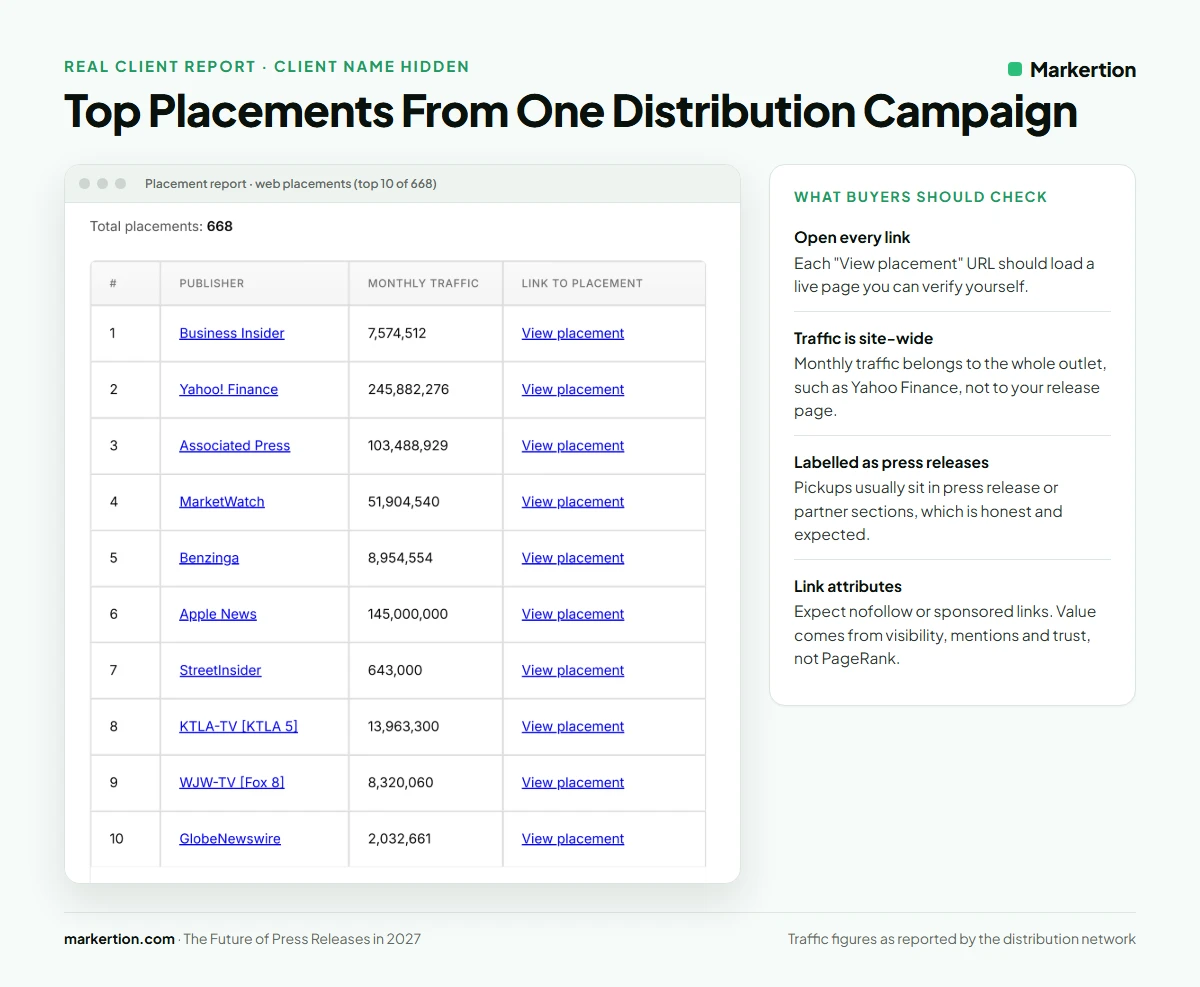
Here are the top placements from the real campaign report shown earlier. This is the level of detail you should expect: named outlets, a working link for each placement and the traffic source of every figure.
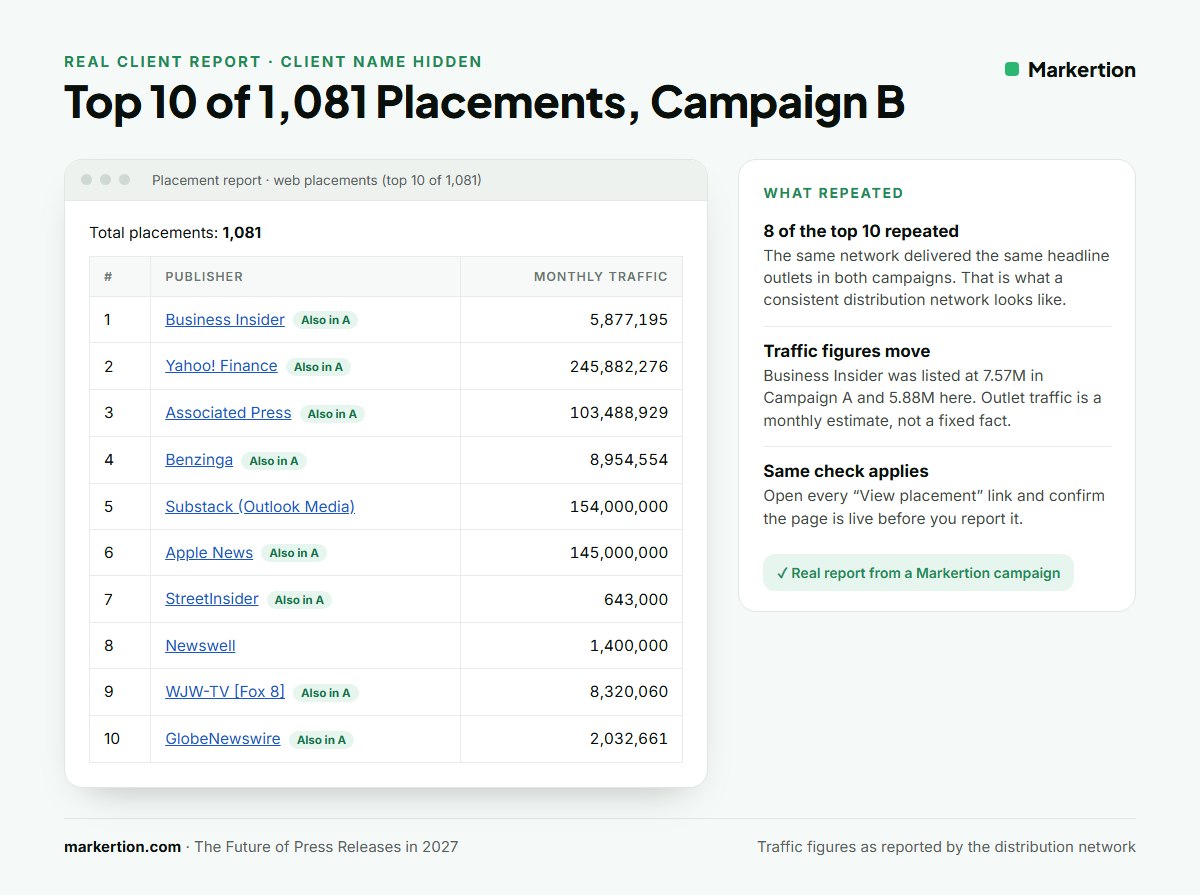
Campaign B’s report showed the same pattern. Eight of its top 10 outlets also appeared in Campaign A’s top 10, which is what a consistent distribution network looks like. The traffic figures moved between reports, a reminder that outlet traffic is a monthly estimate.
To compare providers, see our review of the best press release distribution sites, or look at what is included in Markertion’s press release distribution service.
Cheap vs Premium Press Release Distribution
The price difference usually reflects which outlets are included, how they are selected and how honestly results are reported.
| Typical low-cost network | Typical premium distribution | |
|---|---|---|
| Outlets | Large numbers of little-known “news” sites | Named wires, finance portals, recognized news brands |
| Audience | Little or no real readership | Real, measurable audiences |
| Editorial review | Minimal | Guidelines enforced; promotional copy may be rejected |
| Reporting | Big reach numbers, few verifiable URLs | Every placement listed and checkable |
| Risk | Spammy footprint, irrelevant placements | Low, if links are qualified correctly |
Warning signs
- Promises of “dofollow backlinks” from hundreds of news sites, or guaranteed rankings.
- Guaranteed AI citations or “guaranteed ChatGPT placement”.
- Networks of sites with no original journalism, no named staff and generic templates.
- Reports that show logos but not live URLs.
- Placements on sites unrelated to your country, language or industry.
Duplicate content
Syndication means the same text appears on many sites. That is expected and is not a penalty in itself, but search engines usually show only one or a few versions. Publish the original on your own newsroom first so it is the most complete version, and do not expect every copy to rank.
What buyers should investigate
Ask for a recent sample report, open ten random URLs, check whether the pages are indexed (search for the headline in quotes), look at each outlet’s own content and audience, and ask how links are marked. A provider that welcomes these checks is usually one worth working with.
Why Some Press Releases Do Not Get Indexed
Search engines do not index every page they find. Press release copies are especially likely to be skipped because they are near-duplicates published on many sites at once. Common reasons include:
- Duplicate content: Google typically picks one canonical version from a set of near-identical pages and filters the rest.
- Publisher quality: low-quality or spam-heavy sites may be crawled rarely or not indexed at all.
- Technical blocks: some partner pages use
noindex, robots.txt rules, canonical tags pointing to the wire, or heavy scripts that hide content. - Crawlability: pages buried deep in a site with no internal links may not be discovered quickly.
- Thin or promotional content: releases with little real information are less likely to be judged worth indexing.
- Search engine limits: Google’s AI features documentation repeats that a page must first be indexed and snippet-eligible before it can appear, and indexing is never guaranteed.
What helps: a strong original on your own site, distribution to fewer but stronger outlets, real news, and internal links from your site to the announcement.
How to Measure Press Release Success
Set goals before you distribute, then measure results against them, not against “potential reach”. PR Newswire’s 2026 respondents use media pickup (76%), web traffic or engagement (50%), search visibility and SEO rankings (38%), AEO and AI visibility (34%) and social engagement (32%).
| Metric | How to measure | What it tells you |
|---|---|---|
| Media pickups | Distribution report, verified URLs | Where the release appeared |
| Earned coverage | Journalist follow-ups and original articles | Whether the story had real news value |
| Referral traffic | UTM-tagged links in Google Analytics | Which outlets send readers |
| Brand mentions | Mention monitoring tools | Growth in linked and unlinked mentions |
| Search visibility | Search Console branded queries, news results | Whether more people search for and find you |
| AI visibility | Fixed prompt set tracked over time; AI visibility tools | Whether assistants mention or cite you |
| Website engagement | Time on page, conversions from release traffic | Quality of visitors |
| Leads and outcomes | CRM attribution, sales conversations, investor or partner enquiries | Business value |
A simple rule: if a report only shows reach and logos, ask for the URLs, the views and the outcomes.
Real-World Campaign Experience: Markertion Case Study
The clearest way to show how media coverage interacts with search and AI visibility is with real data, including its limits. The example below is a link building and media placement campaign, not a press-release-only campaign, so it should be read as evidence for the broader approach rather than for distribution alone.
The campaign
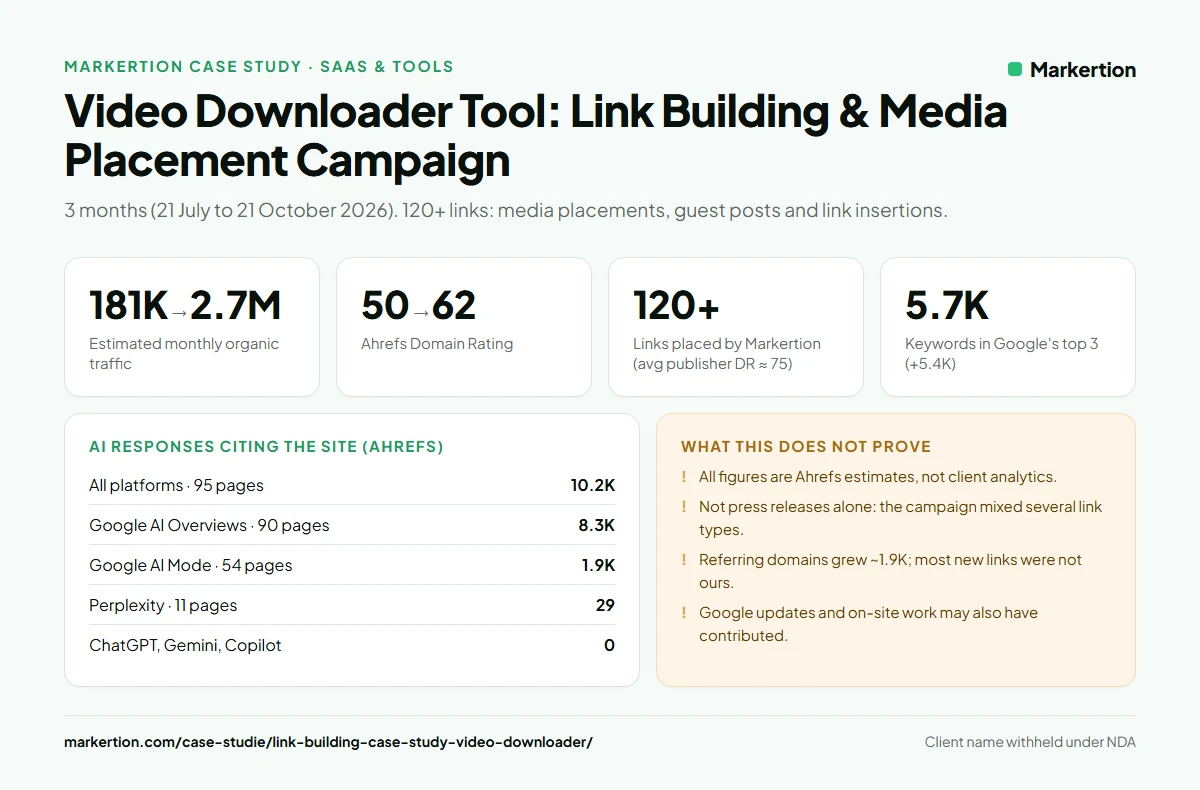
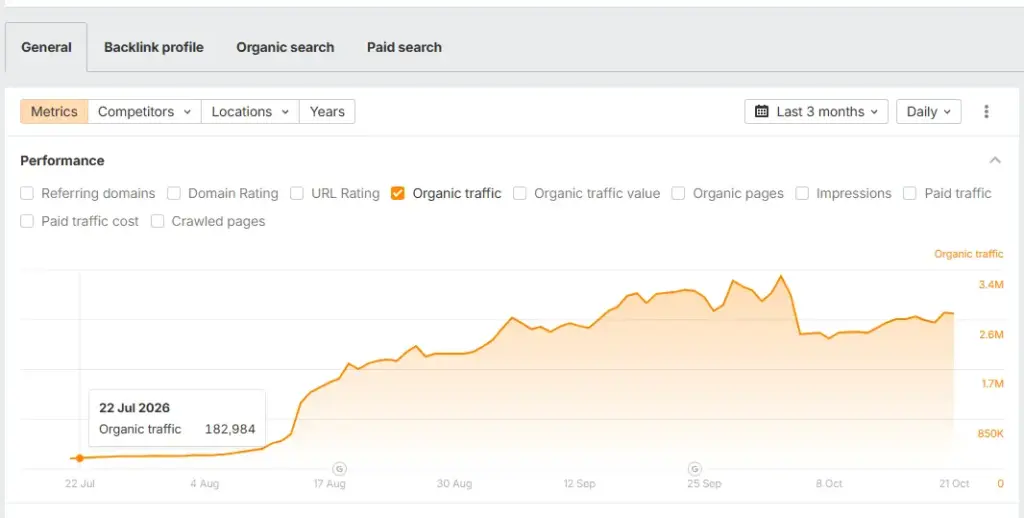
An online video downloader tool came to us with roughly 181K estimated monthly organic visits and a Domain Rating of 50, competing for very high-volume keywords in India, Indonesia and the USA. Over three months (21 July to 21 October 2026), we placed 120+ links: media placements on news, tech and business sites, plus guest posts and link insertions. Average publisher DR was about 75. Most media placements were paid editorial placements on vetted publishers, chosen for relevance and real traffic. No PBNs, link farms or spam directories were used.
The results (Ahrefs estimates)
- Estimated organic traffic: 181K to 2.7M per month (+1,391%).
- Domain Rating: 50 to 62.
- Ranking keywords: 17K, with 5.7K in Google’s top 3.
- AI responses: 10.2K across 95 pages, including 8.3K in Google AI Overviews (90 pages), 1.9K in Google AI Mode (54 pages) and 29 in Perplexity (11 pages). Ahrefs showed zero responses for ChatGPT, Gemini and Copilot in the same report.
What the data shows, and what it does not
- Estimates, not analytics. All traffic and keyword figures come from Ahrefs and will differ from the client’s own analytics. Traffic value is not revenue.
- No single cause. Google updates, on-site changes and existing momentum may also have contributed. We cannot isolate link building as the only cause.
- Not press releases alone. The campaign mixed media placements, guest posts and link insertions.
- Most new links were not ours. Referring domains grew by about 1.9K over the period; we placed 120+.
- AI visibility was uneven. Nearly all AI responses came from Google’s AI features. That fits Google’s statement that its AI features are rooted in its core Search systems: better search visibility tends to show up in Google AI surfaces first.
- Short time frame. Three months is not enough to prove long-term stability.
Read the full video downloader link building case study, or browse more Markertion case studies.
A press-release-only campaign (November 2026)
The campaign above mixed several tactics. For a cleaner read on distribution alone, here is a single press release for a B2B cold calling company, measured 24 hours after it went live:
- 1,081 web placements, including Business Insider, Yahoo Finance, AP and Benzinga
- 9 podcast platforms, 6 of them live within 24 hours
- 20 newsroom terminal submissions, including Bloomberg, Dow Jones Factiva and Thomson Reuters
- 56 AI answers across 16 tracked questions, 11 of them for general buyer questions that did not name the brand
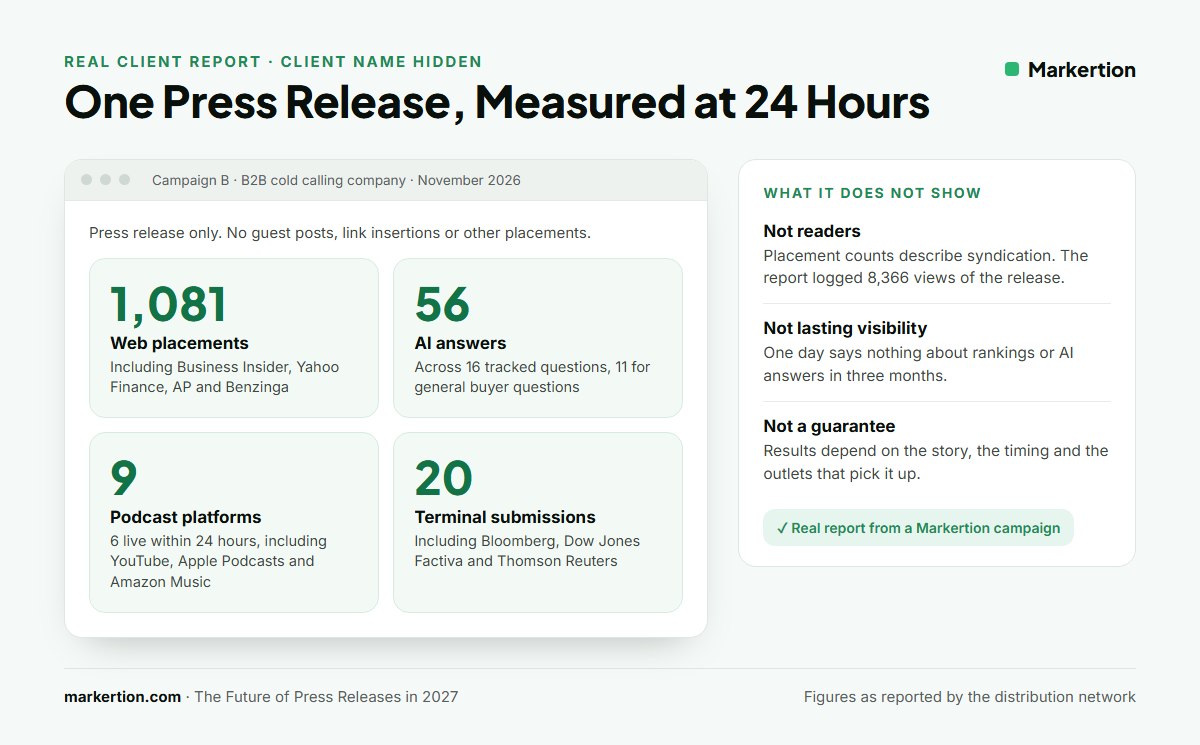
What it does not show: placement counts describe syndication, not readers, and one day says nothing about lasting search or AI visibility. The useful follow-up is to re-run the same 16 questions after 30 and 90 days.
Press Release Strategy for Different Businesses
SaaS companies
Announce meaningful launches, integrations, funding and original usage data. Pair releases with outreach to tech and industry journalists, and make sure product pages, documentation and comparison pages are strong enough to deserve the traffic. Combine distribution with SaaS link building for the editorial links that releases cannot provide.
Startups
Your first releases (launch, funding, first major customer) build a credible footprint for investors, recruits and AI assistants that have little else to say about you. Keep facts consistent across your site, LinkedIn, Crunchbase-style profiles and coverage.
E-commerce brands
Product news alone is rarely newsworthy. Focus on data stories, seasonal trends, charity and community work, and new market launches. Measure referral traffic and branded search, not just pickups.
Established businesses
Use distribution for official announcements and disclosures, and invest more in Digital PR, thought leadership and expert commentary. Monitor how AI assistants describe your company and correct outdated facts at the source.
Agencies
Announce client results (with permission), research, hires and awards. If you resell distribution, be transparent with clients about link attributes and reach. White label services can cover delivery while you own the strategy.
Local businesses
Regional and local news outlets matter more than national wires. Openings, expansions, events and community work suit local coverage, and consistent name, address and phone details across mentions help local search.
The Future of Press Releases in 2027 and Beyond
The following is our analysis and should be read as informed prediction, not established fact. Where research supports a point, we say so.
1. AI-powered discovery becomes a main audience
Releases will be read by machines as often as by people. Clear headlines, direct answers and key-takeaway sections, which communicators are already adopting according to PR Newswire’s 2026 survey, will become standard.
2. Brand authority outweighs link counts
Research such as Ahrefs’ 75K-brand study points toward mentions, branded demand and reputation as stronger correlates of AI visibility than raw backlinks. Expect PR budgets to shift toward earning credible mentions.
3. Media relationships become more valuable, not less
If earned media makes up the large majority of AI citations, as Muck Rack’s research suggests, then the ability to earn real coverage is a competitive advantage that paid distribution cannot replace.
4. Multimedia and data become expected
Images, charts, video and original data make stories easier to cover and easier to cite. Releases without them will look incomplete.
Audio is part of this. In Campaign B, the release was also converted into a podcast episode and syndicated to 9 platforms, 6 of them live within 24 hours, including YouTube, Apple Podcasts and Amazon Music. Each podcast listing is one more place the story can be found.
5. Distribution quality beats distribution volume
Hundreds of low-value pickups add little. Fewer, more relevant, well-labelled outlets, plus a strong original on your own site, will deliver more.
6. Measurement grows up
Expect reports to move from “potential reach” toward verified views, earned follow-ups, branded search, AI mention tracking and pipeline. Google already includes AI Overviews and AI Mode traffic in Search Console’s Performance report.
New opportunities
- Releases built around original research that journalists and AI tools can cite.
- Newsroom pages designed as the authoritative source for company facts.
- Expert commentary programmes that put named spokespeople in relevant coverage.
- Regular AI answer audits to find and fix inaccurate descriptions of your brand.
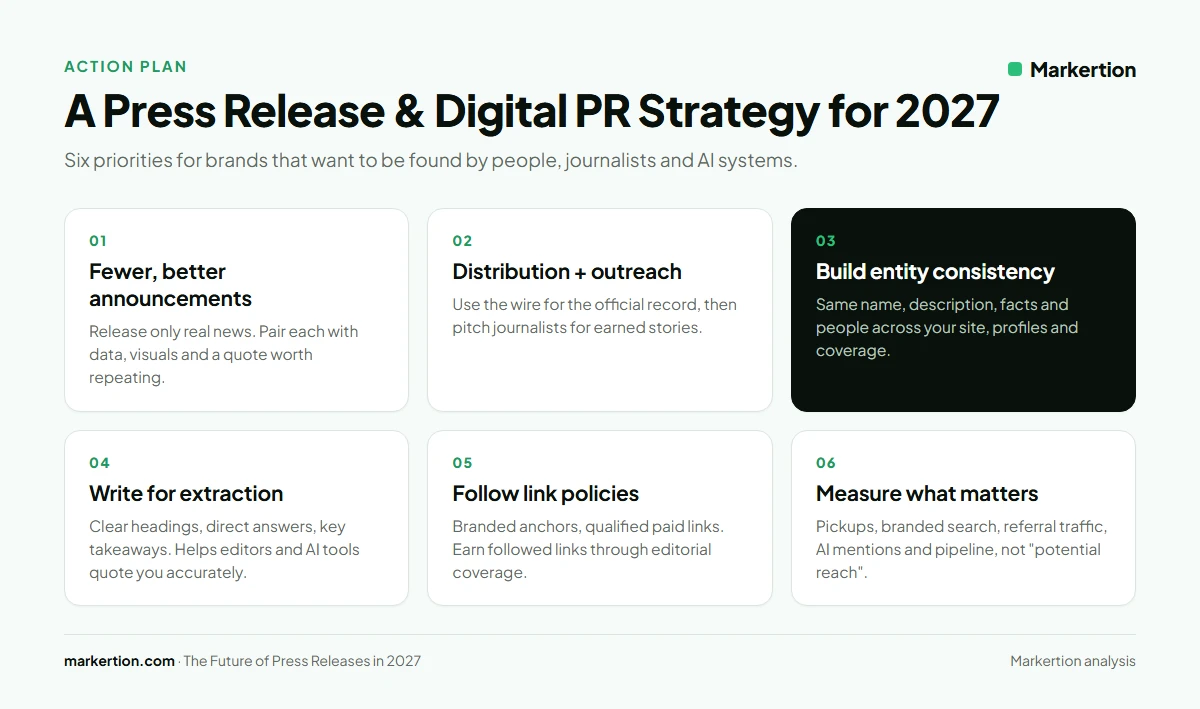
What businesses should prepare for
- Fewer, better announcements, each with a clear news angle.
- A combined plan: distribution for record and reach, outreach for earned coverage.
- Consistent entity information across every channel.
- Link practices that follow Google’s policies.
- Measurement tied to business outcomes.
How Markertion Helps Businesses
Markertion is a Digital PR and link building agency that has worked with SaaS companies, startups, agencies and growing brands since 2021. We combine distribution, outreach and placement so each piece supports the others:
- Press release distribution: professionally written releases distributed to news, finance and local TV news sites, with every placement URL reported.
- Digital PR campaigns: story-led and data-led campaigns that earn journalist coverage and editorial links.
- Media placement: articles published on established news and industry sites, with publisher data shared first and paid placements disclosed as such.
- Brand mentions and listicles: inclusion in relevant industry lists, reviews and roundups.
- SaaS link building: editorial links from relevant tech and SaaS publishers.
- AI search visibility: auditing and improving how your brand appears in AI Overviews, ChatGPT, Gemini and Perplexity.
We do not promise rankings or AI citations. We explain Google’s link policies before work starts, choose publishers for relevance and real audiences, and report results with their limitations. You can read what our clients say or learn more about Markertion.
Looking to improve your brand’s media visibility, digital authority, and online presence? Explore Markertion’s Press Release Distribution and Digital PR services, or book a free strategy call to discuss a realistic plan for your brand.
Frequently Asked Questions
Do press releases still work in 2027?
Yes, for the right goals. They work well for publishing official news quickly, appearing on trusted news and finance sites, building brand mentions and supporting journalist outreach. They do not work as a shortcut to keyword rankings.
Do press releases help SEO?
Indirectly. They can speed up discovery, add brand mentions, send referral traffic and trigger earned coverage. Links inside distributed releases should be nofollow or sponsored and should not be relied on for ranking credit.
Are press release backlinks dofollow?
Links in widely distributed or paid releases should be qualified with rel="sponsored" or rel="nofollow", and most networks do this. Google’s spam policies name optimized anchor text in distributed press releases as link spam.
What is the difference between a press release and Digital PR?
A press release is your own announcement distributed across a network. Digital PR earns independent coverage from journalists through pitching, data stories and expert commentary. Distribution is controlled and fast; Digital PR is earned and usually more valuable.
What is the difference between earned media and paid media?
Paid media is coverage you pay to publish, such as newswire distribution or sponsored articles. Earned media is coverage a journalist or publisher chooses to create independently. Earned media generally carries more trust with readers, search engines and AI systems.
Can a press release appear in Google AI Overviews?
It can, if the page is indexed and eligible for a snippet. Google says there are no additional requirements or special optimizations for AI Overviews or AI Mode. Appearance is never guaranteed.
Can press releases get my brand mentioned in ChatGPT, Gemini or Perplexity?
They can contribute to the information these tools find, especially when a release leads to earned coverage on trusted sites. No provider can guarantee that a specific release will be cited.
Can a press release show up in AI answers within 24 hours?
It can. In one November 2026 campaign, AI assistants surfaced a B2B company’s release in 56 answers within 24 hours, 11 of them for general buyer questions that did not name the brand. Most early answers come from questions about the announcement itself, and results vary by story, so treat early AI pickup as a starting signal, not a guarantee.
What is GEO?
Generative Engine Optimization is the practice of improving how accurately and how often your brand is represented and cited in AI-generated answers, mainly through credible content, consistent brand facts and third-party coverage.
What is AEO?
Answer Engine Optimization is structuring content to answer specific questions directly, using question-based headings, short answers, lists and tables, so search features and AI tools can use it.
What makes a press release newsworthy?
Timeliness, impact on a defined audience, novelty, data, local relevance or notable people. If nothing has actually changed, it is probably not news.
Why didn’t my press release get indexed?
Usually because syndicated copies are near-duplicates and search engines index only some of them, or because partner pages are low quality or technically blocked. Publish a strong original on your own site and favor fewer, better outlets.
How many press releases should a company send?
As many as you have genuine news for. For most small and mid-sized companies, that is a handful of meaningful announcements per year, not a weekly schedule.
How do I measure press release ROI?
Track verified pickups, earned follow-up coverage, UTM referral traffic, branded search, brand mentions, AI visibility for a fixed prompt set, and leads or deals influenced. Compare against the cost and your original goals.
Are cheap press release services worth it?
Often not. Many low-cost networks distribute to sites with little real readership and report inflated reach. Ask for sample reports with live URLs and check the outlets before buying.
Should I write my press release with AI?
AI can help with outlines and drafts, and most communicators now use it for part of the process. A human should verify every fact, name and number and make sure the quote reflects what the spokesperson actually thinks.
Should startups use press release distribution?
Yes, for real milestones such as launch, funding or a major partnership. It creates a credible public record early, which helps with investors, recruits, journalists and AI assistants that otherwise have little to say about a new company.
Conclusion: Preparing Your Press Release Strategy for 2027
Press releases are not dead, but their role has narrowed and sharpened. In 2027 a press release is an official record and a distribution tool. Its value comes from accurate information on trusted sites, brand mentions, and the earned coverage it can lead to, not from the links inside it.
If you take one thing from this guide, make it this: pair every release with a reason for journalists to care. Publish the original on your own site, distribute to relevant outlets with properly qualified links, pitch the story to reporters who cover your space, keep your brand facts consistent, and measure what actually happened rather than what might have happened.
Do that, and press release distribution becomes one part of a stronger system for search, Digital PR and AI visibility. If you would like help planning it, talk to the Markertion team.
Sources
- Google Search Central: AI features and your website
- Google Search Central: Optimizing your website for generative AI features on Google Search
- Google Search Central: Spam policies for Google web search
- Google Search Central: Qualify your outbound links to Google
- Google Search Central: Creating helpful, reliable, people-first content
- PR Newswire: Takeaways from the 2026 State of the Press Release Report and the full report
- Muck Rack via GlobeNewswire: Generative Pulse: Earned Media Consistently Drives AI Citations, Holding at 84% (May 2026)
- Ahrefs: An Analysis of AI Overview Brand Visibility Factors (75K Brands Studied) (May 2025)
- Semrush: Brand Mentions: Complete Guide to Tracking, Measuring & Optimizing
- Cision: 2025 State of the Media Report (survey of 3,000+ journalists)
- Markertion: Video downloader link building case study

Digital PR & Link Building Expert