
AI assistants tend to cite sources that are authoritative, relevant to the exact question, recent, clearly structured and consistent with other trusted pages. In practice that means well-known publications, established review platforms, official brand and product pages, respected industry blogs, reference sites and active community discussions. If you want an assistant to mention your brand, you need to appear on the kinds of sources it already trusts for your topic.
Key Takeaways
- Assistants that search the web mostly cite pages that already rank well and come from trusted domains.
- Different assistants lean on different source types, so a spread of coverage works best.
- Clear structure makes a page easier to quote: definitions, lists, tables and FAQs.
- Consistency across sources matters. Conflicting facts make assistants hedge or skip you.
- You can find the exact sources assistants use for your category and target them directly.
Two Ways Assistants Know About Your Brand
It helps to separate two layers:
- Training data: what the model learned from text it was trained on. This shapes its general knowledge of well-known brands but is fixed at a point in time.
- Live retrieval: when assistants search the web to answer a question, then summarise and cite the pages they found. ChatGPT search, Perplexity, Copilot, Gemini and Google’s AI Overviews all retrieve live sources for many questions.
You cannot easily change training data, but you can influence live retrieval, because it depends on the same web pages and search indexes that SEO and PR already work with. Our guide on how to get cited by AI assistants covers the full process.
The Source Types AI Assistants Rely On
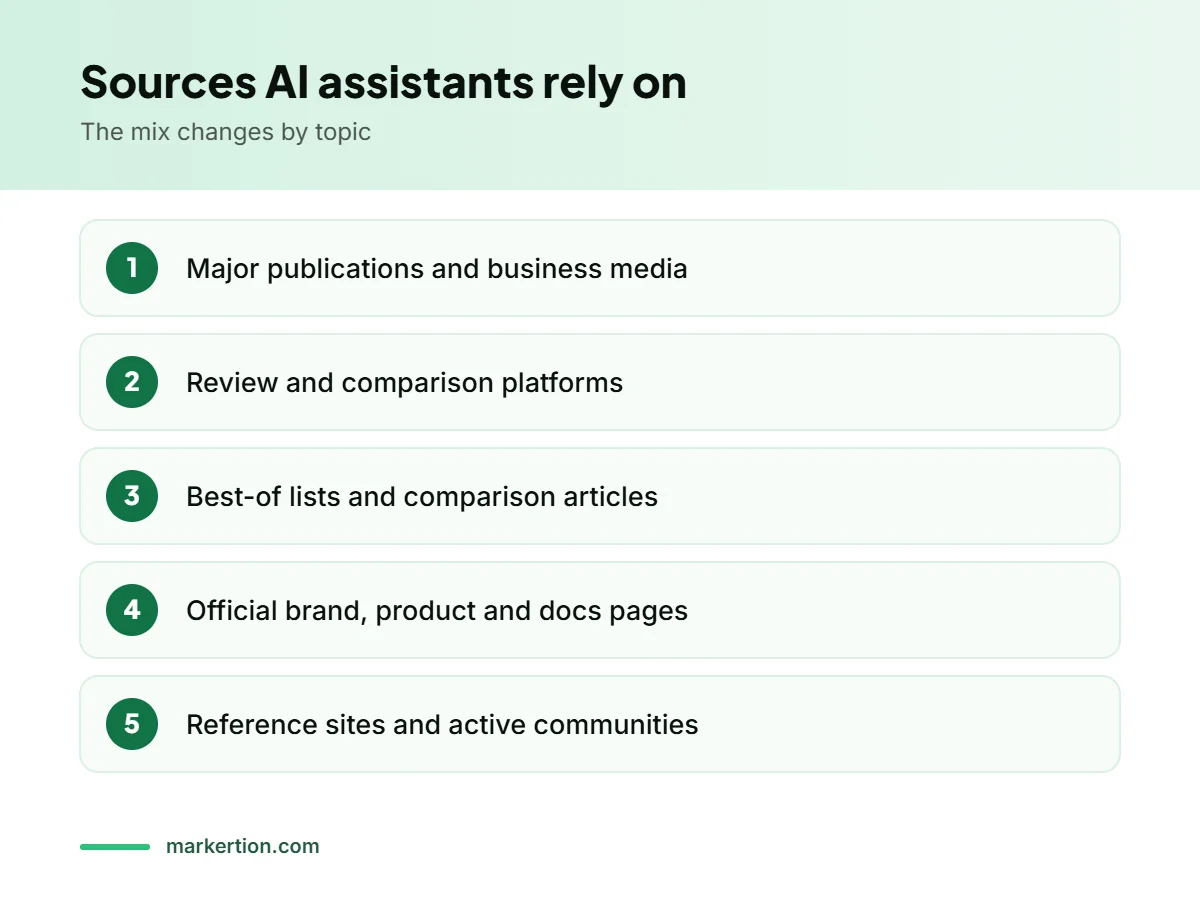
| Source type | Examples | Why assistants trust it |
|---|---|---|
| Major publications | National news, large business and tech media | Editorial standards and strong authority |
| Review and comparison platforms | Software review sites, marketplaces, directories | Structured, many-user opinions |
| “Best X” and comparison articles | Industry blogs and publishers’ roundups | Directly answer recommendation questions |
| Official sites | Brand homepages, product, pricing and docs pages | Primary source for facts about the brand |
| Reference sites | Encyclopedias, knowledge bases, standards bodies | Neutral definitions and background |
| Communities | Forums, Q&A sites and discussion threads | Real user experience and opinions |
| Video and podcasts | Video platforms, transcripts and show notes | Practical demonstrations and expert talk |
The mix differs by topic. For software, review platforms and “best tools” lists dominate. For health or finance, official and reference sources carry more weight. For local services, business profiles, review sites and local news matter most.
What Makes a Source Easy to Cite
Beyond authority, assistants favour pages whose content can be lifted cleanly into an answer:
- A direct answer near the top that makes sense on its own.
- Clear headings that match questions people ask.
- Lists and tables with specific, comparable facts.
- Named entities: brands, products, people and places spelled out clearly.
- Dates and freshness signals for topics that change.
- Structured data that confirms what the page is about. See our schema guide for AI Overviews.
How to Find the Sources Assistants Use for Your Category
- List 20 to 30 buyer prompts such as “best [category] for [audience]” and “[competitor] alternatives”.
- Run them on each assistant and note every cited URL. Perplexity and Copilot show sources clearly; ChatGPT search and Gemini often link them too.
- Group the sources by type: publications, review sites, roundups, communities and official pages.
- Count repeats. Sources that appear across many prompts and several assistants are your highest-value targets.
- Check whether you appear on each one, and how you are described.
AI visibility tools such as those in our list of AI visibility tracking tools can automate much of this.
How to Get Onto Trusted Sources
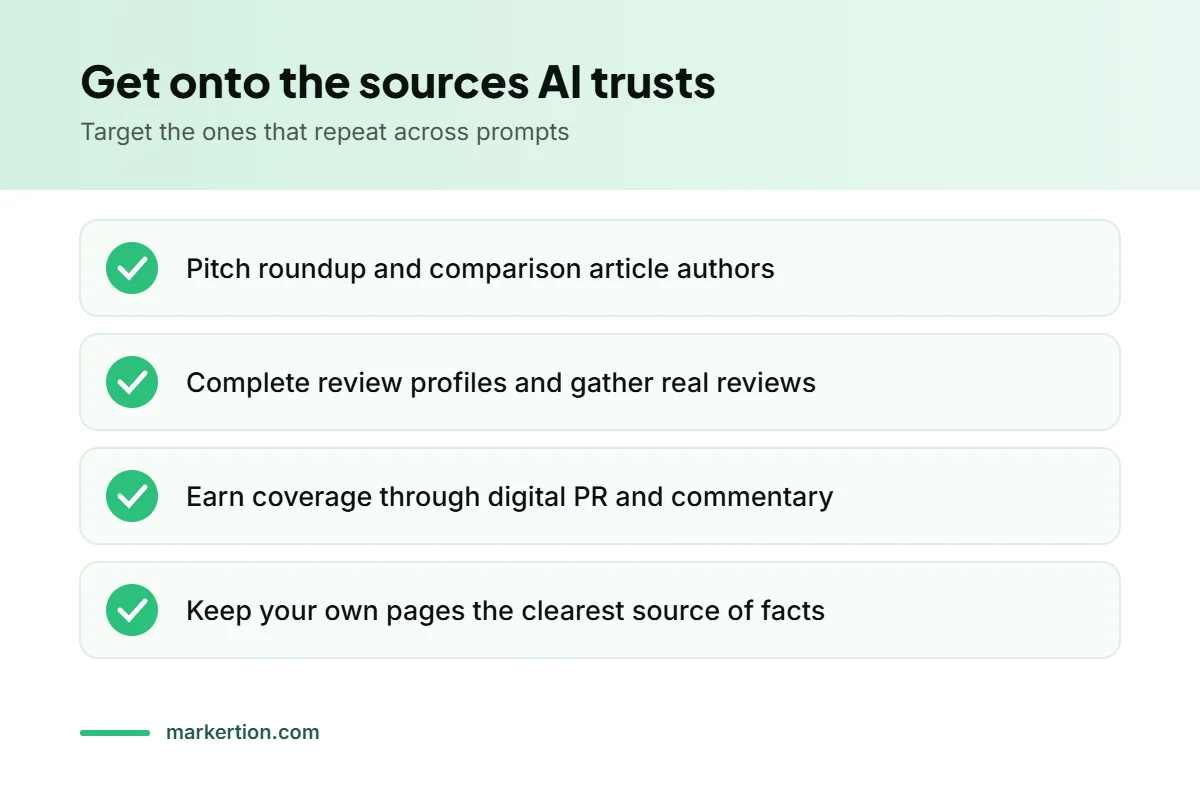
- Roundups and comparison articles: pitch the authors with a clear reason to include you, or ask to be considered when the article is next updated. Our brand mentions service focuses on these placements.
- Review platforms: complete your profiles and ask real customers for reviews.
- Publications: earn coverage through digital PR, data stories and expert commentary.
- Communities: take part genuinely, answering questions where your expertise helps, without spamming links.
- Your own site: make your About, product and pricing pages the clearest, most current source of facts about your brand.
Why Consistency Matters So Much
When an assistant merges several sources, it looks for agreement. If three sources say you serve SaaS companies and two say you are a local web design agency, the assistant may describe you vaguely or not at all. Write one canonical description of your brand, with your services, audience, founding year and key facts, and use it everywhere: your site, social profiles, directories, press releases and partner pages.
Differences Between Assistants
- Google AI Overviews draw on Google’s index and often cite pages that already rank in the top results for the query.
- Perplexity searches the web for most answers and shows many sources, often including forums and newer pages.
- ChatGPT search retrieves web results when browsing is used, combined with what the model already knows.
- Copilot uses Bing’s index, so Bing visibility matters.
- Gemini uses Google’s search and knowledge systems.
Because each one retrieves a little differently, broad coverage across trusted sources is more reliable than optimising for one assistant.
Common Mistakes
- Focusing only on your own website while ignoring third-party sources.
- Publishing self-promotional “best X” lists with yourself at the top and nothing else. Assistants tend to prefer independent sources.
- Inconsistent brand facts across profiles and directories.
- Ignoring Bing, which feeds several assistants.
- Expecting instant results. New mentions need to be crawled, indexed and retrieved before they show up.
A Simple Source Audit You Can Run This Week
If you only have a few hours, this quick audit shows where you stand:
- Pick your five most important buyer prompts.
- Run each one on Perplexity, ChatGPT with search, Gemini and Copilot, and note every cited URL.
- Paste the URLs into a sheet and mark each one: does it mention your brand, a competitor, or neither?
- For pages that mention competitors but not you, note the author or editor and whether the page is updated regularly.
- Choose the five pages that appear most often and plan one action for each: a pitch, a review request, a partner conversation or a PR angle.
Repeat it every month with the same prompts. Within a quarter you will have a clear list of the sources that shape your category’s AI answers, and a record of which ones you have won.
Frequently Asked Questions
What sources does ChatGPT use?
When ChatGPT searches the web, it retrieves and cites pages from its search results, often major publications, review sites, official brand pages and well-ranked articles. Without search, it relies on what it learned during training.
Do AI assistants trust Reddit and forums?
Many assistants do cite community discussions, especially for questions about real user experience. Genuine participation can help, but spammy promotion usually backfires.
Does ranking on Google help with AI citations?
Often, yes. Google AI Overviews and several assistants retrieve pages that already rank well, so strong SEO increases the chance of being cited.
How can I see which sources AI assistants cite for my industry?
Run a fixed list of buyer prompts on each assistant, record the cited URLs, and group them by type. AI visibility tools can automate this tracking.
Can Markertion get my brand onto trusted sources?
Yes. We find the sources assistants cite in your category and earn placements through brand mentions, digital PR and content, as part of our AI search visibility service.
Final Thoughts
AI assistants cite the sources the trusted web already relies on. Find out which ones shape answers in your category, make sure you appear on them with accurate and consistent facts, and keep your own pages clear and current. Do that steadily and assistants will have more reasons, and more sources, to name your brand.
About the author: Shahidul Afridi is the founder of Markertion, a digital PR and link building agency that has built 6,000+ links for 120+ client partners since 2021. He writes from hands-on campaign work, not theory.

Digital PR & Link Building Expert