
A digital PR strategy earns links and brand mentions from news sites and industry publications by giving journalists stories, data and expert comment they genuinely want to publish. In 2026 it works best as a steady programme: a few strong campaign angles each quarter, fast reactive comment on news in your industry, and a clear plan for turning coverage into links, rankings and AI search visibility.
Key Takeaways
- Journalists publish stories, not products. Your angle must be newsworthy on its own.
- Data, expert opinion and timely reactions are the three most reliable story types.
- Target the publications your buyers read and the ones AI assistants already cite in your space.
- Coverage without a link still has value: brand mentions build trust and feed AI answers.
- Measure links, mentions, referral traffic and changes in rankings for the pages you support.
What Digital PR Is (and Is Not)
Digital PR is the online version of public relations with an SEO goal attached. Instead of chasing a front-page feature for awareness alone, you pitch stories that lead journalists to mention and link to your website. A good campaign can earn links from domains that are almost impossible to reach through normal outreach.
It is not mass press release distribution. Wire services can help with announcements, and our guide to press release distribution sites covers when that makes sense, but syndicated releases rarely earn editorial links by themselves. Digital PR depends on pitching real stories to real people.
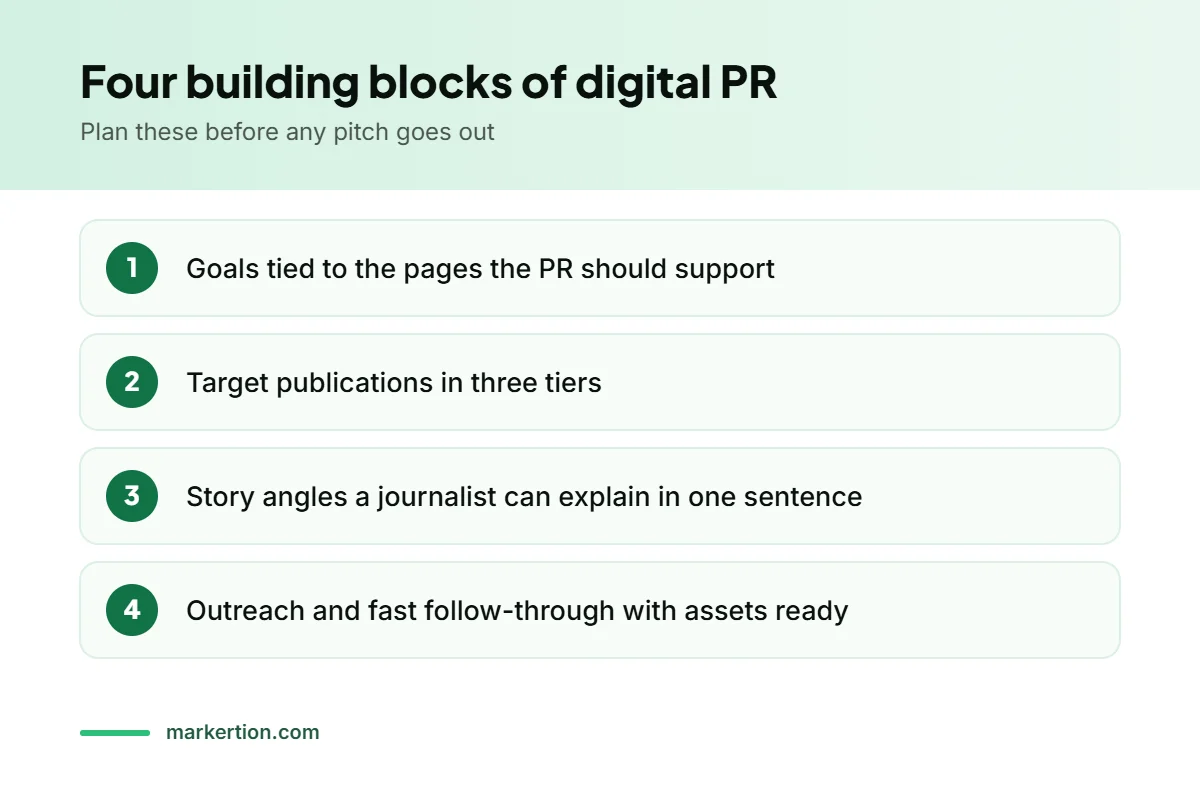
The Four Building Blocks of a Digital PR Strategy
1. Goals tied to pages
Decide which pages the PR should support before you plan any campaign. Usually that is the homepage for brand authority plus one or two service or resource pages. Each campaign should have a natural reason to link to one of them, such as a data page, a tool or a guide.
2. Target publications
Build a list in three tiers:
- Tier 1: national and international news sites and large business publications.
- Tier 2: industry trade publications and well-known niche blogs.
- Tier 3: regional news, podcasts and newsletters relevant to your audience.
Add the sites that AI assistants cite when people ask questions about your category. Getting featured there helps both your links and your AI search visibility.
3. Story angles
Every campaign needs a hook a journalist can explain in one sentence. Strong hooks are surprising, specific, relevant to a wider trend and backed by something credible: data, expertise or a clear point of view.
4. Outreach and follow-through
Write short, personalised pitches, send them to the right journalist for the topic, follow up once, and be ready with quotes, images and data files the moment someone replies.
The Story Types That Earn Coverage
| Story type | What it is | Why journalists use it |
|---|---|---|
| Original data | Survey results, industry analysis, public data studies | New numbers make new headlines |
| Expert commentary | Quotes reacting to news in your field | Saves time and adds authority |
| Reactive or newsjacking | Fast angles on breaking stories | Fits what editors are writing today |
| Guides and tools | Calculators, indexes, checklists | Useful to readers and easy to link |
| Founder and brand stories | Milestones, unusual journeys, opinions | Human interest and local pride |
Data campaigns often earn the strongest links, but expert commentary is the most consistent. Our guide on getting featured in Forbes without a PR agency shows how commentary opportunities work in practice.
How to Build a Campaign Step by Step
- Brainstorm angles around questions your audience and the media care about right now.
- Validate the hook by searching for recent coverage of similar stories. If journalists wrote about the topic recently, there is appetite for a fresh angle.
- Create the asset. Collect the data, write the analysis or prepare the expert view. Keep the method transparent.
- Build the landing page on your site with the full findings, charts and a clear summary journalists can quote.
- Write the pitch: a subject line that states the story, two or three short paragraphs, and the key numbers.
- Pitch in waves, starting with the publications that fit best, then widening.
- Track every placement and ask politely for a link where you were mentioned without one.
Turning Coverage Into SEO Value
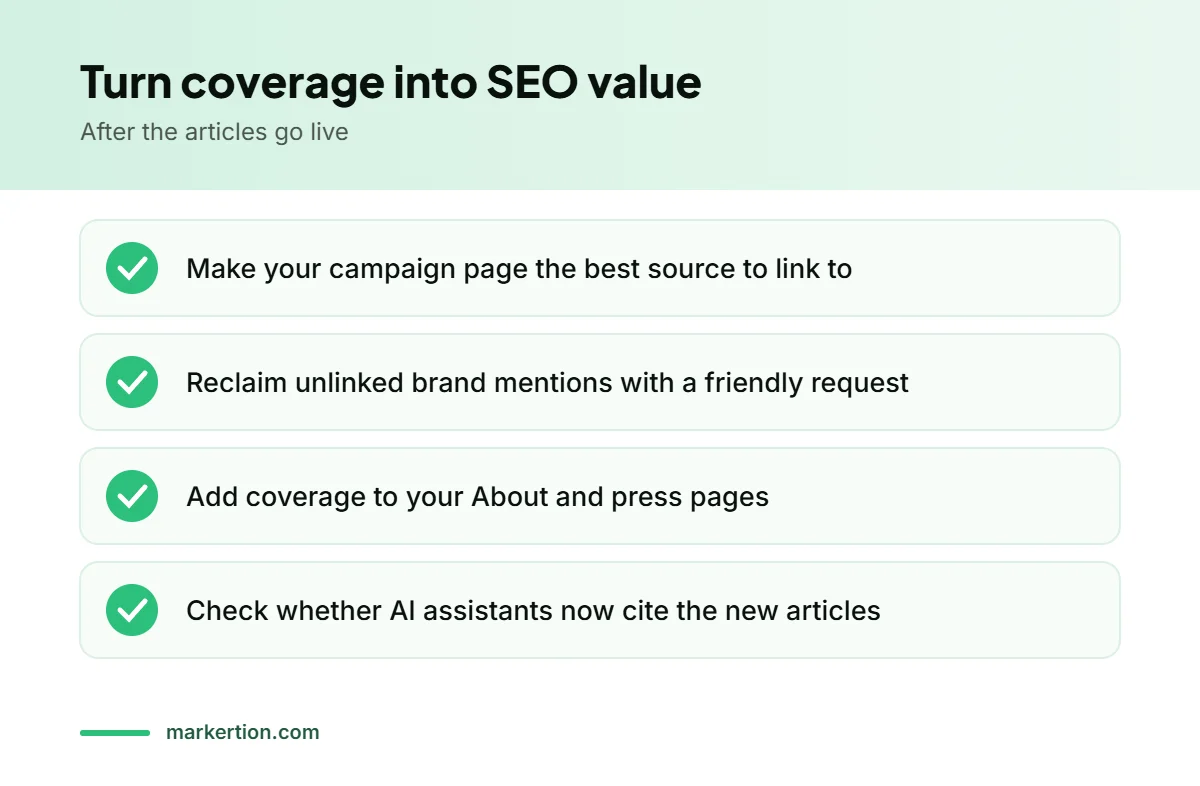
- Link to the right page. Make your campaign page the most useful source so journalists link to it, then link from it to your service pages internally.
- Reclaim unlinked mentions. Many articles name the brand without linking. A short, friendly request often fixes it. See our unlinked brand mentions strategy.
- Update your About and press pages with logos and links to coverage, which supports trust and E-E-A-T.
- Repurpose the story into blog posts, social posts and sales material so one campaign keeps working.
- Watch AI answers. After coverage lands, check whether assistants start citing the new articles when asked about your category.
How Often to Run Campaigns
A realistic rhythm for most brands is one larger data or tool campaign per quarter, plus weekly reactive commentary and monthly outreach to trade publications. Consistency matters more than one big hit, because every new article adds to the body of trusted sources describing your brand.
Measuring Digital PR
| Metric | What it tells you |
|---|---|
| Linked placements | Direct SEO value from coverage |
| Brand mentions | Awareness and trust signals, including for AI assistants |
| Referring domain quality | Whether you reached the tier you targeted |
| Referral traffic | Whether readers cared enough to click |
| Ranking changes on supported pages | Whether the authority flowed where you wanted |
| AI citations | Whether assistants now name or cite your brand |
Common Digital PR Mistakes
- Pitching your product instead of a story.
- Sending the same pitch to hundreds of journalists without checking what they cover.
- Weak or hidden methodology in data stories, which makes editors distrust the numbers.
- No landing page, so journalists have nothing useful to link to.
- Giving up after one campaign. Results build over several campaigns as relationships grow.
Example: What a Good Pitch Looks Like
Most pitches fail in the first two lines. Here is the structure we use, shown with a made-up example so you can see the shape:
Subject line: New data: most small online stores still have no reviews on their product pages
Opening line: Hi [name], I saw your recent piece on ecommerce trust signals and thought this would be useful for a follow-up.
The story: We analysed a sample of small online stores in [market] and found that most product pages had no customer reviews at all, even though review content is one of the main things shoppers check before buying.
Why it matters: It suggests a simple, cheap way for small brands to compete with larger retailers.
What you can offer: The full method, a chart pack and a comment from our founder, ready to use.
Keep it under 150 words. A journalist should understand the story, why their readers care and what you can provide without opening an attachment. Follow up once after a few days with a new detail rather than “just checking in”, and always reply quickly if someone asks for more.
Frequently Asked Questions
What is digital PR in SEO?
Digital PR is earning links and brand mentions from news sites and online publications by pitching stories, data and expert commentary that journalists want to publish.
How is digital PR different from guest posting?
Guest posting means writing an article for another site, usually with agreed placement. Digital PR earns editorial coverage that journalists choose to publish, which often brings stronger links from harder-to-reach domains.
How long does a digital PR campaign take?
Planning and creating a data campaign can take a few weeks, and coverage typically arrives over the first few weeks after launch. Reactive commentary can earn placements within days.
Does digital PR help with AI search?
Yes. AI assistants often cite news and industry publications. Coverage in those sources increases the chance that assistants mention and describe your brand correctly.
Can Markertion run digital PR for my brand?
Yes. Our digital PR campaign service handles angles, assets, outreach and reporting, and we can combine it with press release distribution when you have news to announce.
Final Thoughts
Digital PR rewards brands that give journalists something worth writing about. Tie every campaign to the pages you want to grow, choose angles that are genuinely newsworthy, make your landing pages the best source, and keep a steady rhythm of campaigns and commentary. Over time the coverage builds authority for Google and a body of trusted sources that AI assistants rely on when they describe your brand.
About the author: Shahidul Afridi is the founder of Markertion, a digital PR and link building agency that has built 6,000+ links for 120+ client partners since 2021. He writes from hands-on campaign work, not theory.

Digital PR & Link Building Expert