
AI visibility tracking tools monitor how often AI assistants such as ChatGPT, Gemini, Perplexity, Copilot and Google’s AI Overviews mention your brand, how they describe you, and which sources they cite. The best options in 2026 include dedicated platforms such as Profound, Peec AI, Otterly.AI, Scrunch AI and Rankscale, AI features inside SEO suites such as Semrush and Ahrefs Brand Radar, and a free manual method using a fixed prompt list plus analytics.
Key Takeaways
- All of these tools work the same basic way: they run prompts on AI assistants and record which brands and sources appear.
- Dedicated platforms go deeper on prompts, sentiment and sources; SEO suites are convenient if you already pay for them.
- AI answers vary between runs, so trends across many prompts matter more than any single result.
- Tracking is only useful if it leads to action: fixing brand facts, improving pages and earning mentions on cited sources.
- A manual spreadsheet method is a good way to start before paying for a tool.
How We Chose These Tools
We looked at tools that track brand mentions across several AI assistants, show the sources behind answers, and make it practical to track a prompt list over time. Features and pricing in this category change quickly, so check each vendor’s current plans before buying. The list is in no particular order beyond the groupings below.
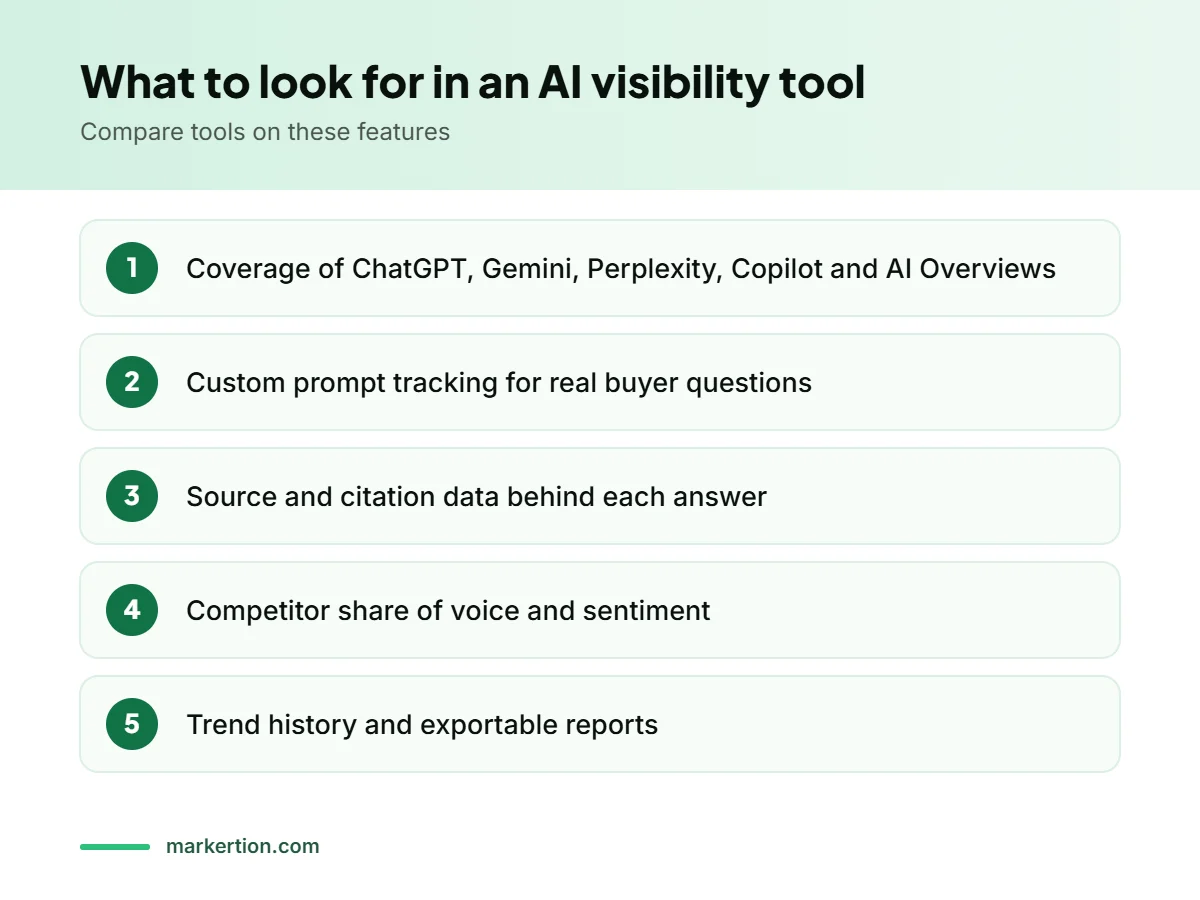
What to Look for in an AI Visibility Tool
| Feature | Why it matters |
|---|---|
| Assistant coverage | ChatGPT, Gemini, Perplexity, Copilot and Google AI Overviews behave differently |
| Custom prompt tracking | You need to track the questions your buyers actually ask |
| Source and citation data | Shows which pages the assistants rely on, so you know where to earn mentions |
| Competitor comparison | Share of voice against named competitors |
| Sentiment or framing | Whether you are recommended, mentioned in passing or criticised |
| Trend history | Month-over-month change across many prompts |
| Exports and reporting | Needed for client or leadership reporting |
The 8 Best AI Visibility Tracking Tools
1. Profound
Profound is a dedicated AI visibility platform aimed mainly at larger brands and enterprise marketing teams. It tracks how brands appear across major AI assistants, shows the sources behind answers and offers analysis of the prompts and topics where competitors win. It suits teams that need deep reporting and have the budget for an enterprise tool.
2. Peec AI
Peec AI focuses on tracking brand visibility, position and sentiment across AI assistants for a custom prompt set. Its strength is a clear view of share of voice against competitors and the sources driving each answer. It is a popular choice for marketing teams and agencies that want a focused tool without enterprise complexity.
3. Otterly.AI
Otterly.AI monitors brand mentions and links in AI answers, including Google AI Overviews, ChatGPT and Perplexity. It is designed to be simple to set up: add prompts, add competitors, and track how often each brand and domain appears over time. Good for small teams starting with AI tracking.
4. Semrush AI visibility features
Semrush has added AI visibility and AI search features to its platform, letting users see how their brand appears in AI answers alongside traditional SEO data. If your team already uses Semrush, these features are a convenient way to start without adding another tool. Check which features are included in your plan.
5. Ahrefs Brand Radar
Ahrefs Brand Radar tracks brand mentions across AI answers such as Google AI Overviews and AI assistants, and lets you compare your brand with competitors. Its advantage is the connection to Ahrefs’ backlink and content data, which makes it easier to move from “where are we missing?” to “which pages should we target for mentions and links?”.
6. Scrunch AI
Scrunch AI focuses on how AI assistants see and describe a brand, including monitoring and insights into the content and sources behind answers. It suits brands that want to understand and improve how they are represented, not only count mentions.
7. Rankscale
Rankscale tracks visibility in AI search engines with a rank-tracking style approach: prompts, positions, competitors and cited sources over time. It appeals to SEO teams who want AI tracking that feels familiar.
8. Manual tracking with a prompt sheet and analytics (free)
Before paying for a tool, you can track AI visibility yourself:
- Write 20 to 30 buyer prompts, such as “best [category] for [audience]” and “[your brand] vs [competitor]”.
- Run each prompt monthly on ChatGPT, Gemini, Perplexity and Copilot, and check AI Overviews for related Google searches.
- Record mention (yes or no), position, description accuracy and cited sources in a spreadsheet.
- In Google Analytics, track referral visits from AI assistant domains such as chatgpt.com and perplexity.ai.
This method is slow at scale but excellent for learning what to look for. Our guide on getting cited by AI assistants explains how to act on the findings.
Quick Comparison
| Tool | Best for | Type |
|---|---|---|
| Profound | Enterprise brands needing deep analysis | Dedicated platform |
| Peec AI | Share of voice and sentiment for teams and agencies | Dedicated platform |
| Otterly.AI | Simple setup for small teams | Dedicated platform |
| Semrush AI features | Teams already on Semrush | SEO suite add-on |
| Ahrefs Brand Radar | Linking AI mentions to backlink data | SEO suite feature |
| Scrunch AI | Understanding how AI describes your brand | Dedicated platform |
| Rankscale | Rank-tracking style AI monitoring | Dedicated platform |
| Manual prompt sheet | Getting started for free | DIY method |
Turning Tracking Into Results
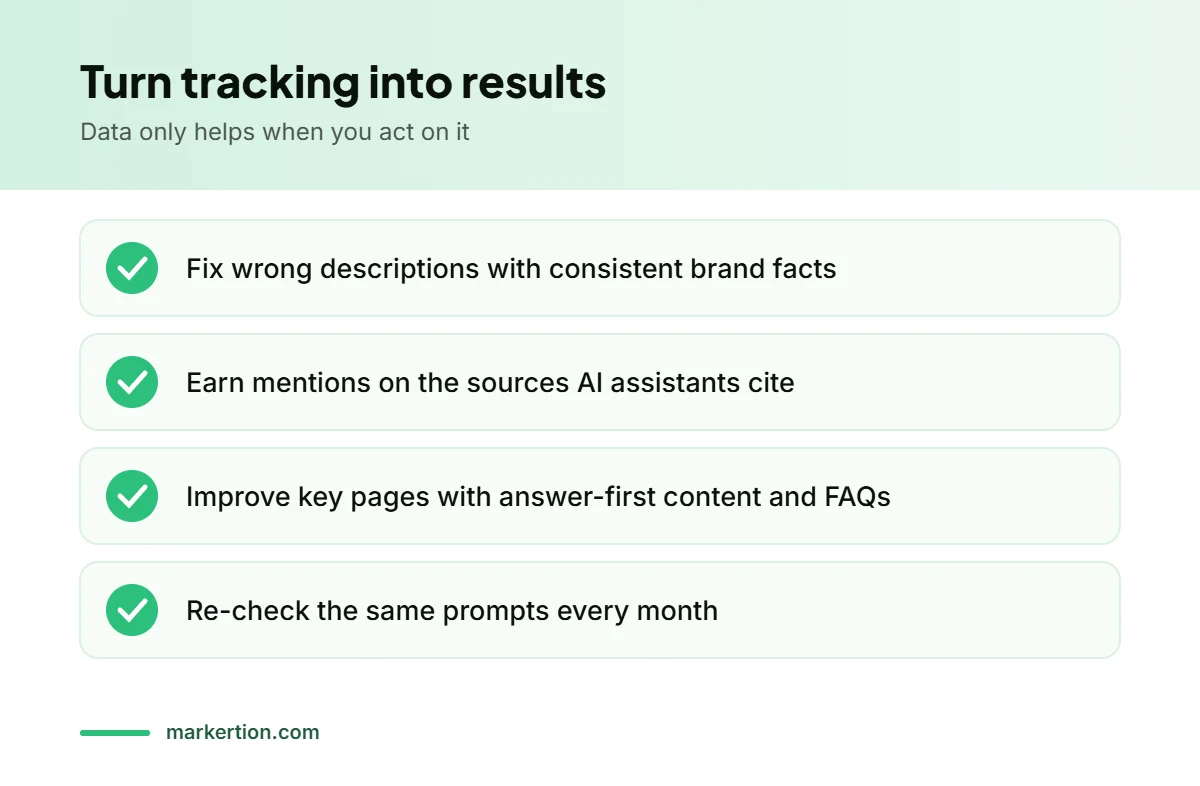
Tracking tells you where you stand. Improvement comes from acting on it:
- Fix wrong descriptions by making your brand facts consistent across your site, profiles and directories.
- Study the cited sources and work to appear on them through outreach, brand mentions and digital PR.
- Improve your own key pages with answer-first openings, tables and FAQs.
- Re-check monthly with the same prompts to see what moved.
Common Mistakes With AI Visibility Tools
- Tracking too few prompts. A handful of prompts gives noisy results.
- Judging single answers. AI responses vary; look at trends.
- Only tracking your brand name. Track category and problem prompts where buyers do not name you yet.
- Collecting data without acting on it.
How to Build a Prompt List Worth Tracking
Whichever tool you choose, the results are only as good as the prompts you track. A strong prompt list mixes four types:
- Category prompts: “best [category] for [audience]”, “top [category] tools in 2026”. These show whether you make the shortlist when buyers do not name you.
- Problem prompts: “how do I [solve problem]” or “what is the easiest way to [task]”. These show whether assistants recommend you as a solution.
- Comparison prompts: “[your brand] vs [competitor]” and “[competitor] alternatives”. These show how you are framed against rivals.
- Brand prompts: “what is [your brand]” and “is [your brand] good for [use case]”. These show whether the facts about you are accurate.
Aim for 30 to 100 prompts depending on how many products, audiences and markets you serve, and keep the list fixed for at least a quarter so trends are comparable. Add a few new prompts when you launch a product or enter a new market, but avoid rewriting the whole list every month, or you will lose the history that makes tracking useful.
Frequently Asked Questions
What is an AI visibility tracking tool?
It is software that runs prompts on AI assistants such as ChatGPT, Gemini and Perplexity and records whether your brand is mentioned, how it is described and which sources are cited.
Which AI visibility tool is best?
It depends on your needs. Enterprise teams often choose dedicated platforms such as Profound, while smaller teams may prefer Peec AI or Otterly.AI, and existing Semrush or Ahrefs users can start with those suites’ AI features.
Can I track AI visibility for free?
Yes. Use a fixed list of buyer prompts, run them monthly on each assistant, record the results in a spreadsheet and track AI referral traffic in your analytics.
How often should I check AI visibility?
Monthly is enough for most brands. Weekly checks can help during active campaigns, but focus on trends across many prompts.
Can Markertion track and improve my AI visibility?
Yes. Our AI search visibility service audits how assistants describe your brand, tracks a prompt set over time and strengthens the sources they rely on.
Final Thoughts
AI visibility tools make it possible to measure something that used to be invisible: how AI assistants talk about your brand. Pick a tool that fits your team and budget, or start with a free prompt sheet, track a meaningful set of buyer prompts, and use what you learn to fix facts, improve pages and earn mentions on the sources that matter.
About the author: Shahidul Afridi is the founder of Markertion, a digital PR and link building agency that has built 6,000+ links for 120+ client partners since 2021. He writes from hands-on campaign work, not theory.

Digital PR & Link Building Expert