Digital PR is the practice of earning online coverage, editorial links and brand mentions by giving journalists, editors and creators something worth publishing: a story, original data, expert commentary or a useful resource. It combines the storytelling of public relations with the measurable goals of SEO, so each campaign builds both reputation and search visibility.
Key Takeaways
- Digital PR earns coverage and links through stories, data and expertise, not through paid placements alone.
- It supports SEO, brand search, referral traffic and visibility in AI answers at the same time.
- The main formats are data campaigns, reactive commentary, product or company news, and expert-led content.
- Results are judged by relevance and quality of coverage, not only by the number of links.
- Most brands need three to six months of consistent activity before the effect on rankings is clear.
How Digital PR Works
A digital PR campaign starts with an idea that a publication’s readers would care about. The team then builds the asset (a study, a survey, an index, a guide or a strong expert opinion), prepares a short pitch, and sends it to a carefully chosen list of journalists who cover that subject. When a journalist uses the story, they usually credit the source with a brand mention and often with a link.
The work is closer to journalism than to advertising. Journalists owe you nothing, so the story has to be accurate, timely and easy to use. That is why a clear plan matters; our digital PR strategy guide covers the planning stage in detail.
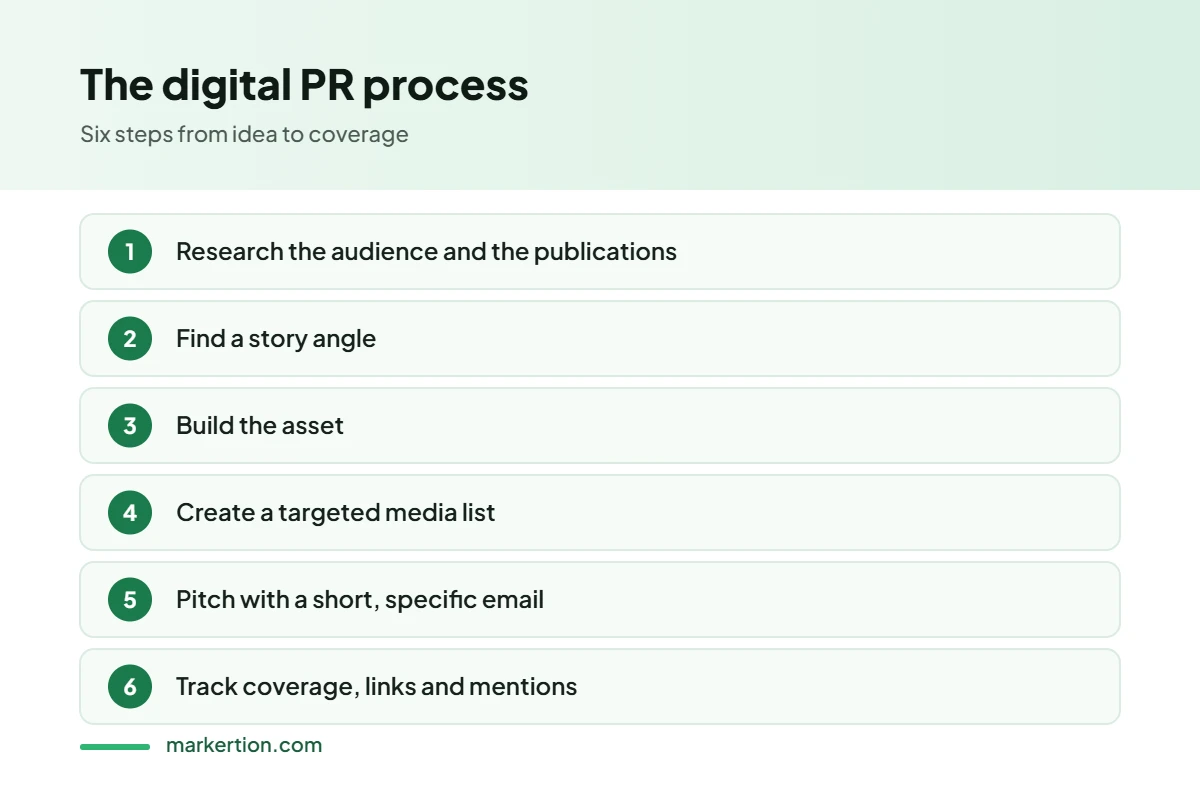
- Research the audience and the publications you want to appear in.
- Find a story angle that is new, useful or surprising.
- Build the asset: data, a report, a tool, or expert commentary.
- Create a targeted media list of relevant journalists.
- Pitch with a short, specific email and follow up once.
- Track coverage, links and mentions, then report on outcomes.
Digital PR vs Link Building vs Traditional PR
These three disciplines overlap, but they are bought and measured differently.
| Factor | Digital PR | Link building | Traditional PR |
|---|---|---|---|
| Main goal | Coverage, links and brand authority | Links to specific pages | Reputation and awareness |
| Typical outputs | News articles, features, mentions | Guest posts, niche edits, resource links | Print, TV, radio, events |
| Control over placement | Low to medium | Medium to high | Low |
| Measurement | Links, mentions, referral traffic, brand search | Links, rankings, page traffic | Reach, sentiment, share of voice |
| Speed | Unpredictable, can be fast for reactive work | Predictable monthly output | Slow, relationship-led |
Digital PR is strong at earning links from news and high-authority sites that you cannot simply request. Planned link building, such as guest posting and niche edits, gives predictable volume and lets you point links at commercial pages. Most growing brands use both, inside one link building strategy.
The Main Types of Digital PR Campaign
Data-led campaigns
You publish original numbers, such as a survey, an analysis of public data or anonymised product data, and offer the findings to journalists. Data gives reporters a reason to cite you. See these data-driven PR campaign ideas for formats that work on small budgets.
Reactive PR and expert commentary
When news breaks in your sector, journalists need informed comment quickly. A named expert with a clear point of view can earn coverage within hours. Journalist request platforms help here; we compare the options in our guide to HARO alternatives.
Company and product news
Funding, launches, partnerships, senior hires and milestones are still news when they are relevant to a publication’s readers. A well-written release, sent through sensible press release distribution and backed by direct pitching, gives the story its best chance.
Thought leadership
Opinion articles, interviews and podcast appearances build the personal authority of founders and specialists. This type of coverage is slower to arrive, but it supports the experience and expertise signals that both Google and AI assistants look for.
Why Digital PR Matters Now
Search has changed. People now get answers from Google’s AI features and from assistants such as ChatGPT, Gemini and Perplexity, and those systems tend to repeat what trusted, independent sources say about a brand. Coverage on respected sites is therefore valuable twice: once as a link signal for classic rankings and again as a source that AI systems can draw on. We explain that second effect in what sources LLMs trust.
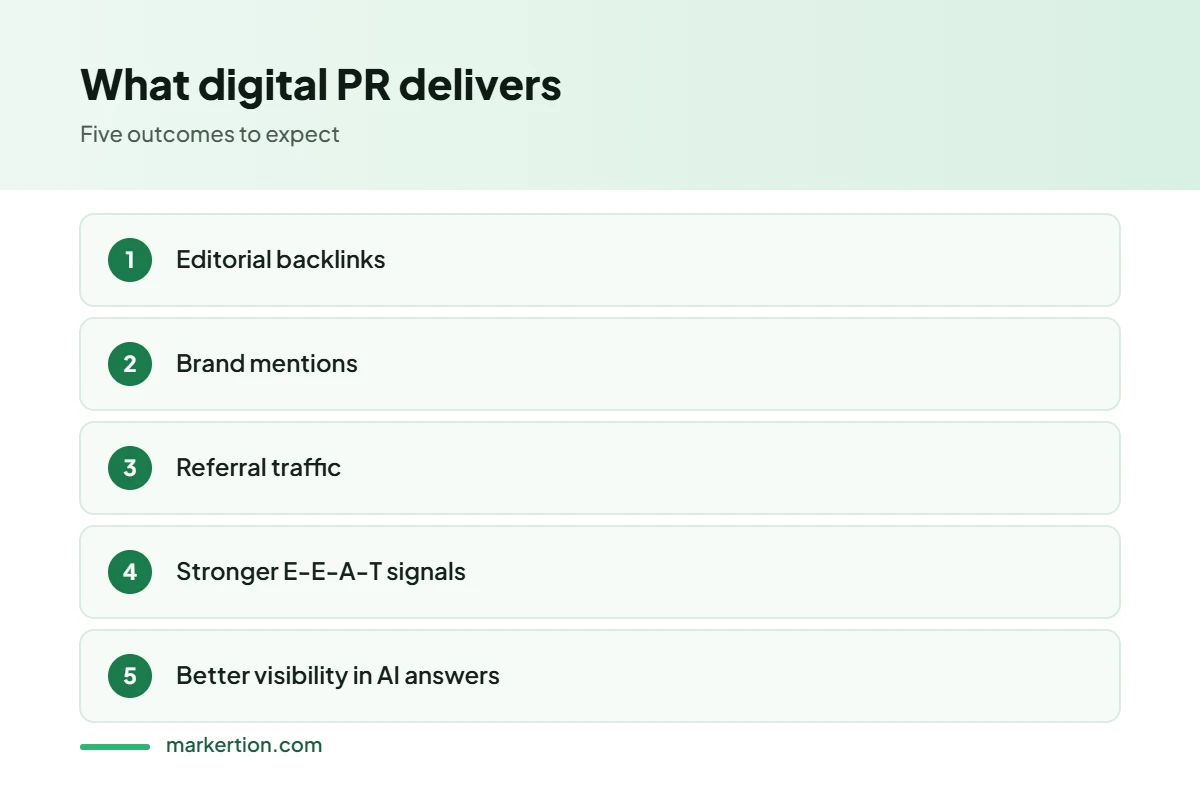
- Editorial backlinks from sites that do not sell links.
- Brand mentions that build recognition, even without a link.
- Referral traffic from readers who are already interested.
- Stronger E-E-A-T signals through named experts and third-party validation.
- Better visibility in AI answers, which rely on trusted independent sources.
How Much Does Digital PR Cost?
Costs depend on who does the work and how ambitious the campaigns are. A freelancer running reactive commentary may charge a modest monthly fee. An agency running data campaigns with design and outreach will cost more because research and production take time. As a rule, pay attention to what is included: idea development, asset production, media list building, outreach and reporting. Be careful with guarantees of a fixed number of links from named top-tier publications, because no honest team controls editorial decisions.
If you are comparing digital PR with planned link acquisition, our link building pricing guide shows typical agency price models.
How to Measure Digital PR
Count links, but do not stop there. A useful report covers:
- Number and quality of pieces of coverage, judged by relevance and real readership.
- Followed links, nofollow links and unlinked mentions, listed separately.
- Referral traffic and any conversions from that traffic.
- Growth in branded search over the campaign period.
- Ranking movement for the pages and topics the campaign supports.
Unlinked mentions are still worth chasing; a polite request often turns them into links, as shown in our guide to unlinked brand mentions.
Common Mistakes to Avoid
- Pitching without a story. A product description is not news.
- Sending one email to hundreds of journalists. Relevance beats volume, and mass emails damage your sender reputation.
- Weak data. A tiny survey or unclear method will be ignored or challenged.
- No landing page. Journalists link to a source page. If the data only exists in the email, there is nothing to link to.
- Stopping after one campaign. Relationships and results build over repeated, useful contact.
Getting Started
Start small. Pick one subject where your team has real knowledge, list ten publications your customers read, and study what those publications already cover. Offer expert commentary first, because it needs no production budget. Once you understand what journalists respond to, invest in one data-led campaign per quarter and keep a steady flow of reactive comment between campaigns.
Frequently Asked Questions
What is digital PR in simple terms?
Digital PR means earning online coverage, links and brand mentions by offering journalists and editors stories, data or expert comment that their readers will find useful.
Is digital PR the same as link building?
No. Link building focuses on acquiring links to specific pages, often through guest posts and niche edits. Digital PR earns coverage through newsworthy stories, and links are one of several results.
How long does digital PR take to work?
Reactive commentary can earn coverage in days, but the effect on rankings and brand search usually becomes clear after three to six months of consistent campaigns.
Does digital PR help with AI search visibility?
Yes. AI assistants tend to rely on trusted independent sources, so coverage and mentions on respected sites increase the chance that a brand is named in AI answers.

Digital PR & Link Building Expert