Google’s spam policies say that links bought or sold to pass ranking credit are link spam, and that paid or sponsored links should be marked with rel=”sponsored” (or nofollow). Editorial guest posts, where a publisher accepts an article on its merits and links naturally, are a different case. In 2026 the practical rule is: be clear about what is paid, focus on relevant sites with real readers, and treat guest posting as content and visibility work rather than buying PageRank.
Key Takeaways
- Google’s link spam policy covers buying or selling links that pass PageRank, including paid guest posts with followed links.
- Google asks site owners to label paid links with rel=”sponsored”; nofollow is also accepted.
- Unpaid editorial guest posts on relevant sites are a normal part of the web.
- Sponsored and nofollow links can still bring referral traffic, brand mentions and AI visibility.
- The safest strategy combines relevance, real audiences and transparency.
What Google’s Policies Actually Say
Google’s spam policies describe link spam as links intended to manipulate rankings. Examples Google lists include buying or selling links that pass PageRank, exchanging money, goods or services for links, excessive link exchanges, and large-scale article marketing or guest posting campaigns with keyword-rich anchor text.
For paid placements, Google’s guidance on qualifying outbound links explains the attributes site owners should use:
| Attribute | Google’s intended use |
|---|---|
| rel=”sponsored” | Links that are advertisements or paid placements |
| rel=”ugc” | Links in user-generated content such as comments and forum posts |
| rel=”nofollow” | Links you do not want to endorse or pass ranking credit through, when the other values do not apply |
Google has also said these attributes are treated as hints. That gives Google flexibility in how it uses them, but the expectation for paid links is clear.
Editorial vs Sponsored Guest Posts
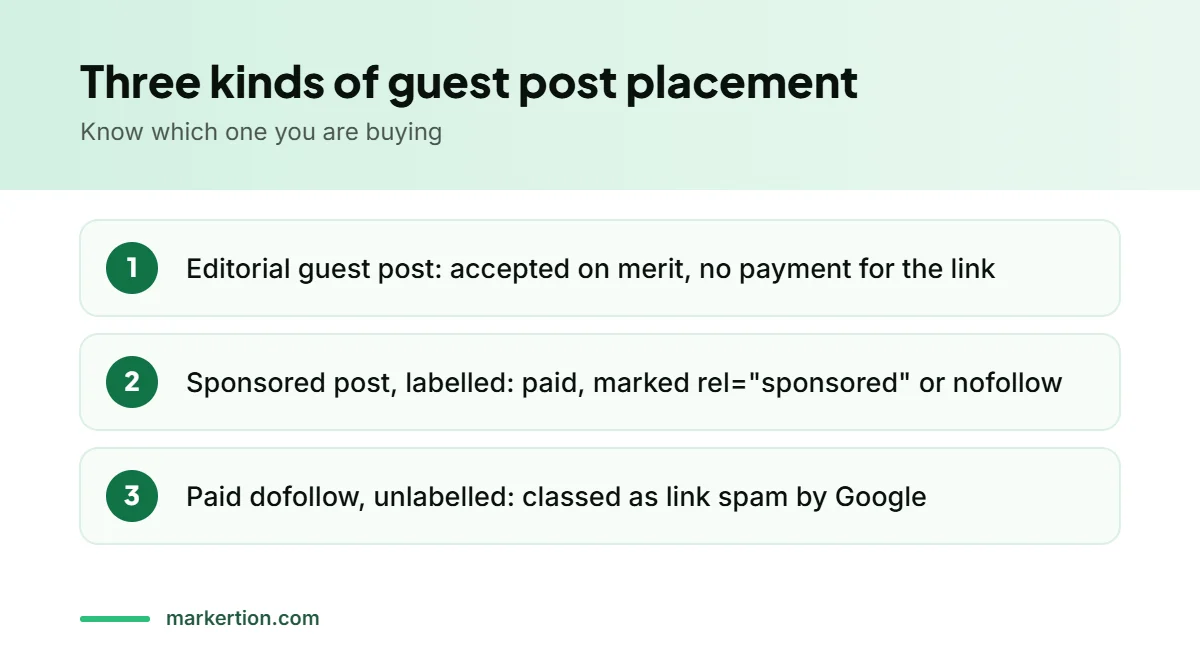
Not every guest post is a paid link. It helps to separate three situations:
- Editorial guest posts. You pitch a useful article, the editor reviews and edits it, no money changes hands for the link, and any link inside is there because it helps readers. This is ordinary publishing.
- Sponsored posts, labelled. You pay for placement, and the publisher marks the content as sponsored and uses rel=”sponsored” or nofollow on the links. This follows Google’s guidance.
- Paid posts with followed links, unlabelled. You pay, and the links are dofollow with no disclosure. Google’s policies classify this as link spam, and it carries risk if detected at scale.
Many marketplaces blur these lines. Knowing which one you are buying is the first step to managing risk.
What Happens if Google Detects Link Spam
Google says its systems, including SpamBrain, can detect unnatural links and neutralise them so they pass no value. In more serious cases, a site can receive a manual action for unnatural links, which appears in Search Console. Neutralised links waste budget; manual actions can hurt rankings until the issue is fixed and a reconsideration request is approved. Patterns that draw attention include:
- Many links from sites that openly sell posts in every niche.
- Repeated exact-match commercial anchors.
- Sudden spikes in links from low-quality guest post farms.
- Links on pages with long lists of unrelated outbound links.
Do Sponsored and Nofollow Guest Posts Still Have Value?
Yes, for several reasons:
- Referral traffic. A relevant article on a well-read site sends real visitors, whatever the link attribute.
- Brand mentions. Your name and expertise appear in front of a new audience.
- AI visibility. AI assistants read and cite pages based on content and trust. A mention in a respected industry article can help you appear in AI answers even when the link is nofollow. See what sources LLMs trust.
- Authority signals. Google treats attributes as hints, and a natural, relevant link profile usually includes a mix of followed and nofollowed links.
- Content distribution. A strong guest article can be shared, linked to by others and drive secondary links.
How to Build Guest Posting Campaigns Responsibly
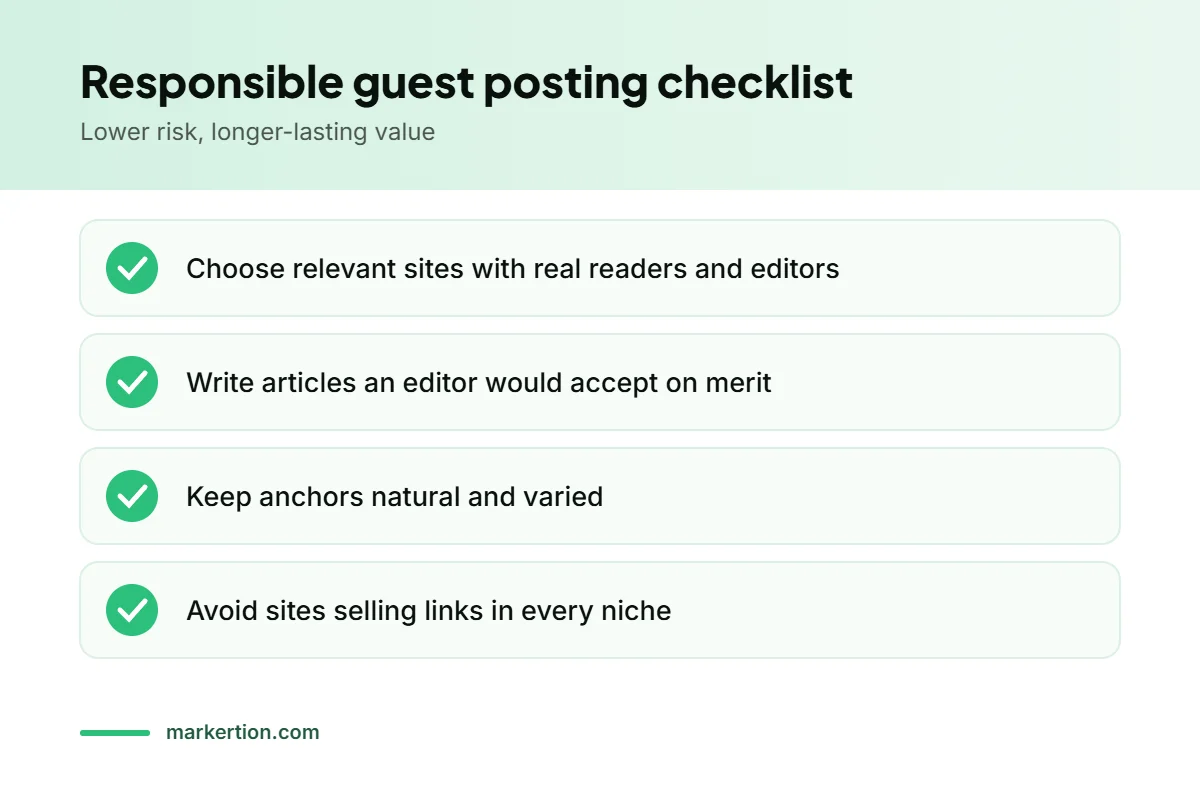
- Prioritise relevance and real readers over domain metrics. Our guest post quality checklist explains what to check.
- Write genuinely useful articles that an editor would accept on merit.
- Keep anchors natural: branded, URL and descriptive phrases rather than repeated exact-match keywords.
- Respect publisher labelling. If a site marks a post as sponsored, that is their right and follows Google’s guidance.
- Avoid sites that sell links in every niche with public price lists.
- Mix link types: guest posts alongside digital PR, brand mentions and naturally earned links. Our link building strategy framework shows how.
Questions to Ask a Guest Post Provider
- Is this an editorial placement, a labelled sponsored post or something else?
- Who decides whether the article is accepted and edited?
- What link attributes will the publisher use?
- Can I see live examples from the same site?
- What is the site’s organic traffic, and where does it come from?
A provider who answers clearly and honestly is far safer to work with than one who promises “guaranteed dofollow on any site”.
The Site Reputation Abuse Angle
Google’s spam policies also cover site reputation abuse: when third-party content is published on a host site mainly to exploit the host’s ranking signals, with little oversight from the host. This mainly targets large sites hosting unrelated commercial content, such as coupon or payday loan sections on news sites. For guest posting, the lesson is that a strong domain alone is not a reason to publish there. The content should fit the site’s purpose and audience.
A Quick Risk Guide
| Placement type | Risk level | Best use |
|---|---|---|
| Editorial guest post on a relevant site | Low | Topical authority, audience and links |
| Labelled sponsored post on a relevant site | Low | Visibility, referral traffic and mentions |
| Paid dofollow post on a relevant, real site | Medium | Depends on scale, anchors and site quality |
| Paid dofollow post on a link farm | High | Avoid |
How Markertion Approaches Guest Posting
We focus on relevant sites with real organic traffic and editorial standards, write content that adds value for readers, keep anchors natural and spread placements across a healthy mix of link types. We also explain to clients what kind of placement each one is, so there are no surprises. That approach aims for links and mentions that hold their value through algorithm updates rather than chasing short-term spikes. See our guest posting services for details.
Frequently Asked Questions
Does Google allow paid guest posts?
Google’s spam policies treat buying links that pass PageRank as link spam and ask that paid links be labelled with rel=”sponsored” or nofollow. Paid posts with properly labelled links follow Google’s guidance.
Are dofollow guest posts against Google’s rules?
Unpaid editorial guest posts with natural followed links are ordinary publishing. Paying specifically for followed links that pass ranking credit falls under Google’s link spam policy.
Do sponsored guest posts help SEO?
They can help indirectly through referral traffic, brand mentions, AI visibility and wider exposure, and Google treats link attributes as hints. Relevance and audience matter most.
What is rel=”sponsored”?
It is a link attribute Google recommends for links that are advertisements or paid placements, so search engines understand the commercial relationship.
Can guest posting get my site penalised?
Large-scale campaigns with keyword-rich anchors on low-quality sites can lead to links being ignored or, in serious cases, a manual action. Relevant, natural placements carry far less risk.
Final Thoughts
Guest posting still works in 2026, but the details matter. Know whether a placement is editorial or sponsored, follow Google’s labelling guidance, choose relevant sites with real readers and keep anchors natural. Treated as content and visibility work, guest posting builds authority, audience and AI presence that last far longer than any short-term link trick.
About the author: Shahidul Afridi is the founder of Markertion, a digital PR and link building agency that has built 6,000+ links for 260+ client partners since 2021. He writes from hands-on campaign work, not theory.

Digital PR & Link Building Expert