
To evaluate a backlink, look past domain rating and check twelve signals: the linking site’s organic traffic and trend, topical relevance of the site and page, page-level traffic, where the link sits, anchor text, link attributes, outbound link load, indexation, the site’s own backlink profile, editorial standards, referral potential and whether the link is likely to last. A link that scores well on most of these will usually help rankings; a link that only has a high DR often will not.
Key Takeaways
- DR and DA describe a domain’s backlink profile, not whether a link from it will help you.
- Relevance and real organic traffic are the two signals that matter most.
- Judge the specific page your link sits on, not just the homepage of the site.
- Placement, anchor and outbound link count change how much value a link passes.
- Use a simple scorecard so every link is judged the same way.
Why DR Alone Is Not Enough
Domain Rating (Ahrefs) and Domain Authority (Moz) are useful shortcuts. They estimate how strong a domain’s backlink profile is compared with others. But they are third-party metrics, not Google signals, and they can be inflated with low-quality links. A site can have a high DR while getting almost no organic traffic, which usually means Google does not trust it much.
That is why experienced link builders treat DR as a starting filter, then look at the signals below. After building more than 6,000 links for client campaigns, the most common problem we see in inherited link profiles is a pile of high-DR links from sites with no traffic and no relevance, links that looked good in a report and did very little for rankings.
The 12 Backlink Quality Signals
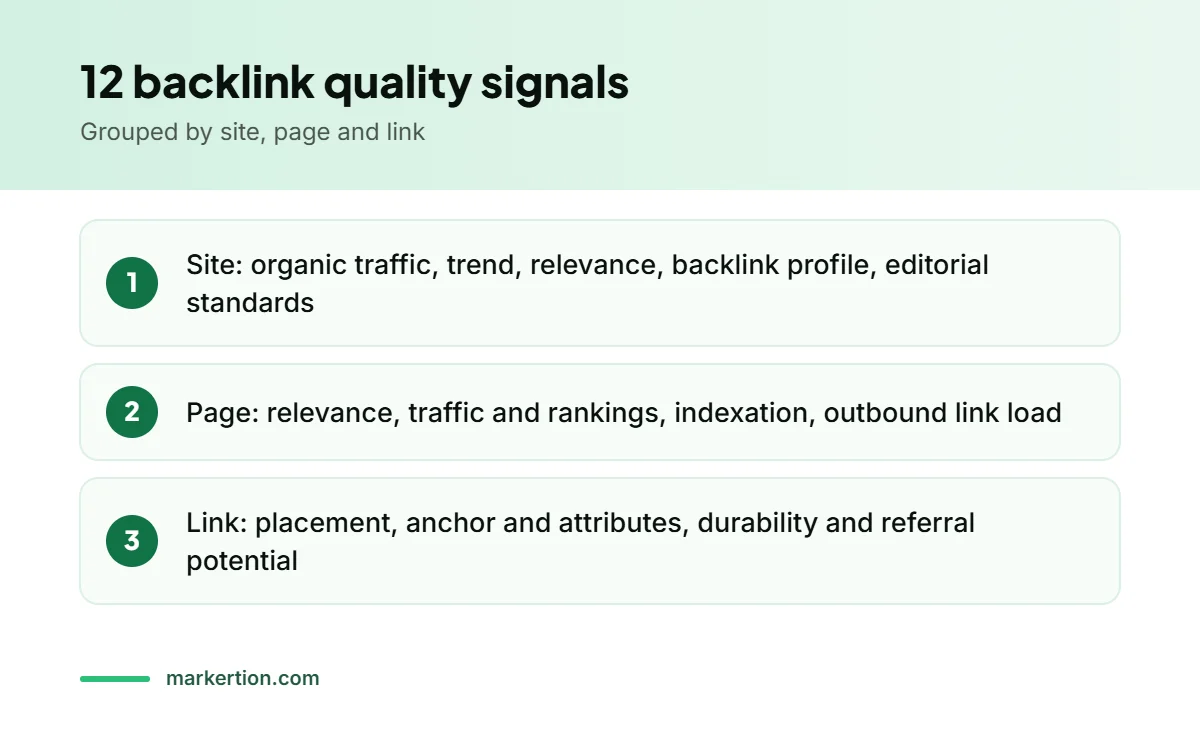
Site-level signals
- Organic traffic. Does the site get meaningful organic traffic? Use Ahrefs, Semrush or similar tools for an estimate.
- Traffic trend. Is that traffic stable or growing over the last 12 months? A cliff after a core update is a warning sign.
- Topical relevance of the site. Does the site focus on topics related to yours? A marketing blog linking to a marketing agency makes sense; a general “news” site covering every niche does not.
- The site’s own backlink profile. Does it have links from real, relevant sites, or mainly from directories, comment spam and other link sellers?
- Editorial standards. Are posts edited, written by real authors and useful to readers?
Page-level signals
- Page relevance. Is the specific article about a topic close to the page you are linking to?
- Page traffic and rankings. Does the page itself get visits and rank for keywords? A link on a ranking page is far stronger than one on a forgotten post.
- Indexation. Is the page in Google’s index? Search the exact URL or use a site: search.
- Outbound link load. How many external links does the page carry? A few relevant ones is normal; many commercial links dilute value and look like a link list.
Link-level signals
- Placement. Is the link in the body of the content, near related text? Body links usually carry more weight than footers, sidebars or author bios.
- Anchor text and attributes. Is the anchor natural and descriptive? Is the link dofollow, or marked nofollow, sponsored or UGC? All can have value, but know what you are getting.
- Durability and referral potential. Is the link likely to stay live, and could it send real visitors who care about your topic?
A Simple Backlink Scorecard
Score each signal from 0 to 2:
| Signal | 0 points | 1 point | 2 points |
|---|---|---|---|
| Organic traffic | None | Some | Strong and real |
| Traffic trend | Falling sharply | Flat | Stable or growing |
| Site relevance | Unrelated | Loosely related | Closely related |
| Site backlink profile | Spammy | Mixed | Clean and relevant |
| Editorial standards | None | Basic | Clearly edited |
| Page relevance | Unrelated | Loosely related | Closely related |
| Page traffic | None | Some | Ranks and gets visits |
| Indexation | Not indexed | Unclear | Indexed |
| Outbound links | Many commercial | Several | Few and relevant |
| Placement | Footer or bio | Lower body | Main body near related text |
| Anchor and attributes | Spammy exact match | Generic | Natural and descriptive |
| Durability and referral | Likely removed | Unknown | Stable and clickable |
A link scoring 18 or more out of 24 is usually strong. Between 12 and 17 it may still be useful as part of a mix. Below 12, it is rarely worth paying for.
Red Flags That Override the Score
Some signals are serious enough to skip a link even if other scores look fine:
- The site openly sells links in every niche on a public price list.
- Many posts link to casinos, payday loans, pills or adult sites.
- The site’s traffic collapsed after a recent core update.
- Pages are not indexed.
- The site is part of an obvious network with the same design and authors across many domains.
Our guest post quality checklist covers how to spot these patterns quickly.
How to Evaluate a Backlink in 5 Minutes
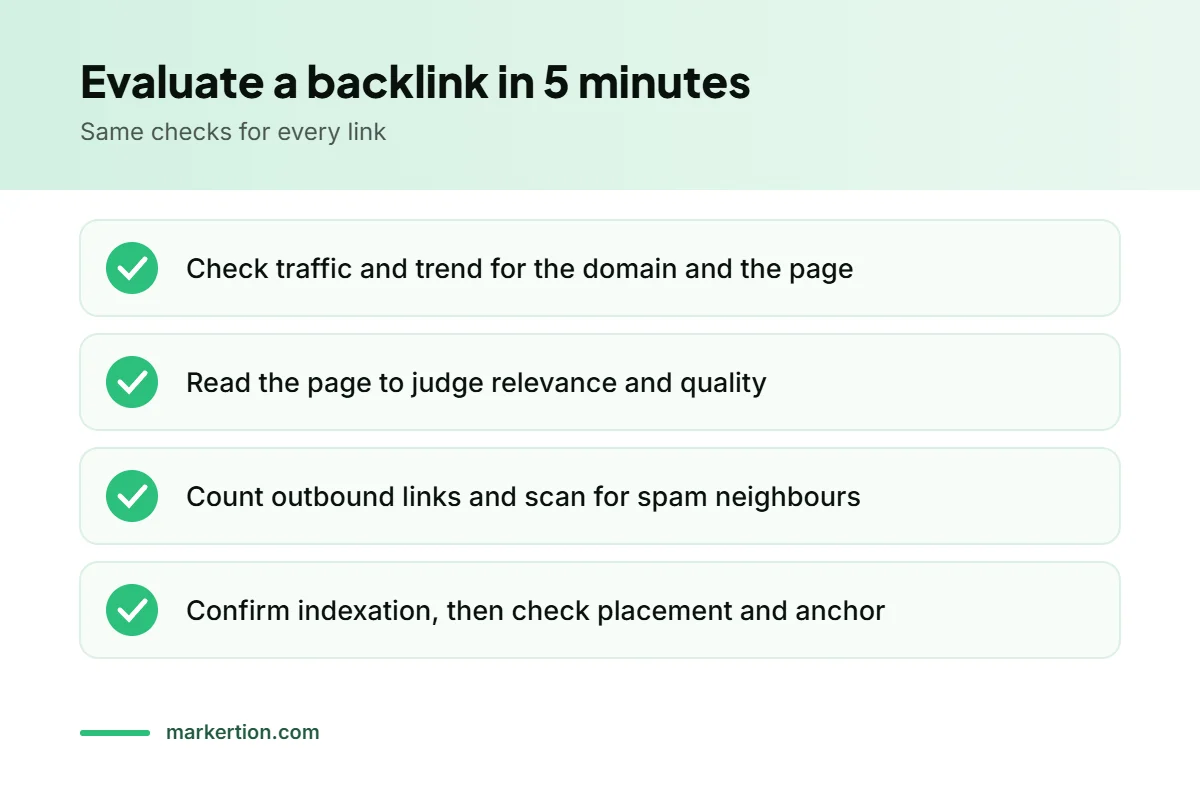
- Check traffic and trend in your SEO tool for the domain and the specific page.
- Read the page and judge relevance and editorial quality.
- Count outbound links on the page and scan for spam neighbours.
- Confirm indexation with a quick search.
- Check placement and anchor once the link is live.
This takes a few minutes per link and saves a lot of wasted budget. For niche edits specifically, see how to choose pages for niche edits.
Evaluating Links You Already Have
The same scorecard works for auditing existing backlinks. Export your referring domains, sort by the most important target pages, and score the links pointing at them. You will usually find three groups:
- Strong links worth protecting and building on.
- Weak but harmless links that you can ignore.
- Clearly manipulative or spammy links that may be worth disavowing if there are many of them and you see signs of a problem.
Google says it ignores most spammy links automatically, so disavowing is only needed in specific cases. Our SaaS backlink audit guide walks through that decision.
Nofollow, Sponsored and UGC Links
Not every valuable link is dofollow. Google treats nofollow, sponsored and UGC attributes as hints rather than strict rules, and links with these attributes from trusted, relevant sites can still bring referral traffic, brand awareness and mentions that AI assistants pick up. Judge them on relevance and audience rather than dismissing them. For paid placements, make sure the labelling follows Google’s guidelines. In a healthy link profile you will naturally see a mix of attributes.
How Backlink Quality Affects AI Visibility
AI assistants retrieve pages from trusted, well-linked sources and then name the brands those pages mention. A relevant link on a real, well-read industry article helps twice: it supports rankings and places your brand on a page that assistants may quote. A link on a no-traffic site rarely does either. That is another reason to weight relevance and traffic above raw domain metrics. Learn more in our guide to what sources LLMs trust.
Common Mistakes When Judging Links
- Sorting by DR and buying from the top of the list.
- Ignoring the specific page and only looking at the domain.
- Accepting links on pages that are not indexed.
- Counting links instead of judging them.
- Over-optimising anchors because the link “looks strong”.
Frequently Asked Questions
What makes a backlink high quality?
A high-quality backlink comes from a relevant site and page with real organic traffic, sits in the body of useful content with a natural anchor, appears on a page with few outbound links, and is likely to stay live.
Is DR a good way to judge backlinks?
DR is a helpful first filter but not enough on its own. It can be inflated, and it does not show relevance or whether Google sends the site real traffic.
Are nofollow links worthless?
No. Nofollow links from relevant, trusted sites can bring referral traffic, brand awareness and mentions, and Google treats the attribute as a hint rather than a strict rule.
How many low-quality backlinks are a problem?
A few low-quality links are normal for any site. Problems usually come from large, deliberate patterns of manipulative links, which is when an audit and possibly a disavow file make sense.
Does Markertion check link quality before building?
Yes. Every placement in our link building services is checked for relevance, real traffic, outbound links, indexation and placement before it goes live.
Final Thoughts
A backlink is worth what it does for your rankings, traffic and brand, not what its DR says. Score relevance, traffic, placement, anchors, outbound links and durability for every link, skip anything with serious red flags, and focus your budget on links that real readers would find and trust. Do that consistently and your link profile becomes an asset that keeps paying off.
About the author: Shahidul Afridi is the founder of Markertion, a digital PR and link building agency that has built 6,000+ links for 120+ client partners since 2021. He writes from hands-on campaign work, not theory.

Digital PR & Link Building Expert