
The best pages for niche edits (link insertion) are existing articles that already get organic traffic, cover a topic closely related to your target page, have been indexed for a while, and carry only a few outbound links. Choosing the page, not just the website, is what decides whether a niche edit moves rankings or simply adds a number to your backlink count.
Key Takeaways
- Judge the specific page, not the domain. Page-level traffic and relevance matter most.
- A page that ranks for keywords close to yours is the strongest possible host for your link.
- Older, stable pages tend to hold value better than brand-new posts.
- The sentence your link sits in should make sense for the reader without the link.
- Avoid pages crowded with outbound commercial links.
Why Page Choice Matters More Than the Domain
Niche edits (link insertion) place your link inside an article that already exists. That is their big advantage over a new guest post: the page may already have age, backlinks of its own, internal links from the site and real visitors. But the same domain can host pages that are worth a lot and pages that are worth almost nothing.
A DR 60 site might have a guide that ranks for dozens of terms in your niche and a forgotten news post from four years ago with no traffic. A niche edit on the first can be one of the most valuable links you build all year. A niche edit on the second passes very little. Most vendors price by domain metrics, which is why buyers who check pages themselves get far better results. Our niche edit pricing guide explains how that affects what you should pay.
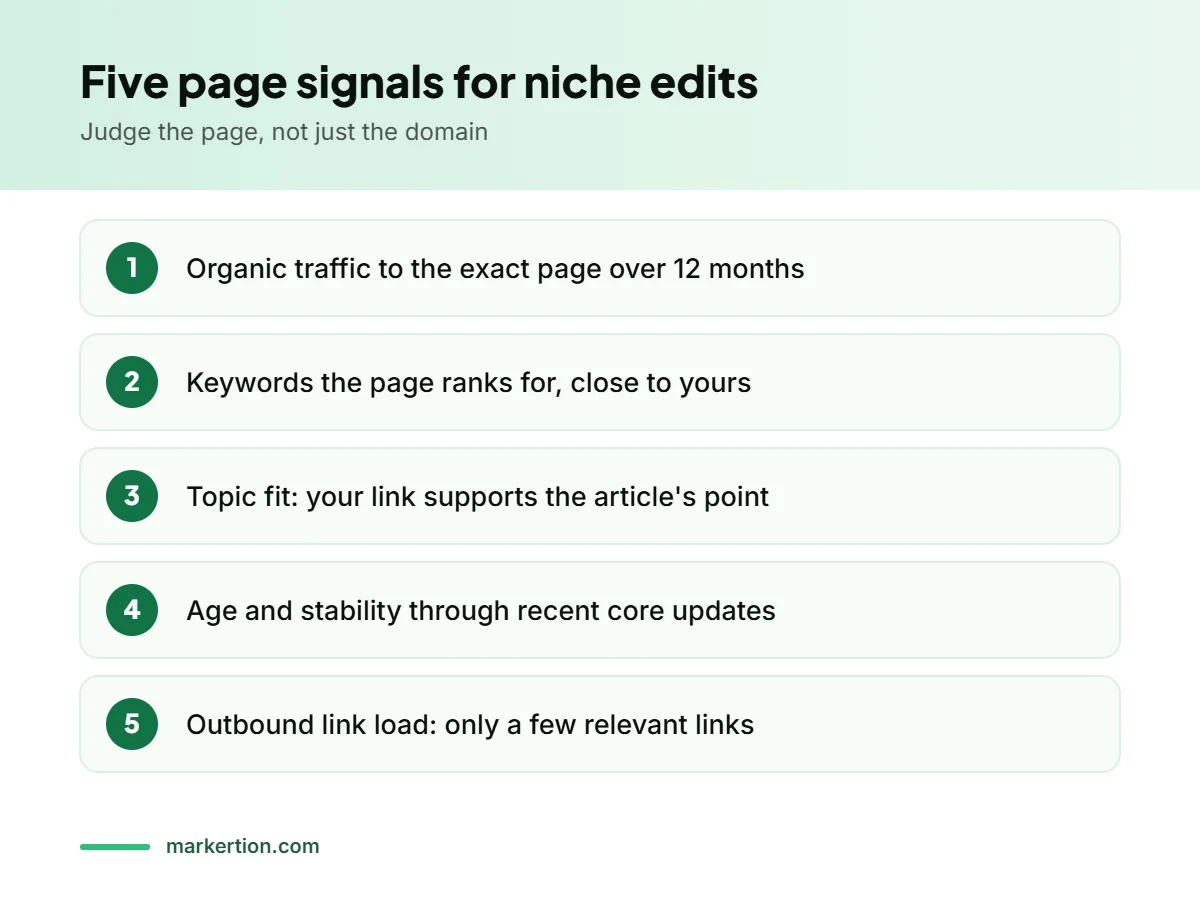
The Five Page Signals to Check
1. Organic traffic to the page
Use Ahrefs, Semrush or a similar tool to check estimated organic traffic for the exact URL. You want a page with steady traffic over the past year, not just a spike. Even a few hundred relevant visits per month is a good sign that Google trusts the page.
2. Keywords the page ranks for
Look at the keywords the page ranks for. If it ranks for terms close to your target page’s keywords, Google already sees it as relevant to your topic. That is the strongest relevance signal you can get.
3. Topical relevance of the article
Read the article. Does your link fit naturally inside it? A page about choosing project management software is a natural home for a link to a time-tracking tool. A page about holiday destinations is not, even if the site is strong.
4. Page age and stability
Pages that have been indexed and ranking for a year or more tend to be stable. Check the publish date and whether the page has kept its rankings through recent core updates.
5. Outbound link load
Count the external links in the article. If it already links to many commercial sites, each link carries less weight and the page may look like it is being sold heavily. A handful of relevant outbound links is normal.
Page Quality Scorecard
| Signal | Strong page | Weak page |
|---|---|---|
| Organic traffic | Steady traffic for 12 months | No traffic or sharp drop |
| Ranking keywords | Ranks for terms close to yours | Ranks for unrelated terms |
| Topic fit | Link fits the article’s main point | Link forced into an unrelated topic |
| Age | Indexed and stable for a year or more | Brand new or recently rewritten for links |
| Outbound links | A few relevant links | Many commercial links |
| Placement | In the body near related text | In a footer, sidebar or list of links |
Score each signal from 0 to 2. A page scoring 9 or more out of 12 is usually worth buying. Below 6, look elsewhere.
How to Find Good Host Pages
- Start with your target keyword. Search it and the closest related terms, then look at pages ranking on pages two to five. These are often strong candidates whose owners may accept a link insertion.
- Use content gap and “also ranks for” reports to find articles that rank for terms near yours.
- Check competitor backlinks. Filter for links inside existing articles. Those pages already accept links on your topic.
- Look for resource-style articles, such as guides and “how to choose” posts, where adding a useful tool or resource feels natural.
Placement Inside the Page
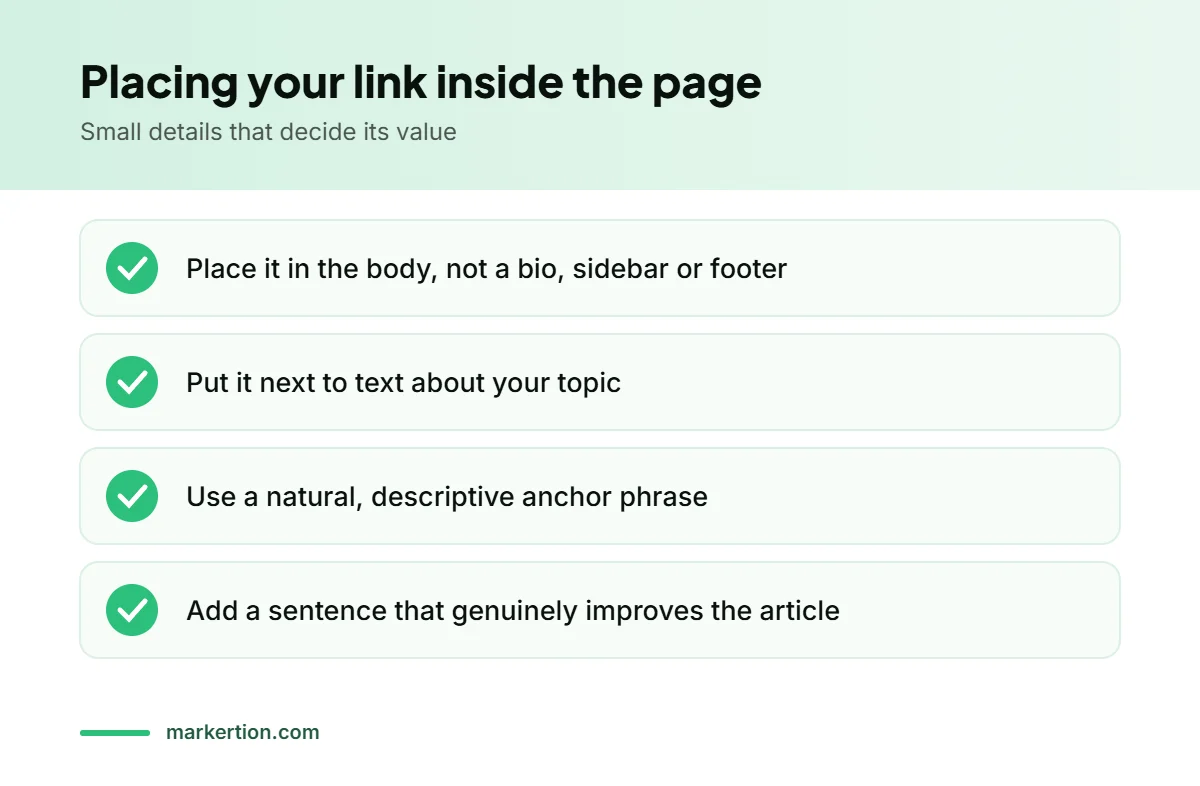
Once you have a good page, the exact placement still matters:
- Body, not boilerplate. Links in the main content carry more weight than links in author bios, sidebars or footers.
- Near related words. Place the link next to text that talks about your topic, so the surrounding context supports it.
- Natural anchor text. Use a descriptive phrase rather than an exact-match keyword every time. Our link building strategy framework covers anchor planning.
- Add value with the sentence. The best link insertions add a new sentence or two that improves the article, for example a tip, a statistic from your own data or a clarification.
- Higher on the page where it fits. A link in the first half of an article is often seen by more readers.
Matching Host Pages to Your Target Pages
Do not point every niche edit at your homepage. Match the host page’s topic to the most relevant page on your site:
- A guide about outreach tools should link to your outreach or link building service page.
- A comparison of SaaS tools should link to your product’s feature or comparison page.
- A local business guide should link to your local service page or location page.
When the host page and target page share a topic, both readers and search engines understand why the link exists. That is also what makes the link safe over time. Our guide on whether niche edits are safe explains the risk side in more detail.
Common Mistakes When Choosing Pages
- Buying on domain rating alone without checking the page’s own traffic.
- Accepting pages created yesterday and called “niche edits”. A new page is a guest post, priced and judged differently.
- Ignoring the outbound link count. A page with fifteen commercial links is a link list, not an article.
- Forcing irrelevant placements just because the site is strong.
- Never rechecking. Links can be removed or pages can lose traffic. Check placements regularly.
Niche Edits vs Guest Posts for the Same Goal
| Goal | Niche edit (link insertion) | Guest post |
|---|---|---|
| Fast impact | Strong, page already indexed and ranking | Slower, new page must be indexed |
| Control over content | Limited to a sentence or short paragraph | Full article |
| Topical depth | Relies on existing article | You shape the whole article |
| Best use | Boosting pages that are close to ranking | Building topical relevance at scale |
Most strong link profiles use both. Read guest posting vs niche edits for a deeper comparison.
Frequently Asked Questions
What makes a good page for a niche edit?
A good page has steady organic traffic, ranks for keywords close to yours, covers a related topic, has been indexed for a while and carries only a few outbound links.
Is domain rating important for niche edits?
Domain rating is a useful tie-breaker, but the specific page’s traffic and relevance matter more. A strong page on a mid-authority site often beats a weak page on a high-authority site.
Where should my link sit inside the article?
Inside the main body, next to text about your topic, ideally in the first half of the article, with a natural descriptive anchor.
How many niche edits can I build per month?
Build them steadily as part of a wider mix with guest posts and digital PR. The right volume depends on your competitors and how many truly relevant pages you can find.
Does Markertion check pages before placing niche edits?
Yes. Our niche edits (link insertion) service checks page traffic, ranking keywords, topic fit and outbound links before any placement, and replaces a link removed within six months.
Final Thoughts
A niche edit is only as strong as the page it lives on. Check page traffic, ranking keywords, relevance, age and outbound links, place your link in the body near related text, and match each host page to the right target page on your site. Do that and every link insertion adds real authority instead of just another line in a backlink report.
About the author: Shahidul Afridi is the founder of Markertion, a digital PR and link building agency that has built 6,000+ links for 120+ client partners since 2021. He writes from hands-on campaign work, not theory.

Digital PR & Link Building Expert