To build links to SaaS comparison and alternative pages, make those pages genuinely useful, then earn links indirectly: link to them internally from strong pages, place niche edits (link insertion) in existing articles that compare tools, earn mentions in “best tools” roundups that link to your comparisons, and use data or original testing that other writers want to cite. Direct outreach for a “[your tool] vs [competitor]” page rarely works on its own, because few sites want to link to a vendor’s own comparison.
Key Takeaways
- Comparison and alternative pages convert extremely well, but they are hard to earn links to directly.
- Make the page worth linking to first: honest, specific, up to date and full of real screenshots or data.
- Use internal links from your strongest pages to pass authority.
- Niche edits on existing comparison articles and inclusion in roundups are the most reliable external sources.
- Link to supporting assets, such as a benchmark or feature matrix, that naturally sit on the comparison page.
Why These Pages Deserve Links
Alternative pages (“[competitor] alternatives”) and comparison pages (“[your tool] vs [competitor]”) target people who are close to buying. They often have modest search volume but some of the highest conversion rates on a SaaS site. The trouble is that competitors, review sites and affiliate publishers target the same searches, and many of them have stronger domains. Without some authority pointing at your comparison pages, they tend to sit on page two.
The Link Problem
Most link-worthy content is neutral: research, tools and guides. A comparison page written by one of the vendors is not neutral, so editors are cautious about linking to it. That is why outreach that says “please link to our [tool] vs [competitor] page” usually fails. The strategy has to make the page more citable, then route authority to it through channels that make sense.
Step 1: Make the Page Link-Worthy
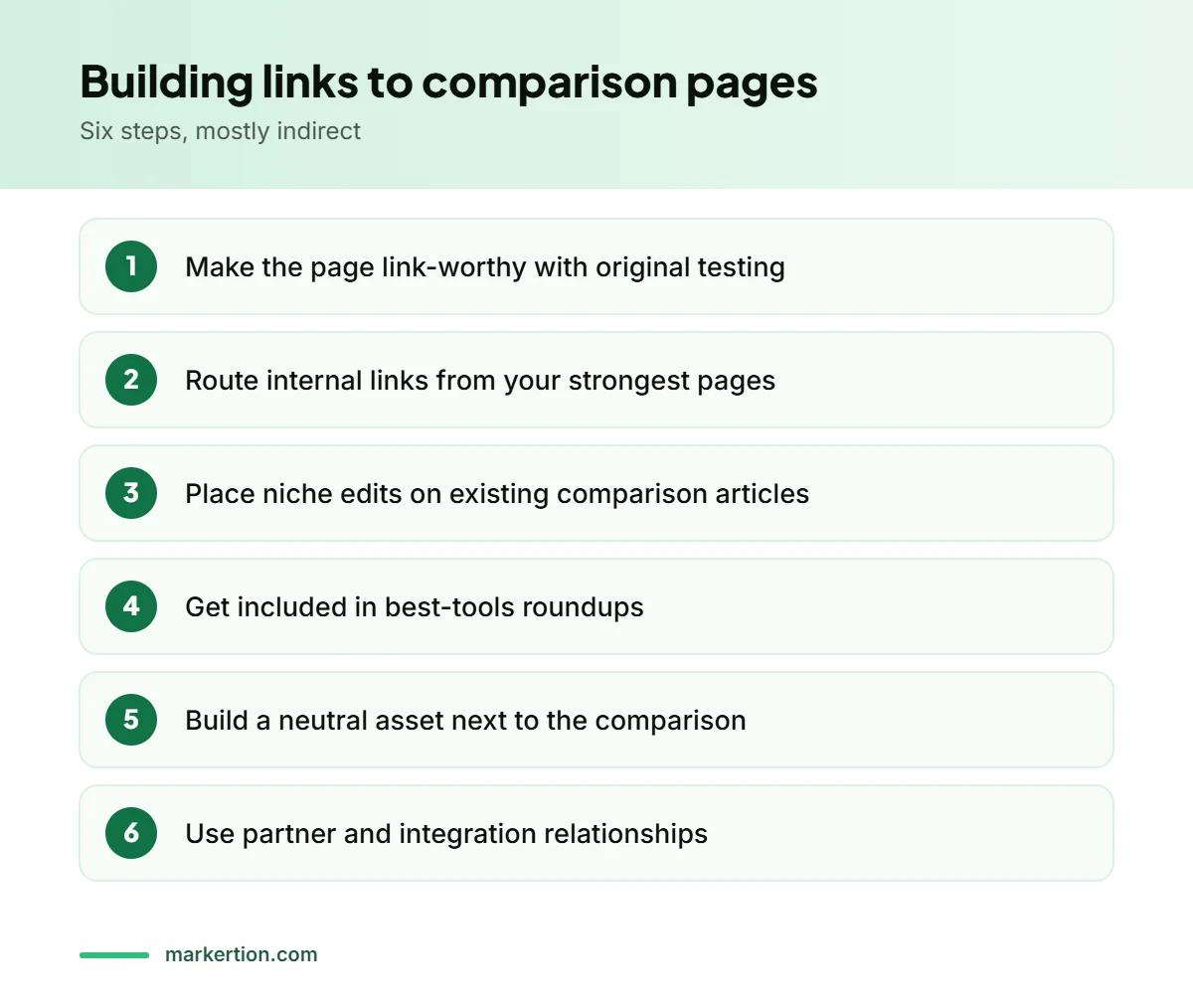
Before building any links, improve the page itself. Our SaaS SEO strategy guide covers the structure in depth, but the essentials are:
- An honest summary of who each tool suits best, including where the competitor is stronger.
- A detailed feature table with clear answers rather than vague ticks.
- Real screenshots of the same task in each tool.
- Original testing or data, such as setup time, number of steps for a common task, or performance benchmarks, with your method explained.
- Migration guidance for people switching.
- A visible updated date.
Original testing is the most important item for link building. It gives writers something specific to cite: “In a test by [your brand], setting up X took Y steps compared with Z.”
Step 2: Route Internal Authority
Your homepage, pricing page, popular guides and integration pages usually have the most backlinks on your site. Link from them to your comparison and alternative pages with descriptive anchors. Add a “compare” section to your navigation or footer, and link comparisons from relevant blog posts. This is often the fastest and safest way to lift these pages.
Step 3: Niche Edits on Existing Comparison Articles
Third-party articles that already compare tools in your category are ideal hosts. A sentence such as “For a detailed side-by-side test, see [your brand]’s comparison of A and B” adds value for readers who want more depth. Choose pages with real traffic and relevance, as explained in how to choose pages for niche edits.
Step 4: Get Into “Best Tools” Roundups
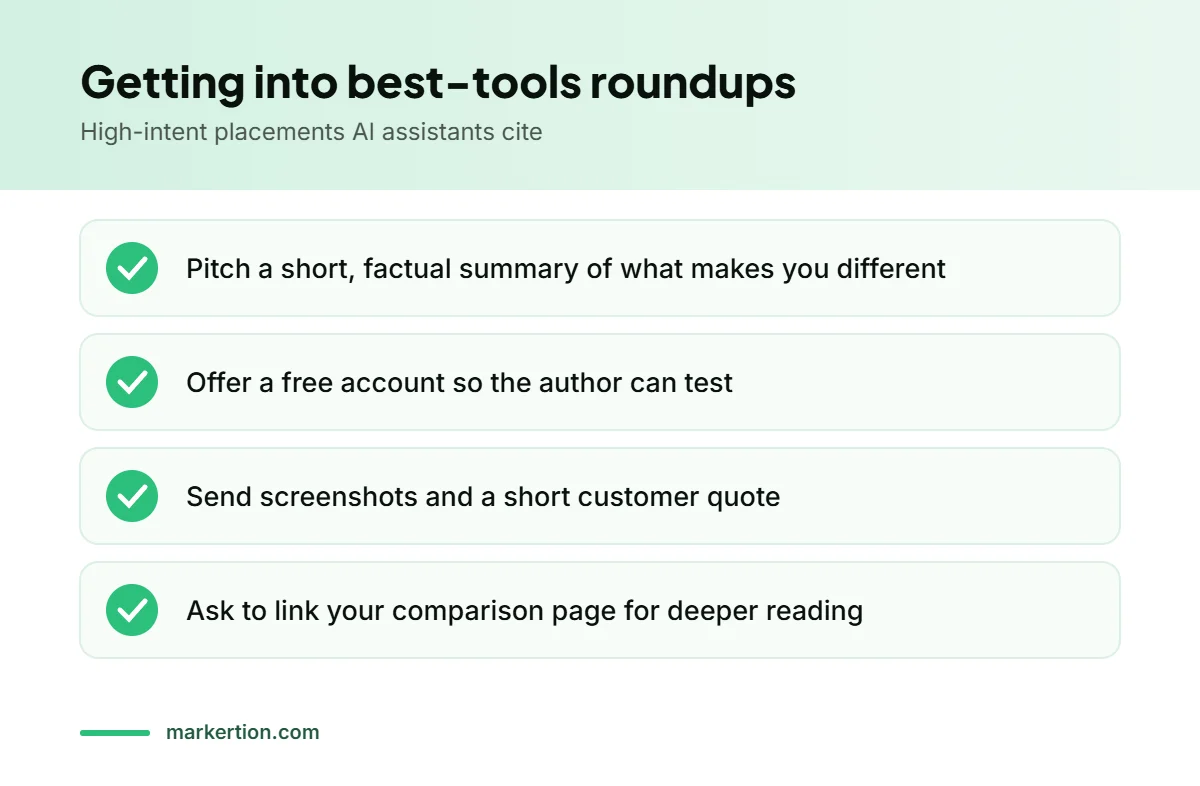
“Best [category] software” and “[competitor] alternatives” roundups on publisher sites are some of the most valuable placements for SaaS. They send buying traffic, carry relevance, and are frequently cited by AI assistants when people ask for shortlists. Ways to get included:
- Pitch the author with a short, factual summary of what makes your tool different.
- Offer a free account for testing.
- Provide screenshots and a short quote from a customer.
- Ask whether they would link to your comparison page for readers who want a detailed side-by-side view.
Our brand mentions service focuses on exactly these listicle placements.
Step 5: Build a Linkable Asset Next to the Comparison
Sometimes the best route is to create a neutral asset that lives on or alongside the comparison page:
- A category feature matrix comparing many tools, not just yours.
- A benchmark report from your testing.
- A pricing calculator that helps buyers estimate costs across tools.
- A switching checklist for teams moving between platforms.
Neutral assets earn links more easily. Link from the asset to your specific comparison pages so the authority flows where you need it. Our SaaS link building team builds assets like these for clients.
Step 6: Use Partner and Integration Relationships
If you integrate with tools that also compete loosely with a rival, partners may be happy to link to comparisons that help their mutual customers choose. Integration directories and co-marketing content can also link to your comparison or migration pages. Our guide on integration and partner page backlinks covers how to build these relationships.
Anchor Text for Comparison Pages
| Anchor type | Example | Use |
|---|---|---|
| Branded | “[Your brand]’s comparison” | Most links |
| Descriptive | “side-by-side test of A and B” | Many links |
| Partial match | “A vs B comparison” | Some links |
| Exact match | “[competitor] alternatives” | Rarely, on the most relevant placements |
Keep anchors natural. Comparison keywords contain competitor brand names, so heavy exact-match anchors look unnatural fast.
How to Measure Success
- Rankings for “[competitor] alternative” and “[your tool] vs [competitor]” keywords.
- Organic sign-ups and demo requests from those pages.
- Referring domains to each comparison page.
- Mentions in AI answers to shortlist and comparison prompts.
Common Mistakes
- Biased pages that only list your strengths. They rarely earn links or trust.
- Direct outreach asking for links to a vendor comparison with no added value.
- Outdated feature tables that competitors or readers can easily disprove.
- Ignoring internal links from your strongest pages.
- Over-optimised anchors with competitor names.
Keeping Comparison Pages Fair and Accurate
Comparison pages carry extra responsibility because they describe other companies’ products. Keep claims factual and verifiable, link to the competitor’s own documentation where it helps, avoid guessing at their pricing if you cannot confirm it, and review each page whenever either product ships a major change. Fair pages are easier for writers to cite, harder for competitors to dispute, and more likely to be trusted by AI assistants that weigh several sources before naming a tool.
Frequently Asked Questions
Can you build backlinks to SaaS comparison pages?
Yes, but usually indirectly. Make the page genuinely useful with original testing, then use internal links, niche edits on existing comparison articles, inclusion in roundups and neutral assets that link to it.
Should comparison pages target competitor names?
Comparison and alternative pages naturally include competitor names because buyers search for them. Keep the content honest and factual and avoid misleading claims.
What makes a comparison page link-worthy?
Original testing or data, honest summaries, detailed feature tables, real screenshots, migration help and a clear updated date make it something others want to cite.
Do AI assistants use comparison pages?
AI assistants often draw on comparison articles and roundups when answering shortlist questions. Being included in trusted third-party comparisons helps you appear in those answers.
Can Markertion build links to my comparison pages?
Yes. Our SaaS link building service combines niche edits, roundup mentions and linkable assets to support comparison and alternative pages.
Final Thoughts
Comparison and alternative pages are some of the most valuable pages a SaaS site can rank, but they need a careful link strategy. Make them honest and backed by real testing, route internal authority to them, place niche edits on existing comparison content, earn spots in roundups and build neutral assets that link onward. Together these steps lift the pages that turn searchers into customers.
About the author: Shahidul Afridi is the founder of Markertion, a digital PR and link building agency that has built 6,000+ links for 260+ client partners since 2021. He writes from hands-on campaign work, not theory.

Digital PR & Link Building Expert