
A local SEO checklist covers everything a service business needs to appear in Google’s map pack and local organic results: a complete Google Business Profile, consistent name, address and phone (NAP) details, strong location and service pages, steady reviews, local citations and local links. The 35 steps below are grouped in the order that usually brings results fastest for plumbers, clinics, law firms, agencies and other service businesses.
Key Takeaways
- Your Google Business Profile is the single most important local ranking asset.
- Relevance, distance and prominence are the three main factors Google uses for local results.
- Consistent NAP details across the web build trust for Google and for AI assistants.
- Every core service deserves its own page; every served area may deserve one too, if it has unique content.
- Reviews and local links separate leaders from everyone else in competitive markets.
How Local Rankings Work
Google’s own guidance says local results are based mainly on relevance (how well your profile matches the search), distance (how far you are from the searcher or the location in the query) and prominence (how well known and trusted your business is). You cannot change distance, so the checklist focuses on relevance and prominence.
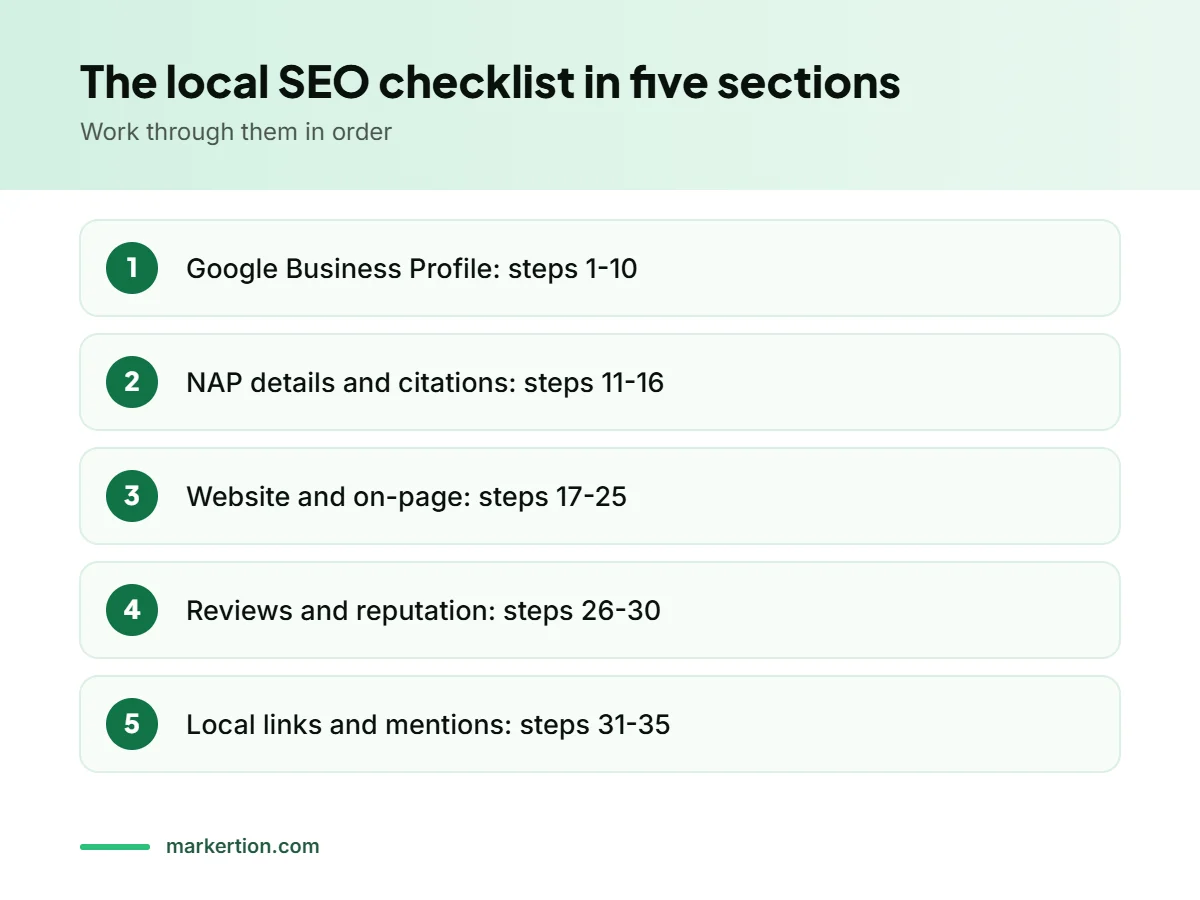
Section 1: Google Business Profile (Steps 1-10)
- Claim and verify your profile. Use the exact legal or trading name, with no extra keywords.
- Choose the most accurate primary category. This is one of the strongest relevance signals. Add secondary categories only where they truly apply.
- Set the correct address or service area. Service area businesses without a storefront should hide the address and list the areas they serve.
- Add accurate hours, including holiday hours.
- Write a clear business description that explains what you do and who you serve, in plain language.
- Add every service with a short description for each.
- Upload real photos: team, work in progress, finished jobs, vehicles and premises. Add new ones regularly.
- Use Google posts for offers, updates and recent projects.
- Answer common questions in the Q&A section so the right information shows.
- Link to the right page, usually the homepage or a location page, and add UTM tags to track visits in analytics.
Our Google Business Profile optimization checklist goes deeper on each of these.
Section 2: NAP and Citations (Steps 11-16)
- Choose one exact format for your business name, address and phone number, and use it everywhere.
- Put NAP details on your website in the footer or contact page as plain text, not only in an image.
- Add LocalBusiness schema with the same details.
- List the business on major directories and data aggregators relevant to your country.
- Add industry-specific directories, such as legal, medical or trade directories.
- Audit and fix inconsistencies in old listings, including previous addresses and phone numbers.
See our list of the best local citation sites for the USA and UK or let our local citations service handle the build and clean-up.
Section 3: Website and On-Page (Steps 17-25)
- Create one page per core service with unique content about that service.
- Create location pages only where you have something unique to say, such as local projects, team members, testimonials or area-specific details. Thin copies with only the city name swapped rarely help.
- Use local terms naturally in titles, H1s and opening paragraphs.
- Embed a map on your contact or location page.
- Show reviews and case studies from local customers on service pages.
- Make phone numbers clickable on mobile.
- Make sure pages load fast on mobile, since most local searches happen on phones.
- Answer local questions in FAQs, such as service areas, response times and pricing approach.
- Link internally between service pages, location pages and relevant blog posts.
Section 4: Reviews and Reputation (Steps 26-30)
- Ask every happy customer for a review with a direct link to your profile.
- Make it easy: use a short URL or QR code on invoices, emails and job sheets.
- Reply to every review, positive or negative, politely and specifically.
- Never buy or gate reviews. It breaks Google’s policies and can lead to removal.
- Collect reviews on other trusted platforms relevant to your industry as well.
Section 5: Local Links and Mentions (Steps 31-35)
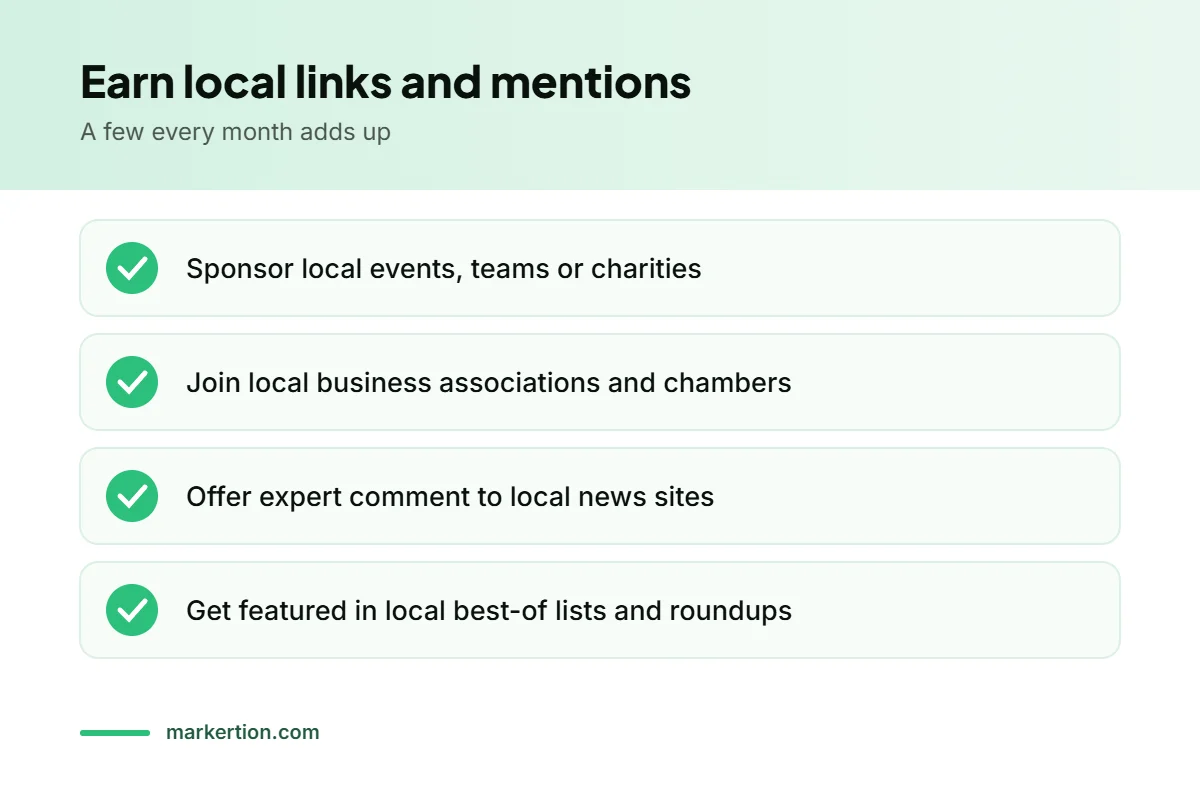
- Sponsor local events, teams or charities that list sponsors with links.
- Join local business associations and chambers of commerce.
- Offer expert comment to local news sites and blogs.
- Partner with complementary local businesses for guides or referrals.
- Get featured in local “best of” lists and roundups, which also helps you appear in AI answers about local providers.
For more ideas, see our guide on ranking a local business on Google Maps.
Quick Priority Guide
| If you have limited time | Focus on |
|---|---|
| One afternoon | Steps 1-10: complete and verify your Business Profile |
| One week | Add steps 11-16 and fix NAP inconsistencies |
| One month | Build service pages, schema and a review request routine |
| Ongoing | New photos, posts, reviews and local links every month |
Local SEO and AI Assistants
People increasingly ask AI assistants for local recommendations, such as “best emergency plumber near me” or “good family dentist in [area]”. Assistants draw on business profiles, review platforms, local news and directories. Consistent NAP data, plenty of genuine reviews and mentions in local roundups all improve the chance of being named. Our guide to AI search visibility explains how those citations are chosen.
Common Local SEO Mistakes
- Stuffing keywords or city names into the business name.
- Using different phone numbers or address formats across listings.
- Building dozens of near-identical city pages.
- Ignoring negative reviews instead of replying.
- Linking the profile to a page that does not mention the service or area.
How to Measure Local SEO Progress
Track a small set of numbers every month so you know which steps are paying off:
- Business Profile performance: searches, views, calls, direction requests and website clicks.
- Map pack rankings for your main service keywords, checked from several points across your service area, since rankings change with the searcher’s location.
- Organic traffic and leads to service and location pages in analytics.
- Review count and average rating, and how quickly you reply.
- Citation accuracy, checked every few months for listings that have drifted.
If calls and direction requests rise while rankings stay flat, your profile content is converting better. If rankings rise but calls do not, look at your photos, reviews and the page the profile links to.
Frequently Asked Questions
What is the most important local SEO factor?
A complete, accurate Google Business Profile with the right primary category is usually the most important single factor, followed by reviews, consistent NAP details and relevant website pages.
Do service area businesses need an address?
You need a real address to verify, but service area businesses without a storefront can hide it and list the areas they serve instead.
How many reviews do I need to rank locally?
There is no fixed number. Look at the businesses in the map pack for your main keywords and aim to steadily match or exceed their review count and recency.
Are local citations still important?
Yes. Citations on major and industry directories help confirm your business details, support trust and often appear as sources in AI answers about local businesses.
Can Markertion help with local SEO?
Yes. Our local SEO service covers Business Profile optimisation, citations, on-page work, reviews strategy and local link building.
Final Thoughts
Local SEO rewards businesses that are complete, consistent and visibly trusted in their area. Start with your Business Profile, lock down your NAP details, build real service pages, ask for reviews every week and earn a few local links each month. Work through these 35 steps in order and you will cover the factors that decide most local rankings.
About the author: Shahidul Afridi is the founder of Markertion, a digital PR and link building agency that has built 6,000+ links for 120+ client partners since 2021. He writes from hands-on campaign work, not theory.

Digital PR & Link Building Expert