
An AI SEO workflow uses AI tools to speed up research, briefing, drafting and optimisation, while people keep control of strategy, facts, experience and final quality. For agencies the winning setup is a fixed pipeline: keyword and intent research, a human-approved brief, an AI-assisted draft, expert editing with real examples, on-page optimisation, and a final quality check before publishing.
Key Takeaways
- AI is best at speed: clustering keywords, summarising competitors, outlining and first drafts.
- People are essential for strategy, original insight, fact-checking and brand voice.
- A written brief is the control point. Weak briefs produce weak AI drafts.
- Google judges helpfulness, not whether a tool was used. Thin, unedited AI content still fails.
- Standardise the workflow so every writer and editor follows the same steps.
Why Agencies Need a Defined AI Workflow
Most agencies already use AI somewhere. The problem is that every team member uses it differently. One writer pastes a keyword into a chatbot and publishes the result; another uses AI only for headings. Quality varies, clients notice, and nobody can say which step caused a weak article.
A defined workflow fixes that. It tells everyone where AI is used, where a human must step in, and what “done” means before a post goes live. It also makes the output easier to scale, because new team members follow the same pipeline from day one.
The Six-Stage AI SEO Workflow
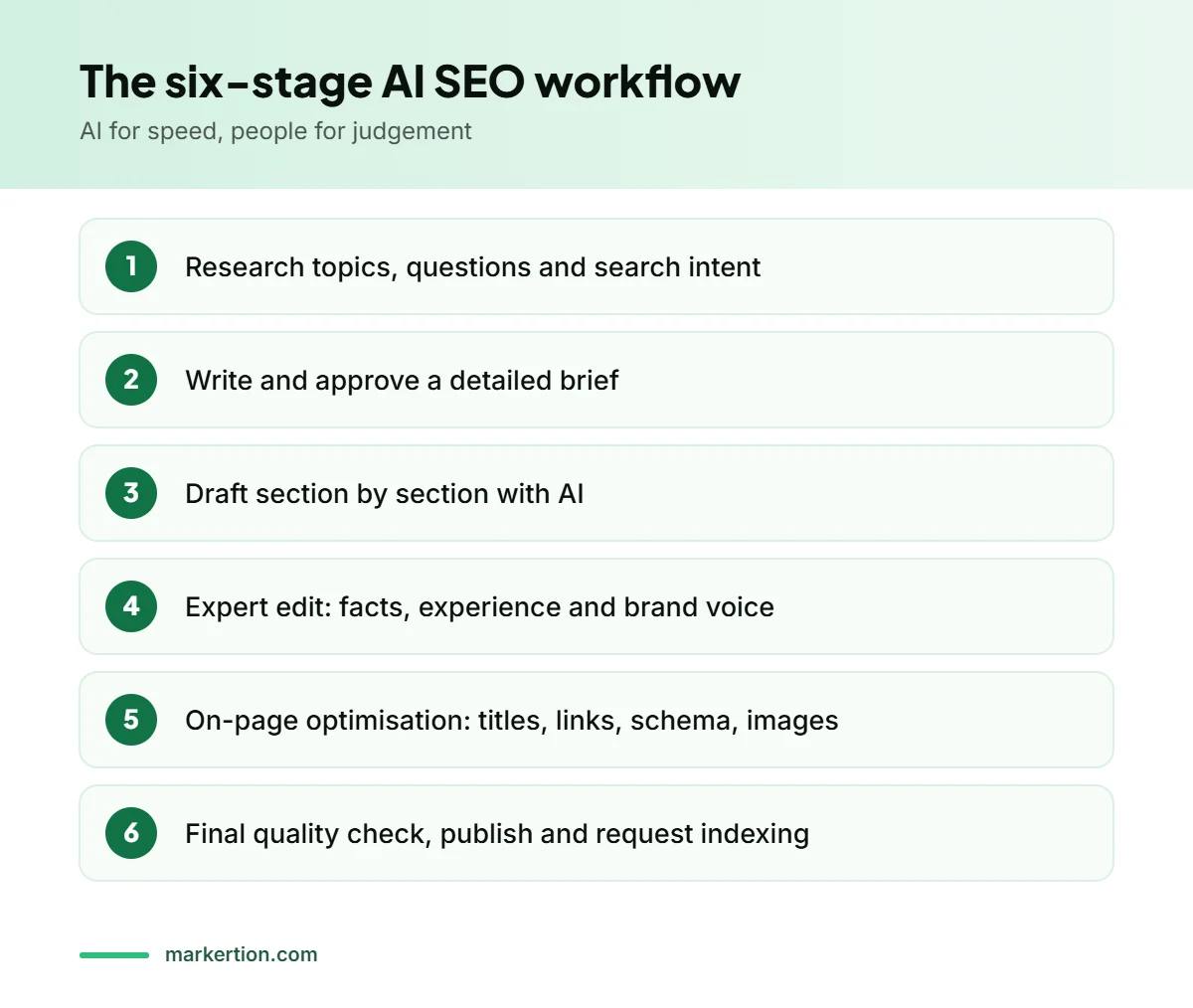
Stage 1: Research and intent
Start with the topic, not the keyword. Use AI to expand a seed topic into related questions and subtopics, then confirm demand with a keyword tool. Look at the current top results and note the intent: guide, list, comparison, tool page or service page. AI can summarise the top ten results quickly, but a person should decide which angle the client can genuinely win with.
Stage 2: The brief
The brief is where quality is decided. A good brief includes:
- The primary keyword and three to five related terms.
- The search intent and the reader’s level of knowledge.
- A required outline with H2 and H3 headings phrased as questions where it fits.
- Points the article must make that competitors miss.
- The client’s real data, examples or process to include.
- Internal links to add and the page the article should support.
- Word count range and format rules.
We use a version of the content brief template for link building articles for every client. AI can draft the brief from research notes, but a strategist approves it.
Stage 3: The AI-assisted draft
Feed the approved brief into your AI tool section by section rather than asking for the whole article at once. Section-level prompts produce tighter, more specific text and make it easier to steer each part. Ask for an answer-first opening, short paragraphs and clear headings. Do not ask the AI to invent statistics, quotes or case studies.
Stage 4: Expert editing
This is the stage that makes content worth ranking. The editor:
- Checks every fact and removes anything that cannot be verified.
- Adds first-hand experience: real examples, screenshots, client lessons and opinions.
- Cuts filler, repetition and generic phrasing.
- Aligns tone with the client’s brand voice.
Google’s guidance focuses on helpful, people-first content with real experience behind it, so this step is not optional. Our guide on E-E-A-T for SEO agencies explains what reviewers look for.
Stage 5: On-page optimisation
Write the title tag and meta description, add internal links from the brief, add schema such as Article and FAQ where appropriate, compress images and write alt text. AI tools can suggest titles and check keyword coverage, but a person makes the final call.
Stage 6: Quality check and publishing
Use a short checklist before every post goes live, then request indexing in Search Console for important pages.
The Pre-Publish Quality Checklist
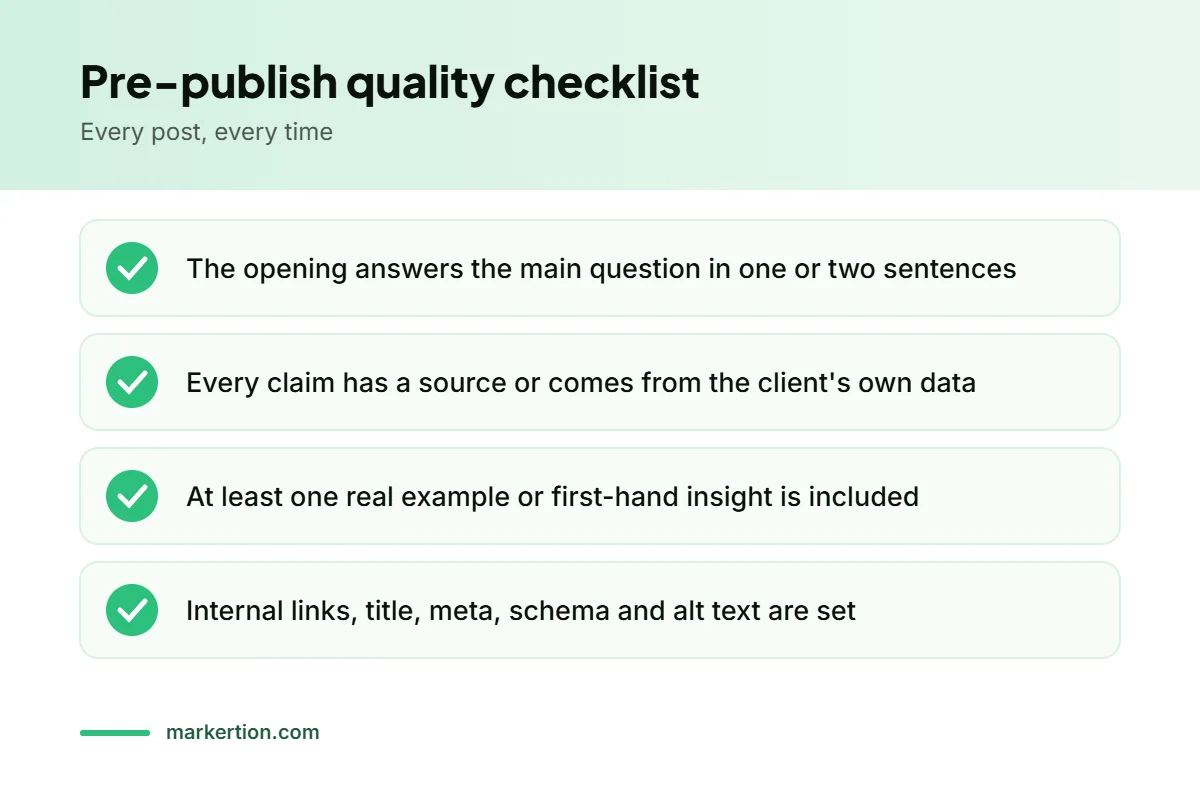
- The opening answers the main question in one or two sentences.
- Every statistic or claim has a source or comes from the client’s own data.
- At least one real example or first-hand insight is included.
- Headings follow the brief and match search intent.
- Internal links point to the right service page and related articles.
- Title, meta and schema are set.
- Images are compressed and have descriptive alt text.
- The article reads naturally aloud with no repeated phrases.
Where AI Saves the Most Time
| Task | Time saved with AI | Human role |
|---|---|---|
| Topic and question expansion | High | Choose which topics matter |
| Competitor summaries | High | Spot gaps worth filling |
| Brief drafting | Medium | Approve and add client insight |
| First draft | High | Edit, fact-check, add experience |
| Title and meta options | Medium | Pick and refine |
| Internal link suggestions | Medium | Check relevance |
| Final quality review | Low | Own the decision |
Tools That Fit the Workflow
You do not need a large tool stack. Most agencies use a general AI assistant for drafting and summaries, a keyword tool for demand data, a crawler for on-page checks, and a project tool to move each article through the stages. If you want to automate hand-offs between steps, see our tutorial on building an AI SEO agent with n8n and ChatGPT and our list of AI content tools for SEO agencies.
Writing for AI Search as Well as Google
The same workflow also improves your chance of being cited by AI assistants. Answer-first openings, clear definitions, comparison tables and FAQs are exactly the passages ChatGPT, Gemini and Perplexity like to quote. Add your brand’s consistent facts and real experience, and the content becomes easier for assistants to trust. Our guide on AI search visibility covers the off-site signals that complete the picture.
Common Mistakes
- Skipping the brief and asking AI to “write a blog about X”.
- Publishing unedited drafts. They read generic, repeat themselves and sometimes contain errors.
- Letting AI invent data. Made-up numbers damage trust with readers, clients and search engines.
- No ownership. Every article needs one named editor responsible for the final quality.
How to Roll the Workflow Out Across Your Team
Writing the workflow down is the easy part. Getting a whole team to use it takes a few deliberate steps:
- Start with one client. Run five articles through the full pipeline, time each stage and note where quality slipped.
- Create shared prompt templates. Save the prompts that worked for research, outlines and each section type, so writers are not starting from scratch.
- Name owners for each stage. A strategist owns the brief, a writer owns the draft and an editor owns the final approval.
- Track two numbers. Measure hours per article and the editor’s revision rate. If revisions stay high, the brief or prompts need work, not the writer.
- Review monthly. AI tools change quickly. Test new models or features on one article before changing the whole process.
Agencies that roll it out this way usually find the biggest gain is not faster drafting but fewer rewrites, because every article starts from an approved brief and passes the same checks before a client sees it.
Frequently Asked Questions
Does Google penalise AI-generated content?
Google focuses on whether content is helpful and original, not on how it was produced. Thin, unedited AI content that adds nothing new tends to perform poorly, while edited content with real expertise can rank well.
What parts of SEO content should AI handle?
AI works well for research expansion, competitor summaries, outlines, first drafts and title options. Strategy, fact-checking, first-hand experience and final approval should stay with people.
How long does an AI-assisted article take?
With a clear brief and workflow, many agencies cut drafting time sharply, but editing and fact-checking still need focused human time. The total depends on topic depth and how much original insight is added.
How do I keep AI content on brand?
Give the AI a short brand voice guide and approved examples, prompt section by section, and have an editor who knows the brand review every article.
Can Markertion produce content for my clients?
Yes. Our content writing service follows this workflow, with human editors, real examples and on-page optimisation for every article.
Final Thoughts
AI makes good agencies faster, but it does not replace judgement. Build a fixed workflow, put the brief and the expert edit at its centre, and use a short quality checklist before anything goes live. That combination lets you scale content for clients without the quality problems that make AI content fail.
About the author: Shahidul Afridi is the founder of Markertion, a digital PR and link building agency that has built 6,000+ links for 120+ client partners since 2021. He writes from hands-on campaign work, not theory.

Digital PR & Link Building Expert