To add link building to your agency services, decide whether to build it in-house or resell a white label partner, package it into clear tiers tied to client goals, set quality rules for every placement, and report results in terms clients understand: rankings, traffic and leads for the pages the links support. Most agencies start with white label fulfilment, prove the results, then decide later whether to bring parts of it in-house.
Key Takeaways
- Link building is one of the most requested add-ons for SEO clients, and one of the hardest to deliver well.
- White label partners let you launch quickly without hiring outreach staff.
- Sell outcomes and process, not a number of links.
- Set written quality standards before your first order, and hold every partner to them.
- Report links alongside the rankings and traffic they support.
Why Agencies Add Link Building
Clients who buy SEO or content eventually ask the same question: “Why are we still not on page one?” In competitive niches the answer is often authority. Great content and clean technical SEO get a site into the race, but links decide where it finishes. If your agency cannot offer links, clients either stall or find another provider who can.
Adding link building also raises the value of each account. It turns a content or technical retainer into a fuller growth programme, and it gives you a clearer story to tell when rankings move.
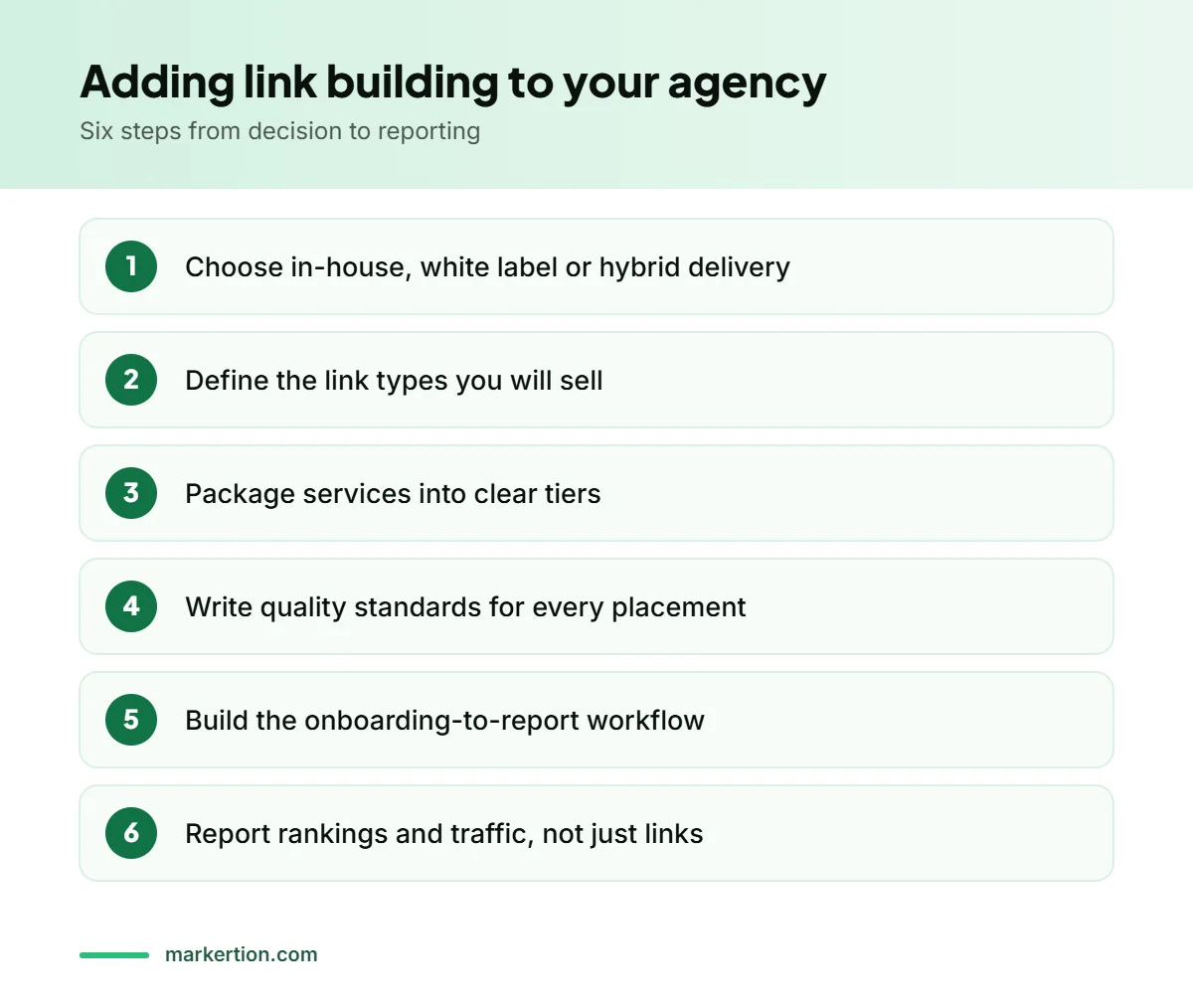
Step 1: Choose Your Delivery Model
| Model | Pros | Cons | Best for |
|---|---|---|---|
| In-house team | Full control, higher margin at scale | Hiring, training, tools and slow start | Agencies with steady high volume |
| White label partner | Fast launch, no hiring, proven processes | Less direct control, need to vet partner | Most agencies starting out |
| Hybrid | Strategy in-house, fulfilment outsourced | Coordination effort | Growing agencies with a strategist |
For most agencies the hybrid model works best: your team owns strategy, target pages and client communication, while a white label link building partner handles prospecting, outreach and placements under your brand.
Step 2: Define What You Will Sell
Decide which link types you will offer and what each is for:
- Guest posts for topical relevance and controlled context.
- Niche edits (link insertion) for placing links on pages that already have age and traffic.
- Digital PR for high-authority links and brand mentions.
- Brand mentions in listicles for visibility in “best of” articles and AI answers.
- Local citations for local clients.
You do not need all of these on day one. Start with guest posts and niche edits, which cover most client needs, then add digital PR once you have results to show.
Step 3: Package It Into Tiers
Clients understand packages better than menus. Build three tiers around the outcome and the level of competition, not just the link count. A simple structure looks like this:
| Tier | Typical client | What is included |
|---|---|---|
| Starter | Local or low-competition sites | A small monthly mix of guest posts and niche edits, anchor plan, monthly report |
| Growth | Competitive national niches | More placements, higher authority targets, topical cluster support |
| Authority | Highly competitive or SaaS | Guest posts, niche edits and a digital PR campaign each quarter |
Set your prices from your fulfilment cost plus your margin and the strategy time you put in. Our link building pricing guide shows what agencies typically charge in each range.
Step 4: Write Your Quality Standards
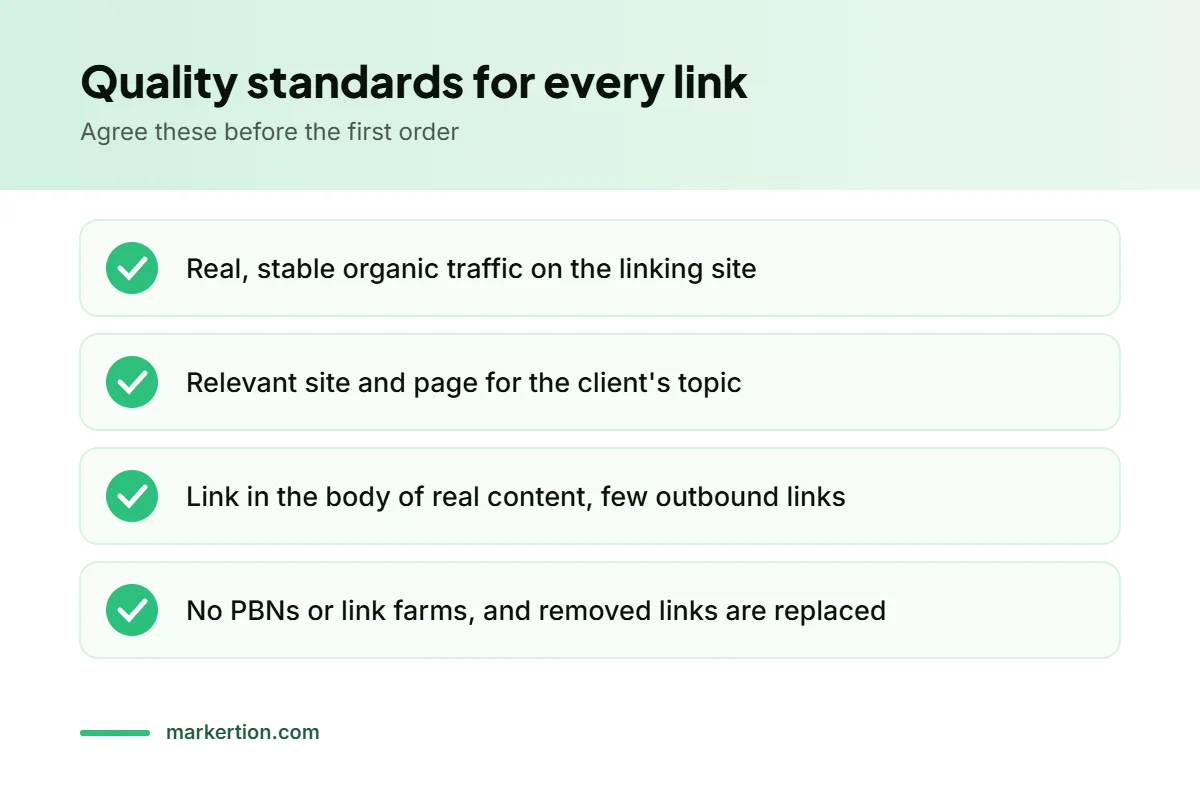
Before you place a single order, write down the rules every link must meet. Share them with your partner and your team:
- The linking site has real, stable organic traffic.
- The site and page are relevant to the client’s topic.
- Links sit in the body of real content, not in footers or bios.
- Outbound links on the page are few and relevant.
- No private blog networks, link farms or spam neighbourhoods.
- Every placement is checked for indexation after publishing.
- Removed links within an agreed period are replaced.
Our guest post quality checklist is a good starting point for these rules.
Step 5: Build the Workflow
- Onboarding: collect target pages, competitors, existing backlinks and brand guidelines.
- Strategy: map topics and target pages, plan anchors and link types for the month. See our link building strategy framework.
- Approval: share the proposed sites or topics with the client if they want sign-off.
- Fulfilment: your partner or team runs outreach and placement.
- Quality check: your team verifies every link against the standards.
- Reporting: deliver a branded monthly report.
Step 6: Report What Clients Care About
A list of URLs is not a report. Clients want to know whether the work is moving their business. Include:
- Links built this month, with site, page, anchor and target page.
- Ranking changes for the target pages and keywords.
- Organic traffic and conversions to those pages.
- What is planned for next month and why.
White label partners usually provide raw link data; your job is to turn it into a clear story.
How to Vet a White Label Partner
- Ask for live sample placements in several niches from the last few months.
- Check the sample sites against your quality standards yourself.
- Confirm the partner works under your brand and never contacts your clients.
- Ask how they handle removed links and replacements.
- Start with a small trial order before moving full client volume.
Our guide to white label guest posting services for SEO agencies covers vetting in more detail.
Common Mistakes
- Selling link counts instead of outcomes, which invites price shopping.
- Skipping quality rules and discovering problems after a client does.
- Pointing every link at the homepage.
- No anchor plan, which leads to over-optimised profiles.
- Underpricing strategy time. Planning and reporting take real hours.
How to Pitch Link Building to Existing Clients
Your current clients are the easiest place to start, because you already know their sites and goals. A simple pitch process works well:
- Find the gap. Pick two or three important pages that rank on page two or low on page one, and compare their referring domains with the pages ranking above them.
- Show the comparison. A short table of “your page vs the top three” for referring domains usually makes the case on its own.
- Propose a focused trial. Offer three months of link building on those specific pages, with a clear plan of link types and anchors.
- Agree what success looks like. Choose target keywords and pages up front so both sides judge the trial on the same numbers.
- Report early wins. Share each new placement as it goes live, then the ranking movement at the end of each month.
Clients who see their own pages move are far more likely to keep the service running and to expand it to more of their site. This also gives you real case studies to use when you sell link building to new clients.
Frequently Asked Questions
Should my agency build links in-house or use a white label partner?
Most agencies start with a white label partner because it is faster and cheaper to launch. In-house teams make more sense once you have steady high volume and want full control.
How should agencies price link building?
Price from your fulfilment cost, your strategy and reporting time, and the margin you need. Package it into tiers based on competition and goals rather than selling single links.
Will clients know I use a white label provider?
A proper white label partner works under your brand, never contacts your clients directly and provides reports you can rebrand.
What should a link building report include?
Each link’s site, page, anchor and target page, plus ranking and traffic changes for the target pages and the plan for next month.
Can Markertion fulfil link building for my agency?
Yes. Our white label link building service handles guest posts, niche edits and digital PR under your brand, with quality checks and rebrandable reports.
Final Thoughts
Link building is one of the best ways to grow an agency’s value per client, but only if quality and reporting are under control. Choose a delivery model, package services around outcomes, write strict quality rules, and report results in the language clients care about. Start small with a trusted partner, prove the results, and scale from there.
About the author: Shahidul Afridi is the founder of Markertion, a digital PR and link building agency that has built 6,000+ links for 260+ client partners since 2021. He writes from hands-on campaign work, not theory.

Digital PR & Link Building Expert