
AI can speed up backlink prospecting by expanding seed topics into search queries, classifying large lists of sites by relevance, extracting contact details from pages, and drafting personalised first lines, but people must still check traffic, quality and fit before any outreach. The best results come from a hybrid workflow: AI handles volume and sorting, while a human reviews the final shortlist against clear quality rules.
Key Takeaways
- Use AI for the slow, repetitive parts: query ideas, categorisation, summarising sites and drafting personal notes.
- Never let AI decide on its own whether a site is good enough. Traffic, spam signals and editorial quality need human checks with real data.
- Feed AI clear criteria, so its sorting reflects your quality standards.
- Keep a human in the loop before emails go out, to protect your reputation and deliverability.
- Measure prospect-to-placement rate, not the size of your list.
Why Prospecting Is the Bottleneck
Prospecting is finding the sites and pages you want links from, then the right person to contact at each. It is often the slowest part of link building. A good campaign might need hundreds of candidate sites to end up with a few dozen strong placements, and every candidate needs checking.
AI tools have changed this. Tasks that took hours, such as sorting a list of 1,000 domains into “relevant”, “maybe” and “irrelevant”, can now take minutes. The risk is that faster prospecting leads to lower standards, with more emails sent to weaker sites. The workflow below keeps the speed and protects quality.
The Hybrid AI Prospecting Workflow
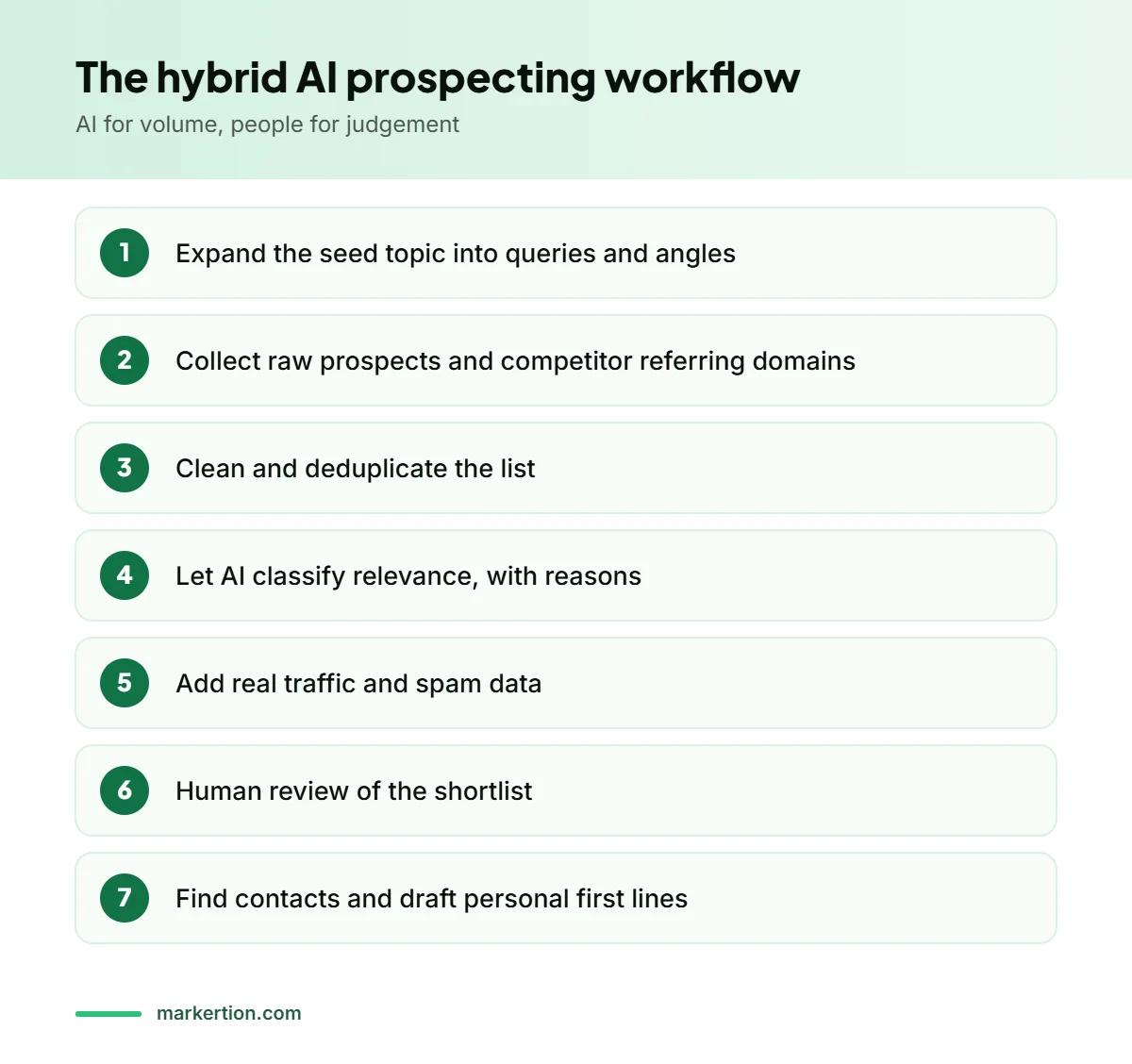
Step 1: Expand the seed topic
Give an AI assistant your target page, audience and topic, and ask for a list of related subtopics, adjacent industries and search operators. For example, a SaaS time-tracking tool might expand into remote work, freelancing, agency management, payroll and productivity. Combine these with operators such as “intitle:best tools”, “write for us” or “inurl:resources”.
Step 2: Collect raw prospects
Run the queries in a search tool or SEO platform and export results. Add competitors’ referring domains from a backlink tool, since sites that link to competitors already accept links on your topic. At this stage the list is large and messy, which is fine.
Step 3: Clean and deduplicate
Remove duplicates, obvious directories, social networks and sites you have contacted recently. Simple spreadsheet rules or scripts handle most of this.
Step 4: Let AI classify relevance
Give the AI a short description of your ideal prospect and ask it to label each site using the homepage title, description and a few recent post titles. Ask for a reason with each label. For example:
- Relevant: focuses on topics closely related to the target page.
- Maybe: partly related or general business content.
- Not relevant: unrelated or spam topics.
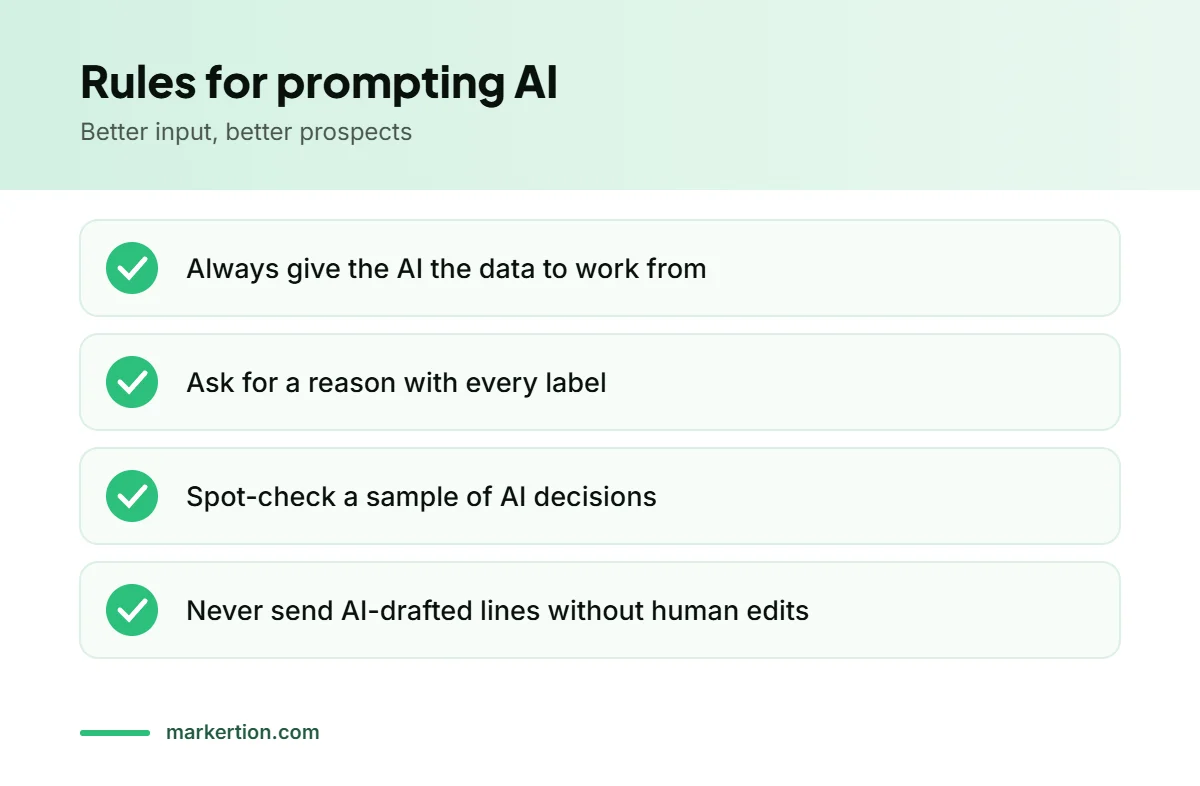
This step saves the most time. Spot-check a sample of labels to make sure the AI follows your criteria.
Step 5: Add real quality data
For the “relevant” and “maybe” groups, pull organic traffic, traffic trend and referring domains from an SEO tool. AI cannot see this data reliably by itself. Filter out sites with no traffic, sharp drops or obvious link-selling patterns. Our guide on how to evaluate a backlink lists the signals to check.
Step 6: Human review of the shortlist
A person reviews the final list, opens each site and confirms relevance, editorial quality and outbound link patterns. This is where judgement matters most. Use the guest post quality checklist as your standard.
Step 7: Find contacts and draft personalisation
AI can extract author names and contact pages, summarise a site’s recent articles and suggest a personal first line for each pitch. A person should edit those lines and confirm they are accurate before sending.
Where AI Helps and Where It Does Not
| Task | AI is good at | Human must handle |
|---|---|---|
| Query and topic ideas | Generating many angles quickly | Choosing which angles fit the campaign |
| Relevance sorting | Labelling large lists with reasons | Spot-checking and final decisions |
| Traffic and spam checks | Summarising data you provide | Pulling real data and judging it |
| Contact finding | Extracting names from pages | Verifying the right person |
| Personalisation | Drafting first lines | Checking accuracy and tone |
| Sending | Scheduling sequences | Approving every campaign |
Prompts That Work for Prospecting
- “Here is my target page and audience. List 20 related subtopics and adjacent industries where sites might link to this page.”
- “Classify each of these sites as Relevant, Maybe or Not relevant to [topic], using only the title, description and recent post titles provided. Give a one-sentence reason for each.”
- “Summarise the main topics of these five recent articles in one sentence each.”
- “Write a one-sentence personal opening for an outreach email to the author of [article title], mentioning a specific point from the summary.”
Always give the AI the data to work from. Asking it to “find sites” from memory leads to invented or outdated results.
Protecting Quality and Deliverability
Faster prospecting makes it tempting to send more emails. Resist it. Sending large volumes to weakly targeted lists increases spam complaints and damages your domain’s sender reputation. Keep a steady sending pace, use a short follow-up sequence, and stop immediately when someone replies or opts out. See our guide to the outreach follow-up sequence for timing rules.
Measuring Whether AI Is Helping
Track these before and after adding AI to your workflow:
- Hours spent per campaign on prospecting.
- Share of prospects that pass the human quality review.
- Reply rate and positive reply rate.
- Placements per hundred prospects contacted.
If speed improves but placements per hundred prospects fall, your AI criteria or human review need tightening.
Example: One Campaign From Start to Finish
To see how the steps fit together, here is how a typical campaign runs for a SaaS client:
- AI expands the topic “remote team time tracking” into 25 related subtopics and search operators.
- The searches plus competitor backlinks produce around 1,200 raw domains.
- Cleaning removes duplicates, directories and recent contacts, leaving about 800.
- AI labels them, and roughly a quarter come back “relevant” or “maybe”.
- Traffic and spam checks with real SEO data cut that to a shortlist of strong sites.
- A link builder reviews each site by hand and approves the final list.
- AI drafts personal first lines, which the link builder edits before sending.
The time saving comes mainly from steps 4 and 7. The quality comes from steps 5 and 6, which stay with people.
Common Mistakes
- Trusting AI-generated site lists without checking they exist and get traffic.
- Skipping human review of the final shortlist.
- Fully automated personalisation that sounds generic or gets details wrong.
- Scaling sending volume faster than quality allows.
Frequently Asked Questions
Can AI find backlink opportunities?
AI can generate search ideas, sort large lists of sites by relevance and summarise pages, which speeds up prospecting. It still needs real SEO data and human review to judge quality.
Which parts of prospecting should stay manual?
Final quality decisions, checking traffic and spam signals, verifying contacts and approving outreach should stay with people.
Is AI-written outreach effective?
AI-drafted first lines can save time, but they work best when a person checks them for accuracy and tone. Generic or incorrect personalisation lowers reply rates.
Will AI prospecting hurt my sender reputation?
Not by itself. Problems start when faster prospecting leads to sending more emails to poorly targeted lists. Keep volume steady and targeting tight.
Does Markertion use AI in link building?
Yes. We use AI to speed up research and sorting, while every prospect is checked by a person against our quality standards before outreach. See our SaaS link building service.
Final Thoughts
AI makes backlink prospecting faster, but quality still comes from human judgement. Let AI expand topics, sort lists and draft personal notes; use real data to check traffic and spam; and have a person approve every shortlist and campaign. That balance gives you the speed of automation with the results of careful link building.
About the author: Shahidul Afridi is the founder of Markertion, a digital PR and link building agency that has built 6,000+ links for 120+ client partners since 2021. He writes from hands-on campaign work, not theory.

Digital PR & Link Building Expert