
For most link building outreach, send one first email and two follow-ups, spaced about three to five working days apart, then stop. Each follow-up should add something new: a fresh angle, a useful detail or an easier ask. A short, polite sequence like this lifts reply rates without annoying editors or hurting your sender reputation.
Key Takeaways
- Many replies come from follow-ups, not the first email, so never skip them.
- Two follow-ups is the sweet spot for most campaigns. More risks spam complaints.
- Space them out: around three to five working days, then about a week.
- Every follow-up must add value. “Just bumping this” adds nothing.
- Stop immediately when someone replies, unsubscribes or says no.
Why Follow-Ups Matter
Editors and site owners get a lot of email. Your first message often arrives at a busy moment, gets read on a phone and is forgotten. A polite follow-up reminds them at a better time. In our own campaigns a large share of positive replies arrive after the first follow-up, which is why a sequence without follow-ups leaves results on the table.
But follow-ups also carry risk. Too many, too close together, or too pushy, and recipients mark you as spam. That hurts the deliverability of every future campaign from the same domain. The goal is a sequence that feels helpful, not relentless.
The Recommended Three-Touch Sequence
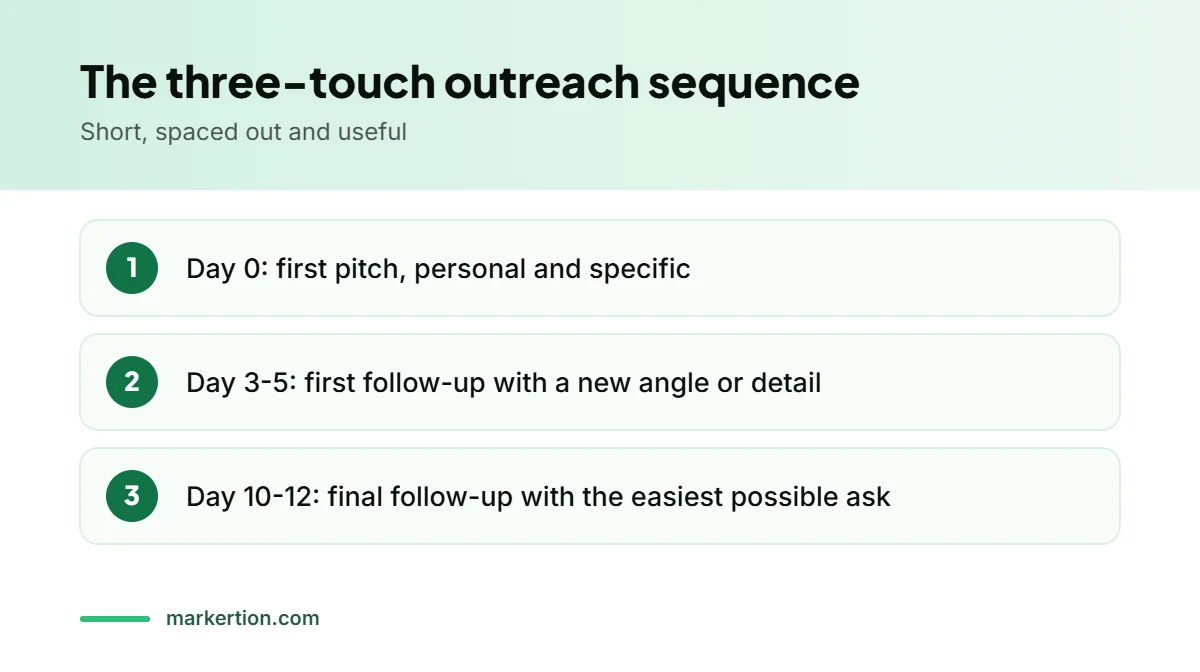
| When to send | Purpose | Length | |
|---|---|---|---|
| Email 1: first pitch | Day 0 | Introduce yourself and the specific idea | 80-150 words |
| Email 2: first follow-up | Day 3-5 (working days) | Add a new angle or detail | 40-80 words |
| Email 3: final follow-up | Day 10-12 | Make the easiest possible ask, then close the loop | 30-60 words |
This structure works for guest post pitches, link insertion requests, resource page outreach and broken link building. For digital PR, where news moves fast, you may shorten the gaps to one or two days.
Email 1: The First Pitch
The first email does the heavy lifting. Keep it personal, specific and short:
- Mention something real about their site or a recent article.
- State your idea in one sentence.
- Explain why it helps their readers.
- Make the next step clear and small.
Our guest posting outreach email templates include tested first-pitch formats.
Email 2: The First Follow-Up
Reply in the same thread so the context stays visible. Add one new piece of value. Options that work well:
- A second topic idea if the first may not fit.
- A specific detail, such as a data point or example you would include.
- A useful resource that relates to their recent article.
Example structure:
Hi [name], following up on my note about a guide to [topic]. One more idea in case it fits better: [second topic in one sentence]. Happy to send a short outline for either. Thanks, [your name]
Email 3: The Final Follow-Up
The last email makes saying yes, or no, easy. It also closes the loop politely, which leaves the door open for future pitches.
Example structure:
Hi [name], I will not keep filling your inbox. If [topic] is not right for [site] at the moment, no problem at all. If it is, just reply “yes” and I will send the outline. Thanks for your time, [your name]
Timing Rules That Protect Deliverability
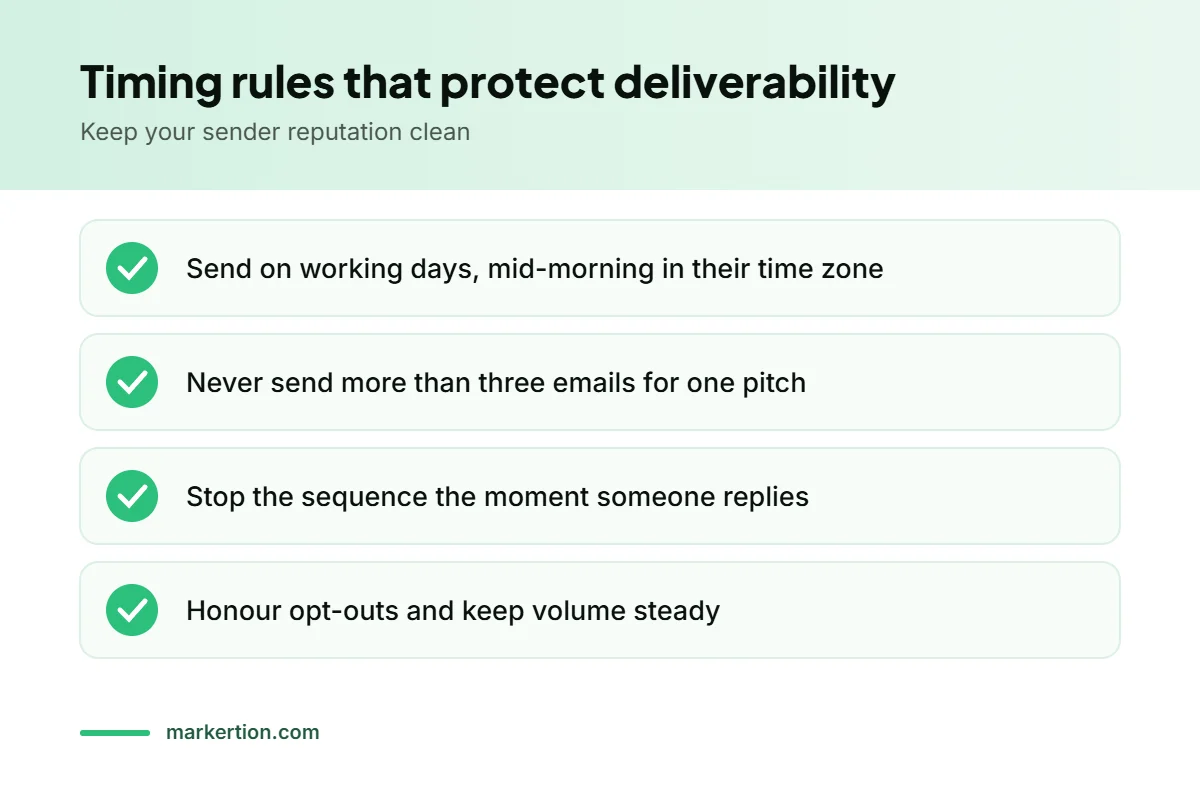
- Send on working days in the recipient’s time zone, ideally mid-morning.
- Never send more than three total emails to the same person for the same pitch.
- Stop the sequence automatically when someone replies, even with a no.
- Honour opt-outs immediately and keep a suppression list.
- Warm up new sending domains before running sequences at volume.
- Keep volume steady rather than sending hundreds of emails in one burst.
If you are scaling outreach with tools, our guide on AI outreach automation for link building covers safe automation settings.
What to Do When Someone Replies
The sequence ends the moment you get a reply. What happens next decides whether the conversation turns into a link:
- A yes: reply the same day with the outline, the draft or the link details they asked for. Slow replies lose more placements than weak pitches.
- A maybe or a question: answer exactly what they asked, briefly, and suggest one clear next step.
- A no: thank them, ask if a different topic might suit them later, and note the reason in your records.
- A price request: decide whether a paid placement fits your guidelines and the site’s quality before you continue. Our guest post quality checklist helps you judge whether it is worth it.
Keep every reply in a simple CRM or sheet with the site, contact, status and next step. Over time this becomes your most valuable outreach asset, because editors who said yes once are far more likely to say yes again.
Measuring Your Sequence
Track these numbers for each campaign:
- Open rate (as a rough health check, since privacy features make opens less reliable).
- Reply rate for each email in the sequence.
- Positive reply rate: replies that lead to a published link.
- Unsubscribe and spam complaint rate, which should stay very low.
If Email 2 drives few replies, test a different value-add. If complaints rise, reduce volume and improve targeting before adding more emails.
Common Follow-Up Mistakes
- “Just bumping this to the top of your inbox.” It adds nothing and feels pushy.
- Changing the subject line so the editor loses the thread.
- Guilt-tripping about not replying.
- Following up on a no. Respect the answer and move on.
- Sending follow-ups to the wrong person after a bad first targeting choice. Fix targeting first.
Adapting the Sequence by Outreach Type
The three-touch structure stays the same, but the value you add in each follow-up should match the kind of outreach you are running:
| Outreach type | Best value-add in Email 2 | Best ask in Email 3 |
|---|---|---|
| Guest post pitch | A second topic idea or a short outline | “Reply yes and I will send the draft” |
| Niche edit (link insertion) | The exact sentence you would add and why it helps readers | “Happy to adjust the wording to fit your style” |
| Broken link building | A second broken link you found on their site | “Even if you skip my page, here is the full list of broken links” |
| Resource page | A short summary of what your resource covers that others miss | “Would it be useful for your readers?” |
| Digital PR | A new data point or a quote from your founder | “Can I send the full chart pack?” |
Notice that the best final asks give something away even if the answer is no. Sending a full list of broken links, for example, helps the editor whether or not they link to you, and it is the kind of gesture that turns a cold contact into a long-term relationship.
Personalising Follow-Ups at Scale
Personalisation should not stop after the first email. Keep a short note for each prospect, such as a recent article they wrote or a section of their site you liked, and reuse it in the follow-up. When you send at volume, use custom fields for the article title and one specific observation so every follow-up still reads as if a person wrote it, because a person did.
Frequently Asked Questions
How many follow-up emails should I send for link building?
Two follow-ups after the first email is the best balance for most campaigns. It captures most of the extra replies without irritating recipients.
How long should I wait before following up?
Wait around three to five working days for the first follow-up and about a week for the second. For time-sensitive digital PR, shorter gaps can work.
Should follow-ups be in the same email thread?
Yes. Replying in the same thread keeps your first message visible, so the recipient can see the full context.
What should a follow-up email say?
Add something new, such as a second topic idea, a specific detail or a useful resource, and make the next step small and clear.
Can Markertion handle outreach for my campaigns?
Yes. Our outreach team runs personalised sequences for guest posting and niche edits, with careful targeting and deliverability controls.
Final Thoughts
A good follow-up sequence is short, spaced out and genuinely helpful. Send one strong first email, two follow-ups that each add value, and then stop. Protect your sender reputation with steady volume and quick opt-outs, and you will earn more replies from the editors who matter, campaign after campaign.
About the author: Shahidul Afridi is the founder of Markertion, a digital PR and link building agency that has built 6,000+ links for 120+ client partners since 2021. He writes from hands-on campaign work, not theory.

Digital PR & Link Building Expert